


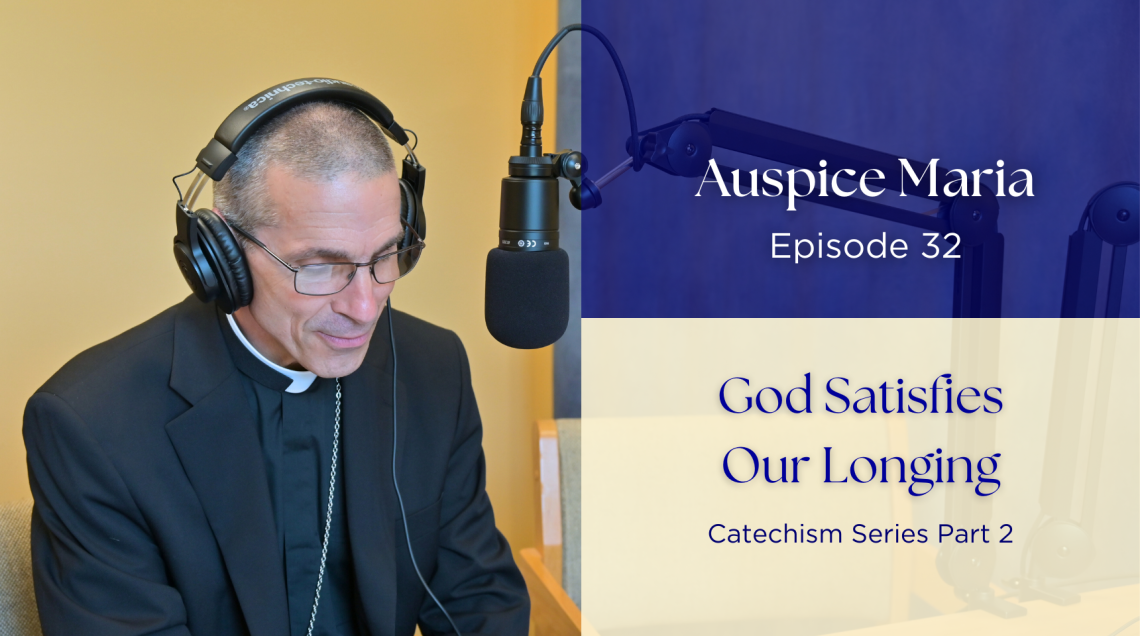
God Satisfies Our Longing (Catechism Series Part 2) - Auspice Maria Ep 32
Follow the Maine Catholic Podcast on:
Transcript:
Well, welcome back to the Auspice Maria podcast. I'm Bishop James Ruggieri of the Diocese of Portland in Maine. And we continue this series on the Catechism of the Catholic Church. Basically, my remarks today, my podcast today, will focus on paragraphs 26 to 100.
As you're reading the Catechism, again, you'll see these emboldened numbers. Those are paragraph numbers. And also, the Catechism lists cross-references within the text. So you'll see in the columns other numbers. And those are paragraph numbers that relate to the paragraph that you're reading. So it's a wonderful, again, a wonderful resource.
And then the last just kind of logistical thing, you'll also find some very extensive footnotes, which I particularly appreciate. I prefer footnotes to endnotes because it's right there at the bottom of the page. So again, the text is set up to be a wonderful resource.
But I think today, as we go through this podcast and touch on some of the elements of these paragraphs, I think today's material invites us more to reflection rather than memorization. So I would just encourage that, as you hear this podcast today, maybe be inclined to reflect or meditate on what you hear, because it really does reflect on who we are, also who God is, and then I think a very important question, how can we know Him?
So I'd like to begin with the prayer, as always, invoking the Holy Spirit to help us as we do our best to serve the Church and to serve the people of God, trying our best to spread this good news of salvation.
Holy Spirit, inspire us, lead us forward in faith, inspire this podcast and all who are listening to it. We ask this through Christ our Lord. Amen.
So there are moments in life when everything appears to be in place. The work is finished. Maybe it's the evening. The home is quiet. If there are children in home, perhaps they're asleep. And you reflect back on the day, and you realize the day's been kind to you, and the events of the day have been kind to you.
And yet, there can remain within this state of contentment within your heart a quiet restlessness. Now it's not dissatisfaction in the ordinary sense, it's really something deeper, and I would say even more mysterious.
It is a sense that even in good moments, there is still a longing that has not yet been fully satisfied. The Catechism of the Catholic Church begins precisely here, not with arguments or rules, but with the human heart itself.
It states very simply that, "the desire for God is written in the human heart because man is created by God and for God. And God never ceases to draw man to himself." That's right from paragraph 27. Beautiful line. The desire for God is written in the human heart.
This means that the longing many people experience is not a defect or a weakness. It really is a sign of who we are and what we are made for. It is an echo of our origin and a quiet reminder of our destiny.
The Catechism goes even further, making a claim that reshapes how we understand human dignity. It says that, "the dignity of man rests, above all, on the fact that he is called to communion with God." And this is a direct reference in paragraph 27 to the Vatican II document, Gaudium et Spes, number 19, paragraph 1.
So in a world that often measures worth by productivity, recognition, or success, this teaching offers something radically different and important. Your deepest dignity does not come from what you accomplish. It comes from the simple fact that you are called by God into a relationship of communion.
Plainly, you are wanted. You are invited. You are not an accident of history or biology. You are someone God desires.
This is why St. Augustine's words continue to speak so powerfully to the human heart today. He says, you have made us for yourself, O Lord, and our heart is restless until it rests in you.
These famous words from his confessions are not sentimental. They are deeply realistic. They describe the experience of many people who have achieved much, possessed much, and yet still sensed that something essential was missing.
They remind us that the human person is created with a capacity for God that nothing else can fully and finally satisfy.
At the same time, the Catechism is honest about the human condition. It acknowledges that this bond with God can be forgotten, overlooked, or even explicitly rejected. It lists real and painful reasons suffering, indifference, distraction, scandal caused by believers, ideologies hostile to religion, and even the effects of sin that cause the human person to hide from God rather than trust him.
But then it offers a truth that should never be forgotten. "Even when man forgets God or rejects God, God never ceases to call every man, every woman, to seek him so as to find life and happiness." And that's from the Catechism from paragraph 30.
In other words, God's fidelity is greater than our forgetfulness, greater than our shame, greater than our guilt, greater than our indifference. God's desire for us does not fade when our desire for him grows weak.
From here, the catechism gently turns our gaze outward to the world around us and to our own interior life to show that God has not left himself without witness. It teaches that the human person can discover ways of coming to know God through what it calls, "converging and convincing arguments" from paragraph 31.
These are not laboratory experiments, but rather signs that point beyond themselves. From the order and beauty of the world, one can come to know God as its origin and end.
St. Paul says that "God's eternal power and divinity can be perceived in the things that have been made." Very important reality, and really a motive, I think, to pay attention. God's eternal power and divinity can be perceived in the things that have been made. A reference to Romans 1, verses 19 to 20.
From the human heart itself, with its longing for truth, goodness, beauty, happiness, and unity, one can also discern signs of God's presence and of the spiritual soul that can have its origin only in God.
These reflections lead to a profound conclusion. "The world and the human person do not contain within themselves their first principle or their final end. They point beyond themselves to a reality that is the first cause and final end of things, that everyone calls God." That's from paragraph 34, and it cites the great theologian St. Thomas Aquinas.
Yet the catechism also makes a crucial transition here. "While human reason can know that God exists, God did not wish to remain distant. He willed to reveal himself and to give grace so that we can enter into real intimacy with him." Referring to paragraph 35.
So, very importantly, the God we seek is also the God who seeks us. This is where the heart of the Christian faith truly begins.
The Catechism teaches that there is another order of knowledge that we could never reach on our own, the order of divine revelation. "Through a free and loving decision, God has revealed Himself and given Himself to us, making known His plan, His loving plan, His goodness by sending His Son and the Holy Spirit. God does not merely give information. He gives himself. He does not remain an abstract principle. He becomes personal, present, and near." And again, those paragraphs are 50 to 51.
So beautifully, we celebrate that in the incarnation of Christ, God becoming man, God dwelling among us.
Scripture expresses this with extraordinary simplicity. "In many and various ways, God spoke of old to our fathers by the prophets, but in these last days he has spoken to us by a son." That's a quote from Hebrews chapter 1 verses 1 to 2.
The Catechism adds that "Jesus Christ is the Father's one perfect and unsurpassable word. In him, God has said everything. There will be no other word than this one. This means that when we look at Jesus, we are not merely seeing a messenger. We are encountering God's definitive self-gift to the world.
But this brings us to a very practical question that touches daily Christian life. If God has revealed himself, how do we truly know him today? How can we be sure that we are encountering the real God and not simply an image shaped by our preferences or our fears?"
And the Catechism gives us some great insight. It explains that "God arranged that what he revealed for our salvation would remain in its entirety and be transmitted to all generations," referring to paragraph 74.
"This happens through sacred scripture and living Tradition, handed on through apostolic preaching, writing, and apostolic succession," referring to paragraphs 76 through 78.
So scripture and Tradition, (again with a capital T,) flow from the same divine wellspring and together form one sacred deposit of the word of God, also known as the deposit of faith.
And the Catechism further teaches that the task of authentically interpreting this word, guarding this deposit of faith, has been entrusted to the magisterium of the Church, exercised by the bishops in communion with the successor of Peter, our Holy Father.
It adds a line of deep humility and reassurance to the church. The magisterium is not above the word of God, but its servant. It listens to it, guards it, and expounds it fully.
This means that the church does not invent the faith. An extremely important reality. The church does not invent the faith. She serves it. She protects it. She hands it on so that each generation can truly know the God who has revealed himself.
Why does all this matter for our ordinary Christian life? Well, it matters because your faith, my faith, is meant to be secure and not fragile.
It's meant to be built on solid rock, not something like opinion or ideological discourse that could simply change from one person or one epoch to another.
Your prayer, my prayer is meant to be rooted in truth, not confusion. Your hope is meant to rest on a foundation that is solid, that does not change.
You were made for God. God has revealed himself in love, and the Church has been entrusted to guard this gift for you. Another great, great blessing and benefit of belonging to our Roman Catholic Church.
The Church guards the faith, the Magisterium of the Church guards the faith, and passes it on to us.
So if your heart is restless, that is not the end of your story. It is really the beginning or the continuation of what is a lifelong journey that leads us right to heaven. It is a sign that God is already at work within you.
And I invite you, just very humbly, very simply, this week to maybe take one small step, and that is open the catechism, and just read paragraph one, the first paragraph.
I know I've been talking about paragraphs 26 to 100, but I want to take you back to the beginning, and just read that first paragraph, but read it slowly.
Let it speak to your heart and let it lead you gently into a deeper friendship with God who has already been seeking you.
So thank you for listening, and I pray that you be blessed. You are blessed by this podcast and that this beautiful desire that God has put on our hearts to know him and to love him, that we may continue to follow that desire.
And I appeal to our Blessed Mother Mary for her loving intercession as I pray with you.
Hail Mary, full of grace. The Lord is with thee. Blessed art thou amongst women, and blessed is the fruit of thy womb, Jesus.
Holy Mary, Mother of God, pray for us sinners now and at the hour of our death. Amen.