



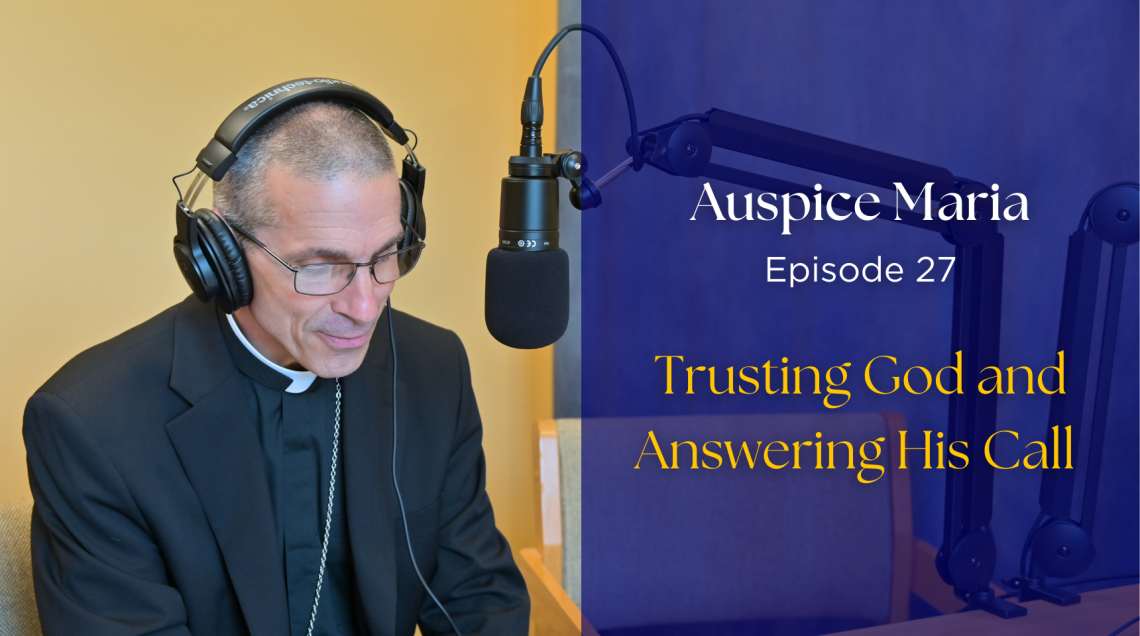
Trusting God and Answering His Call - Auspice Maria Ep. 27
Follow the Maine Catholic Podcast on:
Transcript:
Hello, and welcome back to the Auspice Maria podcast. I'm Bishop James Ruggieri of the Diocese of Portland and Maine, and today I'd like to talk about one of the great prophetic voices of Scripture, who we hear a lot from in the season of Advent, and it's the prophet Isaiah.
But before doing that, I want to just offer a prayer to the Holy Spirit to inspire us, to lead us, open our hearts to his promptings. And especially when we talk about the word of God, we ask that we might listen attentively to the word so that we may grow in faith, hope, and love. So, “Holy Spirit, be with us, accompany us, and bless all those who hear this podcast in whatever way you deem best.” And we ask all this through Christ our Lord. Amen.
So, I'll focus today on the first major section of the Book of the Prophet Isaiah, chapters 1 through 39, what Catholic Scripture scholars often call “First Isaiah” or “Isaiah of Jerusalem.” The Church, following the insights of the New Jerome Biblical Commentary and the Pontifical Biblical Commission, recognizes both the unity of the Book of Isaiah, but also the distinct, we could say, elements of it.
There are really three Isaiahs.Not necessarily three persons, but if we look at the text, the entire 66 chapters, there are three distinct movements in this book. So, we have the 8th-century prophet Isaiah of Jerusalem, chapters 1 through 39. We also have an exilic prophetic voice, meaning someone, or perhaps different people, writing from the exile when the southern kingdom was exiled, the prophetic voice coming from that experience of exile. That would be chapters 40 to 55.
And then there’s what scholars say is a post-exilic voice. So, in the early sixth century BC, when Israel, through the decree of King Cyrus, was allowed to return to, or those who wanted to, to return to Jerusalem and rebuild the temple, that is often referred to as the post-exilic time. And that would be chapters 56 through 66. But again, together, these Isaias, different Isaias, form a single inspired work pointing ultimately, as does all Scripture, to Christ.
But before we look at Isaiah’s message, I really want to begin where Isaiah himself begins, and it’s really his remarkable call in chapter six. It’s chapter six, verses 1 to 8. His vocation as a prophet begins with this incredible vision of God’s overwhelming majesty. I’m quoting chapter six, verse one: “In the year King Uzziah died, I saw the Lord seated on a high and lofty throne, with the train of his garment filling the temple.”
Catholic scholars describe this as a throne theophany, that is, a revelation of God’s kingship and holiness. The heavenly temple is alive with adoration as these angelic creatures, the seraphim, proclaim, “Holy, holy, holy is the Lord of hosts. All the earth is filled with his glory,” referring to verse 3.
Confronted with such holiness, Isaiah cries out in verse 5, “Woe is me, I am doomed, for I am a man of unclean lips.” Now, an authentic encounter with God does not crush us; however, it reveals the truth about ourselves. Isaiah stands before God honestly, without any pretense.
Then a seraph touches Isaiah’s lips with a burning ember. This is verse seven. "See, now that this has touched your lips, your wickedness is removed, your sin purged."
Isaiah does not purify himself. Very importantly, God purifies him. And only after this act of divine mercy does Isaiah hear the Lord say, “Whom shall I send? Who will go for us?” Verse eight. Isaiah answers with the generosity of someone who has seen the glory of God and experienced his mercy. Isaiah responds, “Here I am, send me.” Verse eight.
And so we could say his vocation as a prophet, or his vocation, begins with grace. Mission flows from encounter, encounter with the living God. I also think it’s very important to point out, because sometimes we feel so unworthy because we focus so much on our sinfulness or we are burdened with shame, we feel that God’s mercy is beyond us. Quite the contrary. Isaiah shows us that God’s mercy is available, and God’s initiative really is merciful.
The other important thing is when we’re considering a vocation, perhaps to priesthood or to religious life, even marriage, because it's a very important vocation in the Church, we may feel that, well, we’re not capable, we just, we don’t have what it takes. Remember Isaiah. God prepared him. God made him ready for his vocation. God initiated the burning ember touching his lips.
So, I heard something a long time ago which really has stuck with me: that God does not call the qualified; God qualifies the call. Now, that particular phrase was applied to a vocation of priesthood and religious life, but I think it could also be applied to any vocation—marriage, even a person called to a single consecrated life. God qualifies the call. And so it really takes a lot of pressure off of ourselves, thinking we have to be perfect before we enter some state of life that is mission-driven or in the Church. Quite the contrary. God will qualify or help us do what God is calling us to do.
So, back to Isaiah. To understand Isaiah’s ministry, we really need to understand the role of the prophetic vocation in Judah, the southern kingdom of Israel. The prophet is not primarily a predictor of the future, though sometimes that’s what we might think the word means. The prophet is, above all, God’s spokesman, the one who speaks God’s truth into the concrete circumstances of history, into our reality. One who speaks God’s truth.
So, Isaiah’s ministry arises because the covenant at that time—again, we’re talking in the early 800s BC, like 720s or so—because the covenant is being forgotten or redefined. Central to the covenant, meaning the people’s sacred relationship with God, is the first commandment: “You shall not have other gods before me,” clearly stated in Deuteronomy chapter five, verse seven.
This commandment is deepened in the Shema, which is prayed daily to this very day by faithful Jews and very important to repeat: Deuteronomy six, verses 4 to 5. “Hear, O Israel, the Lord is our God, the Lord alone. Therefore, you shall love the Lord your God with all your heart, and with all your soul, and with all your strength.”
That line, that prayer, is called the Shema, and again recited daily by faithful Jews, a reminder that there is only one true God, and that we—Jews, of course, who pray it, but I would also extend that to Christians—we are to remind ourselves that we are called to love the one true God with all our heart, our soul, all our strength, our entire being.
So, Isaiah stands in this tradition. His mission is to call God’s people back to a love that is whole and undivided. I’d like to talk now about some major themes that we find in Isaiah 1 through 39. Now again, this is not all-inclusive. I would encourage you, especially in these times of Advent, to go back in the Scripture and really allow the word of God to be a support and also a teacher for you in this wonderful time of the year.
Isaiah opens with the summons in chapter one, and heaven and earth are called to witness God’s grievance against his people. Yet even at the start, the message is not only judgment but mercy. So, it’s not all condemnation, but it’s really mercy. Verse 18 of chapter 1: the famous line, “Though your sins be like scarlet, they may become white as snow.” So, reminding us—as Isaiah was reminding his listeners back in his day—Scripture reminds us today, God desires conversion, not condemnation.
In chapter two, Isaiah envisions a future in which the knowledge of God transforms the world. Verse four: “They shall beat their swords into plowshares, their spears into pruning hooks.” Sort of this new age when we allow the covenantal relationship with our God to truly permeate all aspects of our lives. It’s transformative, even in human society.
And the peace he’s talking about here is not merely political. It’s really the fruit of a relationship with the living God, fruit of God’s instruction flowing from Zion out into the world.
And then there’s chapter five. Isaiah sings a very poignant parable, and it’s the parable of the vineyard. Israel is God’s vineyard. God has tended this vineyard with care, yet it has produced the wild grapes of injustice. And Catholic commentators emphasize Isaiah’s consistent connection: when worship becomes hollow, injustice follows. So, a beautiful connection between worship—meaning relating to the one true God in prayer and song—worship, when worship is strong, justice is strong. When worship is hollow, injustice follows.
When we worship sincerely, of course, we’re going to be people who want to do what is right and good and virtuous.
And now I’d like to also just talk about this trust, trust in God versus reliance on political alliances. Because, again, underneath Isaiah’s time, or within his time period, there was some political intrigue going on around him. Isaiah warns Judah, again the southern kingdom of Israel, not to place ultimate trust in foreign powers—not in Assyria, which was at that time a world power; not in Egypt, another power; not in military strength. But trusting these alliances instead of the Lord, Isaiah reminds the people, is a form of idolatry.
This theme comes to a decisive moment in Isaiah’s encounter with King Ahaz—or Ahaz—in chapter seven. I’m going to say Ahaz. The sign to Ahaz, and this is a very important passage because it is meaningful, of course, to us today when we talk about the coming of Christ.
So, Isaiah in chapter seven—let me set the stage here though first—it’s during the Syro-Ephraimite crisis. King Ahaz is tempted to seek protection from Assyria, again a world power at the time. Makes a lot of sense: a smaller country or a smaller self-governing nation looking for the protection of a larger nation. Isaiah, though, is sent to reassure Ahaz, “Take care, you remain tranquil and do not fear.” Verse four.
However, Ahaz, succumbing to what he sees as the reality around him, unfortunately refuses to trust the Lord, and he hides behind a veneer of piety. He says to Isaiah—Isaiah says, “Ask for a sign,” and Ahaz says, “I will not ask, I will not tempt the Lord.” And interesting that it’s a veneer of piety, not necessarily sincere.
And God responds with this very famous verse, verse 14 of chapter seven: “Therefore the Lord himself will give you a sign.” Again, Isaiah, the spokesperson, speaking: “Therefore the Lord himself will give you a sign. The virgin shall be with child and bear a son, and shall name him Emmanuel.”
Now, in the immediate historical context in which this was spoken, this child is a sign to the house of David that God has not abandoned his people. In the fullness of Revelation, however, in the fullness of Revelation, the Church sees this prophecy perfectly fulfilled in Christ. And Matthew, in the Gospel of St. Matthew, quotes it: “Behold, the virgin shall be with child and bear a son, and they shall name him Emmanuel.” Again, we hear these words as we tell the story of the Incarnation, as we tell the story of Christmas.
Isaiah can speak with courage because he has already spoken those decisive words to God. He has given himself to God, first experiencing the incredible majesty, the incredible mercy of God. He has given himself to God; in trust and confidence he said—remember back in chapter six—“Here I am, send me.” So he can speak with courage and confidence to Ahaz. Say, “Ahaz, do not trust in foreign powers; trust in the Lord.”
Well, interestingly, Isaiah’s world is separated from ours by many centuries, yet the spiritual terrain is interestingly similar. We may not bow before carved idols, as the people of Isaiah’s time did, but we are surrounded, really, by forces that subtly ask for our trust, our time, and our hearts. Just some thoughts about this.
For example, social media, which is so prominent and prevalent in our world today, can shape people’s identities more powerfully than the gospel. It can draw people into comparison, anxiety, and distraction. It’s addicting for people. But that’s sort of sobering, this line that social media can shape identity, personal identity, more powerfully than the gospel. I would ask us as Catholic Christians to really think about that. Where does my identity come from? Where am I deriving my sense of worth, sense of dignity? Is it the gospel, this good news of the Church, of Jesus Christ proclaimed through the Church? Or am I really looking to define myself through social media?
Another aspect to consider, as we are sometimes tempted to trust in other sources or other forces than God: consumerism. Consumerism tells us that fulfillment is found in acquiring more rather than seeking the kingdom of God. Kingdom of God, again, is really building a culture of authentic love, truth, justice, peace. However, it’s very possible that we could fixate on things—owning things, buying things, selling things, business—and unfortunately seek that with more vigor than we seek to build the kingdom of God in our midst.
Political ideologies, too, can become substitutes for discipleship and even distort our sense of Christian mission. Any ideology really is rooted in opinion and not truth.
And then there’s technology and comfort. Now, not that we shouldn’t take care of ourselves or that we can’t use technology. This podcast would not be possible without technology. However, technology and, I think, personal comfort or self-care can create the illusion that we are self-sufficient and that we do not need God.
And then there’s the pursuit of approval or achievement. And I sort of alluded to that earlier when I talked about social media and how that often can feed not only our ego, but we can define ourselves through what others think about, or what others say about us through social media. But pursuing approval or achievement, I think, especially is tempting for young people today, can become a measuring rod for our worth rather than our true dignity as children of God. Again, losing perspective of our true dignity. If we’re basing our dignity on what others think of us, then it’s very possible we could lose a true sense of who we are as sons and daughters of God.
So, in summary, this section here: these are really, we could say, competing gods of our time. They’re not always obvious. They can be very quiet, subtle, persuasive, but relentless. And like the people of Judah, we are sometimes tempted to rely on what is immediate, what we can control, or culturally what is popular, rather than entrusting ourselves to the one true living God.
Isaiah reminds us that true worship and authentic justice, deep trust and faithful obedience, always belong together. Our fidelity to God is expressed not only in prayer but in the concrete choices we make each day—how we use our time, our talent, our material treasure; how we use our devices; how we, again, spend our money; how we treat the people with whom we interact on a daily basis, either in our houses or our workplaces; how we treat our neighbor; where we turn for security and comfort; and really what truly shapes our identity. I think if we honestly evaluate some of these areas of our lives, we can sort of get a sense of where we are in our relationship with God.
Well, in closing, I would invite you, perhaps this week, to pray with Isaiah 6 and his call. It’s an inspiring scene. And again, it says a lot about the initiative of God in calling us to a particular lifestyle, a life’s vocation. Or maybe even Isaiah 7 and the whole thing with Ahaz and the sign. But the incredible thing about Isaiah 7 is that it’s fulfilled—7, verse 14—it’s fulfilled in Jesus Christ. He is Emmanuel. He is God with us.
So, I would also maybe pose some questions for your prayer and reflection. “Where are you, God, asking me to trust more, to trust you more deeply?” This is a wonderful question of dialogue with the Lord. “Where are you asking me, Lord, to trust you more deeply?”
Or, “Where are you inviting me, Lord, to witness to you more boldly?”
Finally, “Lord, how can I respond like Isaiah? ‘Here I am, send me.’”
If we can get to that point in our relationship with God where we truly have discerned where he’s leading us and calling us to, the vocational state he’s inviting us to embrace, and if we can respond, “Here I am, send me,” it gives an incredible dimension of confidence to our life’s mission and purpose.
Well, I pray that the Lord who purified Isaiah, who sustained him in some very difficult times, and also who fulfilled his promises in Christ, that the Lord purify us. The Lord strengthen us, and the Lord send us always his Holy Spirit to guide us, to lead us, and to help us, especially in our daily tasks as disciples.
Thank you again for joining me in this Auspice Maria podcast, and I pray that the Lord bless you, bless your families, and may God keep you always under the maternal care of Mary, our mother, whom I’d like to just conclude this podcast with by offering together with you a Hail Mary.
“Hail Mary, full of grace, the Lord is with thee. Blessed art thou amongst women, and blessed is the fruit of thy womb, Jesus. Holy Mary, Mother of God, pray for us sinners, now and at the hour of our death. Amen.”