

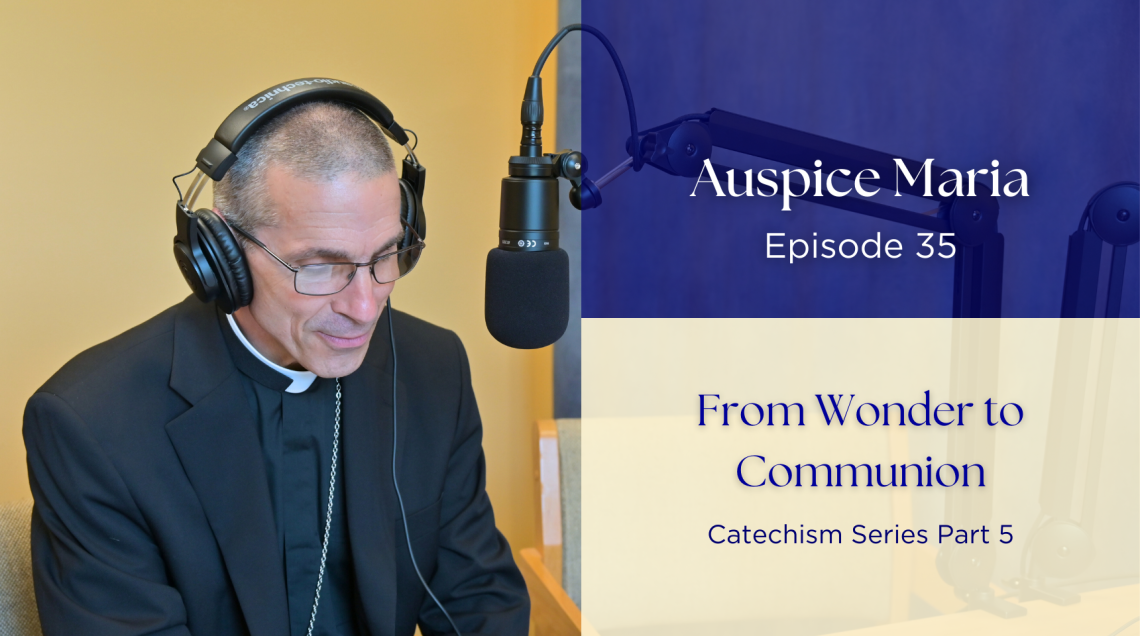
From Wonder to Communion (Catechism Series Part 5) - Auspice Maria Episode 35
Follow the Maine Catholic Podcast on:
Transcript:
Welcome back to the Auspice Maria podcast. I'm Bishop James Ruggieri of the Diocese of Portland in Maine. And today we continue with our series on the Catechism. I could call it from wonder to communion. Basically, we're in the 200s of the Catechism, again, that first section of the four.
And as always, just want to invoke the Holy Spirit's guidance and inspiration as we embark on this.
Holy Spirit, come to us. Renew our hearts and minds, open us to your promptings, and give us greater understanding. We ask this through Christ our Lord. Amen.
So I'd like to begin this week not with definitions or doctrines again, but with questions. Questions that live directly in every human heart. They surface when we pause long enough to notice the world around us or when life unsettles us and reminds us how little control we truly have.
The Catechism names these questions with remarkable honesty in paragraph number 282. It asks, "Where do we come from? Where are we going? What is our origin? What is our end? Where does everything that exists come from and where is it going?" (CCC 282)
Now these are not academic questions. They are human questions. I would call them existential questions. They emerge when we look at the night sky and feel both the awe and also the insignificance as we recognize the vastness of our universe. They arise when we hold a newborn child and truly sense and understand that life is a gift before it is an achievement. These questions return with urgency when we confront suffering, loss, uncertainty.
The church does not dismiss these questions. She receives them and she teaches us that creation itself becomes a form of catechesis, a school that trains the heart to wonder, to seek, and ultimately to worship.
The catechism acknowledges the genuine achievements of science and human inquiry, and it says in paragraph number 283, “The question about the origins of the world and of man has been the object of many scientific studies which have splendidly enriched our knowledge of the age and dimensions of the cosmos, the development of life forms and the appearance of man.”
But then it adds something deeply pastoral.
“These discoveries invite us to even greater admiration for the greatness of the Creator, prompting us to give Him thanks for all His works and for the understanding and wisdom He gives to scholars and researchers.” (CCC 283)
In other words, wonder is not the enemy of faith. Wonder is often its beginning. Creation does not simply tell us that something exists, invites us to ask why.
And beyond the scientific questions of how and when, the Catechism identifies a deeper question, one that science alone cannot answer. “Is the universe governed by chance, blind fate, anonymous necessity, or by a transcendent, intelligent and good Being called ‘God’?” (CCC 284)
Right out of the Catechism, that beautiful question found in paragraph 284.
It's a decisive question because if the universe is ultimately accidental, then meaning is fragile, makeshift, relative. But if the universe flows from intelligence, wisdom, and goodness, then reality is charged with purpose.
The Catechism is clear in its confession. It says, in number 295, “We believe that God created the world according to His wisdom. It is not the product of any necessity whatever, nor of blind fate or chance.” (CCC 295)
Creation, therefore, flows not from compulsion, but from freedom. God did not need the world. God chose it. He chose to create it. And the reason is simply love.
In number 295, the Catechism states, “We believe that it proceeds from God’s free will; He wanted to make His creatures share in His being, wisdom, and goodness.” (CCC 295)
This matters deeply for the spiritual life. If creation is a gift, then the first posture of the human person is not suspicion but gratitude. Life is received before it is managed. Existence itself becomes something to be reverenced.
The Church also confesses that God creates out of nothing. In number 296, clearly the Catechism states, “God creates freely out of nothing.”
This means that everything depends on God, not only at the beginning, but at every moment. And also the Catechism makes a statement that is both theologically precise and also very pastorally consoling.
In paragraph 301, “With creation, God does not abandon His creatures to themselves. He not only gives them being and existence, but also, and at every moment, upholds and sustains them in being, enables them to act and brings them to their final end.” (CCC 301)
That phrase, at every moment, just echoes when I read that quote from 301. God is not only at the origin of things, He is present to the present. The God who creates is the God who sustains.
At this point, a real and painful question arises. If God sustains everything, why is there suffering? Why evil? Why loss? The Catechism does not evade these questions. It asks directly, “If God the Father almighty, the Creator of the ordered and good world, cares for all His creatures, why does evil exist?” (CCC 309)
And then the catechism responds with honesty. “To this question, as pressing as it is unavoidable and as painful as it is mysterious, no quick answer will suffice.” (CCC 309)
So faith does not offer slogans. It does not make us numb to pain. It does not deny the wound. Instead, faith situates suffering within the whole of God's saving plan that culminates in Christ crucified and risen.
The Catechism acknowledges what every believer eventually learns. “We firmly believe that God is master of the world and of its history. But the ways of His providence are often unknown to us.” (CCC 314)
So here we're not resigning ourselves to simply not knowing or confusion. It is humility, and it is the soil in which trust grows. Trusting in God's providence, as paragraph number 314 urges us, providence allows us to place our lives in God's hands.
So faith does not remove the cross, rather faith gives us a way to carry it without despair.
So up to this point, we've spoken about what God does. Creation, sustenance, meaning sustaining His creation, providence, meaning allowing or governing things by His divine intelligence, care, wisdom, and love.
And the Catechism also gives us language for moving from God's works to God Himself. Because it's a beautiful movement as we look around and we notice creation. Obviously, one of the things or one of the ways we are led is to the Creator.
So the Catechism beautifully talks about this movement from what we see, what we experience, to the origin of all. “The Fathers of the Church distinguish between theology (theologia) and economy (oikonomia). ‘Theology’ refers to the mystery of God’s inmost life within the Blessed Trinity and ‘economy’ to all the works by which God reveals Himself and communicates His life.” (CCC 236)
So that beautiful distinction, theology, the mystery of God, God's innermost life, which we can never know fully because God is mystery, and economy, the works by which God reveals Himself, our surroundings, the story of salvation, Scripture.
So then the Catechism adds, “God’s works reveal who He is in Himself.” (CCC 236)
Creation is not only evidence that God exists, but creation is a doorway into who God is. And what the Church dares to proclaim is that the Creator is not solitary, not a solitary power, but living communion. The Catechism begins its teaching on the Trinity not with abstraction, but with baptism.
So now we're kind of getting into this reality of relationship. So we look around, we see the beauty of God's creation. We see how God in His generosity has so ordered things and sustains things. And now we, the creatures, standing in the midst of this beautiful universe, this beautiful world, we are now led to even deeper understanding of the intimacy and the love of God as we reflect on baptism.
“Christians are baptized ‘in the name of the Father and of the Son and of the Holy Spirit.’” as paragraph 232 reminds us. And then interestingly, paragraph 232 continues to tell us that “The faith of all Christians rests on the Trinity.”
And this matters really pastorally because Christianity is not first a theory about God. It is an entrance into a relationship. At baptism, a name is placed upon us and we belong. We are baptized into the church, into the community, and again, very powerfully, into a relationship with the living and true God who is Father, Son, and Holy Spirit.
Catechism then states, in 234, “The mystery of the Most Holy Trinity is the central mystery of Christian faith and life. It is the mystery of God in Himself.”
So why is this central? Why is this doctrine or this dogma of the Trinity, this reality, inner reality of God, central? 234 tells us, “It is therefore the source of all the other mysteries of faith, the light that enlightens them.”
The Trinity is central because God is love. Love is relational. The Father eternally gives Himself to the Son. The Son eternally receives Himself, receives that love from the Father, and the love between them is the Holy Spirit.
This is not an abstract doctrine imposed on experience. It is the deepest truth that gives meaning to experience itself. Love is self-gift. Love is relational, being made in the image and likeness of God. We are made to receive love and to give love. Receive love from God, give love to God. Receive love from others, give love to others.
How can we conclude this? This is pretty deep. We began with questions, those existential questions. Why are we here? What is the meaning of existence?
And then we looked at creation and discovered not chaos but wisdom. God has a plan. God created orderly, with order. We confronted suffering and we found not easy answers, actually really no clear answers other than suffering does exist. God allows suffering, but also mysteriously, God redeems us, saves us by suffering, the suffering of Jesus Christ.
And also through it all, we remember that God remains very present to us. And then from creation, we moved, and from those existential questions, we moved to the heart, we could say the heart of God, the heart of the mystery of God. God is a trinity of persons, God is love, a community of love.
Creation teaches us how to look. Providence teaches us how to trust. Again, if God has everything under control, then we can trust. And the Trinity teaches us who God is.
The God who creates is not distant. The God who sustains is not indifferent. The God who saves is communion itself.
And when we profess our faith, whether in the creed at mass or in the quiet of prayer, we are not reciting distant truths. We are placing our lives into the hands of the living and true God, who is Father, Son, and Holy Spirit.
The One who made the stars also knows your name.
The One who sustains the universe also sustains your life.
And the One who is Love itself invites you not merely to believe, but to belong.
Thank you for joining me in the Auspice Maria podcast. And I'd like to offer everything to the intercession of Mary, our mother, as we pray.
Hail Mary, full of grace. The Lord is with thee. Blessed art thou amongst women and blessed is the fruit of thy womb, Jesus. Holy Mary, mother of God, pray for us sinners now and at the hour of our death. Amen.