

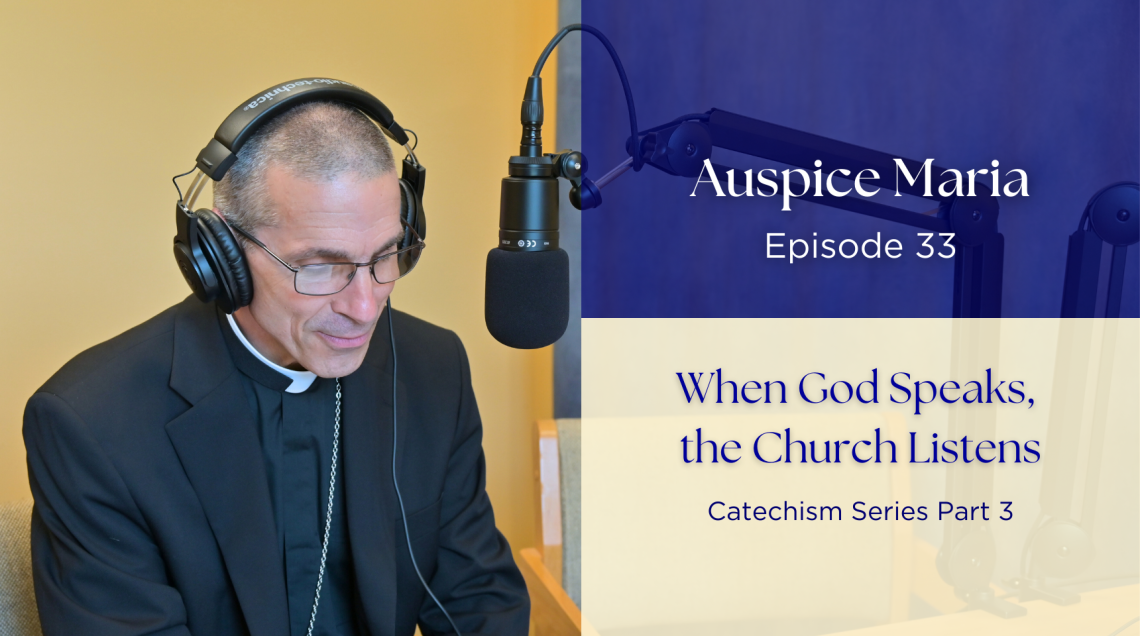
When God Speaks, the Church Listens (Catechism Series Part 3) - Auspice Maria Episode 33
Follow the Maine Catholic Podcast on:
Transcript:
Well, welcome back to the Auspice Maria podcast. I'm Bishop James Ruggieri of the Diocese of Portland in Maine. And I continue with this series on the catechism. This is episode three. And I'm focusing on paragraphs 101 to 184.
With emphasis on the word of God, again, this early part of the catechism focuses on the creed, the first part of the four major sections. And one of the principles at work in the early part of the creed is God desires to have a relationship with us. And so in the process of that relationship or relationship building, God extends, we could use the beautiful imagery, extends his loving hand to us. And that we could say that's revelation so that we could know him and love him in return.
And of course, Jesus is the fullness of his revelation. So today we talk about the word because it is an important part of these paragraphs in regards to how does God reveal himself to us? How can we know him so we can truly respond in freedom to him.
And so I'd like to just start with a prayer. Again, thanksgiving to all who make this podcast possible, especially Jake, our producer. We thank God for him and for all his good work.
So Lord, please bless this podcast and all those who hear it. And Holy Spirit, inspire us simply to know your will, to do it with courage, and to fall more deeply in love with your Word, the Holy Word of Scripture. And we ask all this through the Holy Spirit's inspiration and guidance, ultimately through Christ our Lord. Amen.
So I wanted to begin with a definition today, but I'd like to take a moment that perhaps it's a pastoral moment. And I'd like just to present it to you. I'd like to keep this sort of at the beginning, because it does demonstrate how God's word truly can touch our hearts, particularly in moments of need and moments of vulnerability.
But it's a pastoral scenario. So imagine this. A person sits in a church for a funeral mass, and perhaps it's been years that they have been to mass, but obviously out of respect for the deceased and the deceased family, they are there. They're not sure what they believe anymore because of the years and maybe the meandering personally and spiritually that they've experienced over these years, but they've come because it feels right to be there, because silence sometimes feels more honest than words.
And the scriptures are proclaimed, of course, in every Mass. We are so blessed as Catholics to have the scriptures proclaimed. The scriptures are proclaimed perhaps at this particular funeral Mass. It is a psalm. Perhaps it is a line from Saint Paul, who commonly is read at funerals.
And then unexpectedly something happens. A sentence lingers, a phrase maybe resonates in the mind and heart of this person. Obviously it doesn't solve the grief, it does not remove the pain, but it speaks into it. It names something that the person could not articulate.
And for a moment, this person realizes "I am being addressed, I am being spoken to." Now that experience is not accidental. The Catechism of the Catholic Church gives language to it. It says very simply and very beautifully that, "in sacred scripture, the Father who is in heaven comes lovingly to meet His children and talks with them." That's paragraph 104.
I'd like to also just say for clarification, these paragraphs, especially in this section regarding the sacred scripture, these paragraphs of the Catechism are very dependent upon the document Dei Verbum, the Vatican II document on Revelation. It's a wonderful document. But again, so there's a double citation. The paragraph is quoting a line or a series of lines from Dei Verbum. But I'm just going to cite the Catechism paragraph just for the sake of simplicity and hopefully for continuity in this podcast.
So again, back to the Catechism, it says, the Father who is in heaven comes lovingly to meet his children and talks with them in the sacred scripture. Not lectures them, not overwhelms them. God comes to meet them. God comes to speak with them.
And this is where the church begins when she speaks about Scripture, not with techniques or theories, but with relationship. God speaks because God desires communion.
The Catechism teaches that God does not speak from a distance. "In order to reveal Himself to men in the condescension of His goodness, God speaks to them in human words." That's Catechism paragraph 101.
That phrase, "condescension of His goodness," is important. It's obviously a mouthful, I was stumbling over that word. But the condescension of his goodness is important because it reminds us that God lowers himself not because we are unworthy, but because God is loving.
Just as the eternal word took flesh and became like us, God's word takes human language so that it could be heard, remembered, prayed over and with, and lived.
This is why the Catechism insists that sacred scripture is not a collection of "disconnected texts." Even the Testament, there's connection between the Old and the New Testaments. "Through all the words of Scripture, God speaks only one single word, His one utterance, in whom He expresses Himself completely. That's from paragraph 102.
That word is Jesus Christ. So in all the words of scripture, catechism tells us God speaks one single word and that word is Jesus Christ. "Every page in one way or another leads toward Him or flows from Him, meaning Christ.
And because Scripture is living, the Church has always treated it with reverence that is almost startling. The Catechisms states that "the Church has always venerated the Scriptures as she venerates the Lord's body." Paragraph 103.
This is not poetic exaggeration. At mass, the word is proclaimed. If we're attentive to some of the liturgical gestures around the word of God, we will see the emphasis placed not on simply reading but proclamation.
The word is processed with the carrying of the book of the Gospels. The Gospel book is reverenced or it is kissed. And if the bishop is present, he often will bless the congregation with the book of the Gospels after he has reverenced the book.
Again, it's not because these pages, these pages of paper really are sacred, it's what's on the page. The words are honored because Christ himself is speaking to us.
The church knows that we need to be fed in more than one way. She therefore sets before us "the bread of life taken from the one table of God's word and Christ's body." That's a quote from paragraph 103.
Many Catholics do not realize this. They hunger for peace, for direction, for meaning. And they do not know that they are hungry for the Word, capital W.
The Catechism names what the Church has learned through centuries of lived faith. Sacred Scripture is nourishment and strength. "In Sacred Scripture," paragraph 104 tells us, "the Church constantly finds her nourishment and her strength."
This is not theory, it is experience repeated again and again in the lives of ordinary believers. But there's another experience just as common, and the catechism does not ignore it.
Again, another pastoral scenario. A young parent sits at the kitchen table late at night. And maybe parents listening, this scenario really speaks to your heart:
A young parent sits at the kitchen table late at night. The house is finally quiet. The children are asleep. Worries that were held back during the day due to maybe busyness or simply not appropriate timing to share those worries now surface in the quiet of the house. There's concern maybe about money, maybe about health, perhaps about the future.
And this dear parent, in the quiet of the house, opens the Bible, hoping for comfort and instead encounters a passage that is maybe quite confusing or distant or very hard to understand. Well, frustration follows, and perhaps this person closes the Bible, the moment passes, and what perhaps was an opportunity is now tabled, literally tabled.
Many people assume that if Scripture does not immediately console them, then something is wrong with them or with the text.
However, and this is just a good advisory, the church sees it differently. She teaches that scripture must be interpreted with care, with patience, and with humility. In paragraph 109, Catechism tells us, to interpret scripture correctly, the reader must be attentive to what the human authors truly wanted to affirm and to what God wanted to reveal.
Now this means recognizing history, culture, literary form, and human expression. There's a beautiful science to understanding scripture, to studying scripture.
But the Catechism then adds something essential, something deeply pastoral. Without the Holy Spirit, Scripture can remain a dead letter. That's very important because we can dissect it from an academic point of view, but without the Holy Spirit, Scripture can remain a dead letter.
Paragraph 111 tells us, "Sacred Scripture must be read and interpreted in the light of the same Spirit by whom it was written."
This is not an academic principle. It is a spiritual reality. Scripture opens fully only in prayer, only in trust, only when the heart is willing to listen.
This is why the Catechism insists that Christianity is not a, "religion of the book in the narrow sense." It is the religion of the living Word of God, the living Word, Jesus Christ.
"If scripture is not to remain a dead letter, Christ, the eternal word of the living God, must, through the Holy Spirit, open our minds to understand the Scriptures," from paragraph 108.
And this is where the Church becomes not an obstacle but a companion. Again, I think such a blessing to belong to our Roman Catholic Church, our companion on this journey to heaven, very important companion, our mother on this journey of heaven.
Well, in a world where many voices compete to interpret Scripture, the Catechism reminds us of something very foundational. It's from paragraph 120. "It was by the apostolic Tradition, that the Church discerned which writings are to be included in the list of the sacred books."
The Bible did not fall from heaven already bound. It was received, prayed over, discerned, and safeguarded within the living church. And we call this body of discerned, acknowledged, inspired books "the canon of the Scripture."
Now this matters pastorally. It means that when you open the Scriptures, you're not standing alone. You're reading with the Church across time.
Catechism explains that the Church does not place herself above the Word, rather she serves the Word. She watches over it, she hands it on faithfully, so that it remains life-giving and not distorted.
Very important fact of reality, that with the Church to help us interpret the Scripture, the Word of God, we avoid this temptation to distort the Word of God to make it self-serving.
Well, there is a humility here, and it's often missed. St. Augustine once said with really great honesty, and this is quoted in paragraph 119, I would not believe in the gospel had not the authority of the Catholic Church already moved me.
Well, he was not denying faith. He was acknowledging how God works through a living community that guards what is too precious to be left to private interpretation.
Very important, this living community, this church, invites us to be members, to be a part of it. And it's sometimes a reality that we don't always recognize. The benefit of belonging to a community that helps us on our way to heaven.
Well, the Catechism expresses this maternal role with clarity and warmth. In paragraph 168, "it is the church that believes first and so bears, nourishes, and sustains my faith."
Many believers recognize this in hindsight. There are reasons when personal faith is weak, distracted, or wounded. In those seasons of a person's life, the church continues to believe.
Mother Church is constant. The church continues to pray, to proclaim and to hold the word of God steady until the individual is ready to receive again.
The Catechism does not want Scripture to remain abstract, it wants it woven into daily life. From paragraph 131, "The Word of God can serve the Church as her support and vigor, and the children of the Church as strength for their faith, food for their soul, and a pure and lasting font of spiritual life."
That is why the Church urges that the access to Scripture be opened wide, and why she insists that, "ignorance of scripture is ignorance of Christ himself."
And that's a famous reference to a quote from Saint Jerome, the great scripture scholar of the early church, one of our fathers in the church, who said that, "ignorance of scripture is ignorance of Christ."
This is why the church does not merely place a Bible in our hands. She proclaims it at mass, she explains it in preaching, she interprets it within tradition, she guards it so that it guards us.
The word of God, the scripture, is so central to our identity as Catholic Christians. And the Catechism teaches that all scripture is ultimately one book and that book is Christ. One word, as I said earlier.
So when believers begin to realize this, scripture changes. It becomes less about mastering or memorizing content and more about encountering a person, and that person is Christ.
Allow me to return briefly to the young parent at the kitchen table. Remember the one I was sharing with you, that sort of that pastoral scenario, the house is quiet, the parent opens the Bible, encounters a passage that is confusing, closes the Bible, sort of that moment is broken.
Here's another scenario, a follow up. On another night, that same parent opens the Psalms, those beautiful Psalms found in the Old Testament. Not searching for answers, but simply for words.
And the parent reads the Psalm verse, "the Lord is close to the brokenhearted."
The Lord is close to the brokenhearted.
The line resonates. It does not remove anxiety, but it gives language to prayer. And that is how a sacred scripture often works. It does not always fix, but it does accompany, and it teaches us how to speak to God when we do not know what to say.
That is the gift that catechism is trying to protect and to offer.
So, my dear brothers and sisters listening, the Scriptures are not merely ancient texts as we are reminded again and again, particularly in these paragraphs of the Catechism. "They are the place where the Father comes lovingly to meet his children." That's from paragraph 104.
The church is not merely an institution, she is the mother who teaches us how to listen, how to discern, and how to trust. References to paragraphs 168 to 171.
The church safeguards the sacred word, not to control it, but so that it may remain what God intends it to be, living, truthful, saving, and very close to us.
So may the Lord awaken in us a deeper hunger for his voice. May he draw us again to the one table where he feeds us with his word and his body.
And may Mary, who received the word with faith, teach us how to listen and how to respond yes, freely and wholeheartedly. And it's her intercession now that I invoke as we conclude.
Hail Mary, full of grace. The Lord is with thee. Blessed art thou amongst women, and blessed is the fruit of thy womb, Jesus. Holy Mary, mother of God, pray for us sinners now and at the hour of our death. Amen.