


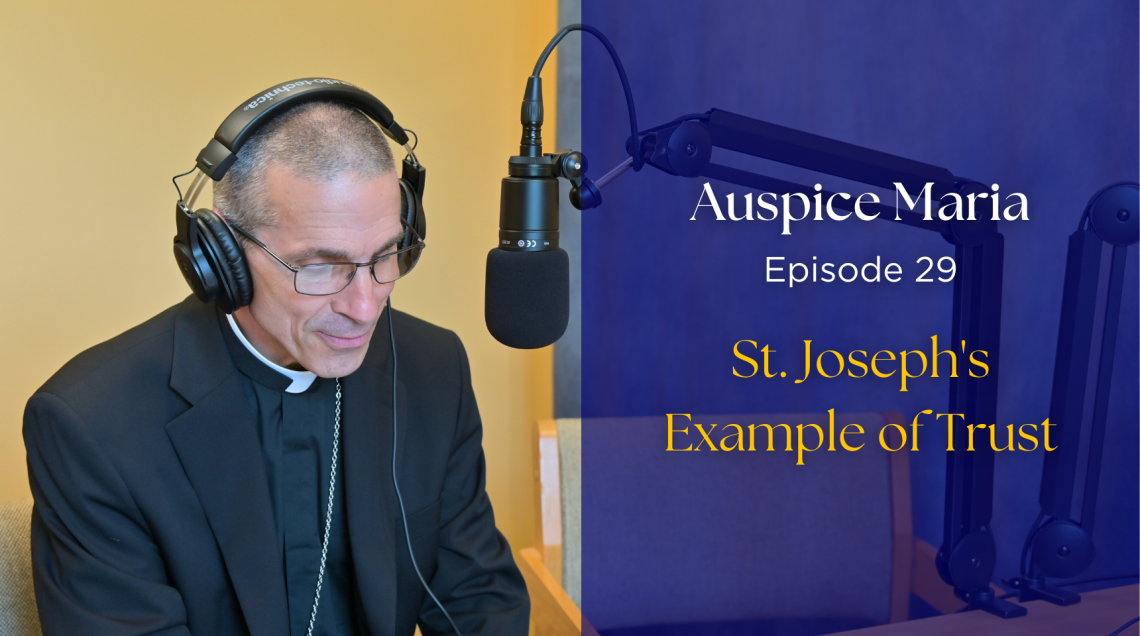
St. Joseph's Example of Trust - Auspice Maria Ep. 29
Follow the Maine Catholic Podcast on:
Transcript:
Well, welcome back to the Auspice Maria podcast.
I'm Bishop James Ruggieri of the Diocese of Portland in Maine.
Today I'd like to talk about St. Joseph, and I'd like to start by reading a passage from Matthew, which really brings Joseph to the forefront. It's Matthew chapter 1, verses 18 to 24.
Matthew writes,
"Now this is how the birth of Jesus Christ came about, when his mother Mary was betrothed to Joseph, but before they lived together, she was found with child through the Holy Spirit. Joseph her husband, since he was a righteous man, yet unwilling to expose her to shame, decided to divorce her quietly. Such was his intention when behold the angel of the Lord appeared to him in a dream and said, Joseph, son of David, do not be afraid to take Mary your wife into your home, for it is through the Holy Spirit that this child has been conceived in her. She will bear a son and you are to name him Jesus because he will save his people from their sins. All this took place to fulfill what the Lord had said through the prophet. Behold, the virgin shall be with child and bear a son, and they shall name him Emmanuel, which means God is with us. When Joseph awoke, he did as the angel of the Lord had commanded him and took his wife into his home."
Now when we think about St. Joseph, we are struck by how little the Gospels say about him, yet how central he is to the heart of the mystery of our faith. He is the earthly father of Jesus. He is the husband of Mary of Nazareth.
God entrusted to him the earthly care and protection of his son and the woman chosen to bear Jesus. And still, Joseph remains entirely silent. He speaks no recorded words. He performs no public miracles. He delivers no sermons. And yet, without Joseph, the Gospel story unfolds very differently. His life reminds us that God often works most powerfully through those who are content to remain hidden, faithful, and attentive.
Joseph lived in Nazareth. It was a small and insignificant village in Galilee. Nazareth was not known for scholarship or influence. It was not a place where people expected anything remarkable to emerge from. Life there would have been simple, repetitive, and demanding. Joseph likely grew up in a household shaped by the faith of Israel, formed by daily prayer, by the Psalms, by the recitation of the Shema, and by the stories of God's fidelity to his people.
From a young age, Joseph would have learned what it meant to trust God not in extraordinary circumstances, but in ordinary life. He would have learned that faithfulness is practiced day after day, often without recognition. He learned to work with his hands, to shape wood, to build and to repair, to provide for others through steady labor. His trade as a craftsman required patience, care, and perseverance. Things had to be measured correctly. Foundations had to be strong. Shortcuts were not an option.
All of this formed Joseph's heart long before the angel ever spoke to him. Joseph, his life, teaches us an important lesson. God does not suddenly create holiness in a moment of crisis. He prepares it quietly over the years. The way Joseph responds to Mary's pregnancy flows from the man of virtue he had already become.
Joseph was betrothed to Mary of Nazareth. This was not a casual arrangement or a trial period. Betrothal was a binding covenant. Joseph and Mary were already legally husband and wife, though they did not yet live together. Their relationship would have been marked by mutual respect, shared faith, and deep trust.
Joseph knew Mary. He knew her devotion to God. He knew her integrity, her purity, her attentiveness to the Lord. Mary's virtue was not hidden from him. She was not someone whose character was uncertain or questionable. This is essential for understanding what happens next.
St. Matthew tells us that before they lived together, Mary was found to be with child through the Holy Spirit. Now Joseph is suddenly confronted with something that defies explanation. And St. Matthew describes Joseph with one decisive phrase, "he was a righteous man."
The word righteous tells us far more than we might realize at first. Joseph was not simply someone who followed religious rules, he was a man who sought to live in right relationship with God. His righteousness was not harsh or rigid, it was marked by mercy, humility, and reverence. He was attentive to God's ways, even when those ways were not immediately apparent.
Matthew then tells us that Joseph decided to divorce Mary quietly, unwilling to expose her to shame.
At first glance, it is easy to assume that Joseph believed Mary had been unfaithful. But the Gospel never says this. And when we pause and reflect, especially in light of Joseph's righteousness and his knowledge of Mary, another interpretation emerges, one that the Church has reflected on for centuries.
Joseph's decision need not be understood as a sign of suspicion.
It can be understood as holy fear. Joseph senses that God is acting in a way that overwhelms him. He does not yet know how, he does not yet understand what God is doing, but he knows enough to recognize that this is not ordinary and that he is standing very close to a mystery far greater and bigger than himself. His instinct is not accusation, it is humility. He chooses to step back rather than presume to step in.
This kind of fear is not fear of punishment, it is not fear of disgrace. It is the fear that arises when a human being becomes aware of God's holiness and feels unworthy to stand so close without invitation. We see this pattern throughout the scriptures when, for example, Moses encounters God in the burning bush. He hides his face.
When Isaiah stands before the holiness of the Lord as he receives his call to be a prophet, he cries out that he is unclean.
And when Peter witnesses the miraculous catch of fish, he falls at Jesus' knees and says, depart from me, Lord, for I am a sinful man.
None of these figures are rejected by God. None of them are condemned. Their fear does not push God away.
Rather, it becomes the place where God meets them.
Joseph stands in this same biblical tradition. His fear is not a lack of faith. It is faith responding honestly to mystery. Now St. Thomas Aquinas helps clarify this. St. Thomas, in his collection of patristic scriptural commentary, the Catena Aurea on Matthew 1.19, following St. Jerome and St. John Chrysostom, presents Joseph's decision not as a suspicion of Mary's infidelity, but rather as a reverential fear before a divine mystery he did not yet understand.
Let's talk about this phrase now, reverential fear. Reverential fear is born not of doubt, but of awe. It arises when we recognize God's greatness and our own smallness.
Back to Joseph. Joseph feared, not because he questioned Mary's virtue, but because he recognized that God was acting in a way that surpassed his understanding, that truly surprised him. And it is precisely here that God speaks. An angel appears to Joseph in a dream. This too is deeply biblical. Throughout the history of salvation, God often speaks through dreams to those who are receptive and attentive. Joseph listens. He does not argue. He does not delay. His heart is already disposed to obedience.
The angel says, "do not be afraid to take Mary your wife into your home." Notice what the angel does not say. The angel does not say to Joseph, do not accuse Mary. He does not say, you are wrong to question her. Instead, the angel addresses Joseph's fear and invites him into deeper trust.
Joseph is told that the child is conceived through the Holy Spirit. He is told to name the child Jesus, and that is a very important command because it carries some significance. For in the biblical world, to name a child is to claim responsibility for that child. So by naming Jesus, Joseph accepts legal fatherhood. He places Jesus within the line of David. He commits himself to protecting, providing for, and forming the Son of God.
Joseph awakens from the dream and, as always, he obeys. He takes Mary into his home. He embraces the mystery that once overwhelmed him. His fear is not eliminated, of course. Rather, it is transformed. It becomes the ground of faithful action.
Joseph's story speaks powerfully to our own lives. Many of us know what it is like to stand before something we do not fully understand, a diagnosis, a call to responsibility we did not seek. A moment when life changes suddenly and we realize that we are not in control. In those moments, fear is natural, but Joseph teaches us that not all fear is the same.
There is a fear that closes us in on ourselves and there is a fear that opens us to God. Reverential fear keeps us humble. It keeps us listening. It keeps us from acting too quickly or assuming we understand God's ways. In a culture that often demands certainty, St. Joseph teaches trust. In a world that values control, St. Joseph teaches surrender.
He shows us that God does not always explain himself fully before asking for our fidelity. St. Joseph reminds us that God's greatest works often unfold quietly and trusted to those who are willing to say yes without needing to be seen. Joseph did not fully grasp the mystery placed before him, but he trusted. He trusted the God who placed it there.
May St. Joseph teach us how to live with holy fear, deep trust, and quiet faithfulness. May he help us stand reverently before God's work in our lives and when the time comes to step forward in obedience.
St. Joseph, guardian of the Redeemer, spouse of Mary, pray for us.
Thank you for listening to this Auspice Maria podcast and I'd like to conclude asking our Blessed Mother Mary, spouse of Joseph, to intercede for us as we pray,
Hail Mary, full of grace, the Lord is with thee. Blessed art thou amongst women and blessed is the fruit of thy womb, Jesus. Holy Mary, Mother of God, pray for us sinners now and at the hour of our death. Amen.