

"Resist the false choice" - Bishop Ruggieri's reflection during Holy Hour for Peace and Consolation
Transcript:
"At that time, Jesus said in reply, I give praise to you, Father, Lord of heaven and earth, for although you have hidden these things from the wise and the learned, you have revealed them to the childlike. Yes, Father, such has been your gracious will. All things have been handed over to me by my Father. No one knows the Son except the Father. And no one knows the father except the son, and anyone to whom the son wishes to reveal him. Come to me, all you who labor and are burdened, and I will give you rest. Take my yoke upon you and learn from me, prime me in humble heart, and you will find rest for yourselves, for my yoke is easy, and my burden light." (Matthew 11:25-30)
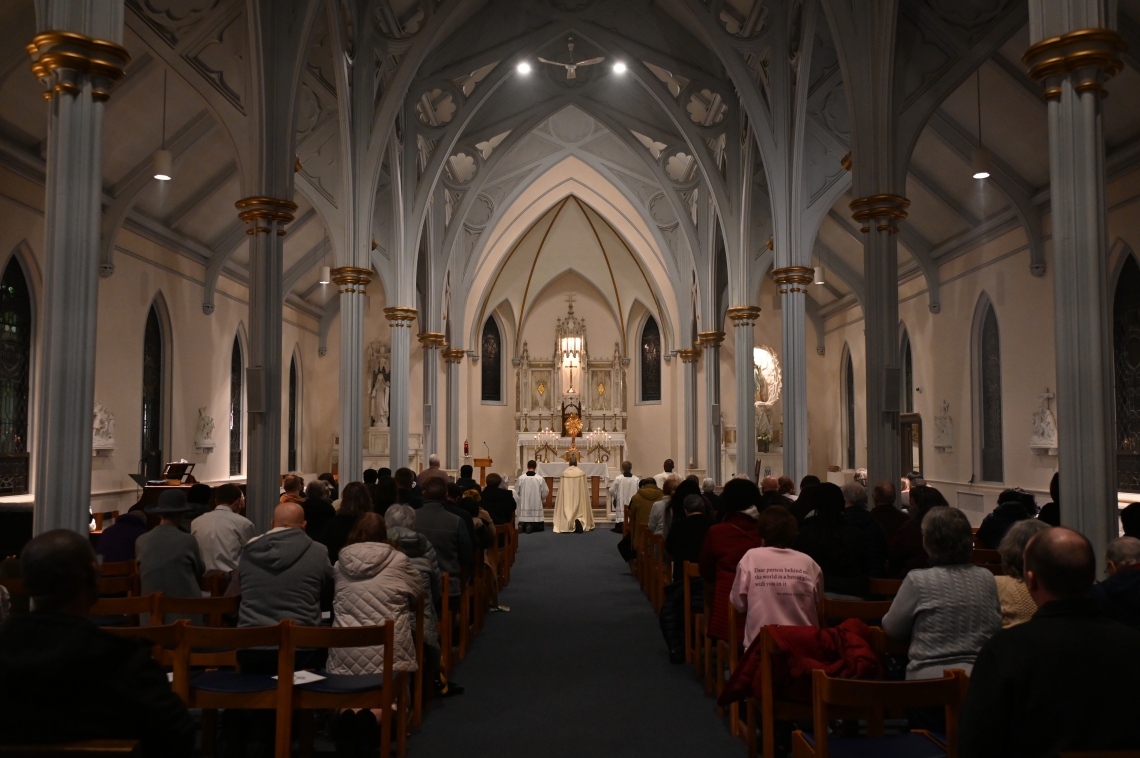
First, I'd like to thank you all for coming tonight, as we sit before our Lord in adoration or neon. It is a time as the scripture invites us to seek rest, to bring our burdens, to bring our prayers, to bring our thanksgiving, to bring our very selves before the Lord. I'd like to thank Father Seamus and Father Sylvester their help and also all the Cathedral staff that has helped to organize tonight's Holy Hour for peace and for consolation.
Tonight we hear words from the Gospel of Matthew, words of Jesus that are once gentle and strong. Come to me, all you who labor and are burdened, and I will give you rest. We gather at a time when many in our nation are laboring and burdened. Some are burdened by fear, some by anger, some by uncertainty. Some are burdened by grief over violence, some by concern for public safety, some by anxiety about loved ones who feel vulnerable.
Our national conversation about immigration, human dignity, and security has become heavy. It weighs on families. It strains communities. It tests trust. And into that heaviness, Jesus does not shout. Jesus does not take sides. Rather, through the words that we hear tonight, Jesus invites. Come to me.
It is important to remember where this passage appears in the Gospel of Matthew. It comes at the end of chapter 11. It comes after rejection, after doubt, after Jesus laments cities that refuse to repent. Jesus speaks these words in a climate of tension. He does not grow harsh, rather he opens his heart. I am meek and humble of heart. That is the Lord, the very Lord and Savior before whom we kneel tonight, in whose presence we are. I am meek and humble of heart.
Jesus first praises the Father in this passage because what is hidden from the wise and the learned is revealed to the childlike. In this context, the wise and the learned are not condemned for their intelligence. Rather, they in one way represent self-sufficiency. The temptation to think that we as human beings have everything figured out on our own, or we can figure out everything on our own. Also, this passage stirs the reality of the temptation to reduce complex human situations to over simplistic, compartments or silos.
The childlike are those who remain open, those who are willing to receive, those who say, Lord, teach us. I believe it is here in this posture, in this disposition, Lord, teach us, that peace begins, that consolation is received, not in control, not in rhetoric, but in humility before God. And tonight, I come, you come, we come not as possible. We come rather as sons and daughters who need wisdom, the wisdom of the father.
Come to me, all you who labor and are burdened. The burdens in our present moment are real. There are immigrant families who live with the fear of separation or instability. There are parents who worry about what tomorrow may bring. There are citizens who worry about crime, about the protection of children, about the safety of neighborhoods. There are law enforcement officers who carry serious responsibility and who themselves deserve to be treated with dignity. There are priests and pastors and ministers trying to accompany frightened parishioners and congregations while preserving unity within their communities.
All of this is weight. The church cannot ignore fear. The Church cannot ignore the legitimate concern for public safety. The Church cannot ignore the inviolable dignity of every human being. And we must resist the false choice that tells us we must defend one good by denying another. Human dignity and legitimate security are not enemies, both belong within the moral vision of the Gospel.
The Church must say clearly, every human person is created in the image and likeness of God, from the moment of conception until natural death. No one. No one is disposable. No one is merely a problem to be solved. No one should be treated as less than human.
We must also say clearly, nations have a responsibility to regulate their borders and protect their people. The protection of children, and the innocent is not contrary to the Church teaching. He's a part of it. The Church does not defend criminal behavior. The Church does not support harboring those who pose a genuine threat to others at the same time. Enforcement must always respect human dignity. It must avoid cruelty, arbitrariness, and dehumanizing language. Due process matters. The measure, though, finally, is always the heart of Christ.
Then Jesus says something in the passage that maybe we didn't expect. Take my yoke upon you and learn from me. Take my yoke upon you and learn from me. A yoke is not a decoration. It is an instrument used for domestic work animals. It joins two together so that they move in the same direction to accomplish the same task, the same mission, the same work.
When Jesus speaks of his yoke, he is not promising that all burdens disappear or will disappear. Rather, he is telling us that we do not carry them alone. He places himself beside us. He shares the weight. In moments like this when our public life feels very strained and divided, we can easily take on other yokes. The yoke of frustration, the yoke of fear, the yoke of anger. These may feel powerful at first, but they're heavy, and they can narrow the heart.
Jesus offers something different. He says, "learn from me, for I am meek, meek and humble of heart." Meekness, as the adage goes, is not weakness. It is strength disciplined by love. Again, meekness is not weakness. It is strength disciplined by love. It is the refusal to let hostility govern our spirit or our actions.
If we are to speak about human dignity, if we are to insist that no one be treated as disposable, we must do so always in a way that reflects His heart, the heart of Christ. If we are to affirm the importance of public safety and the protection of the innocent, we must do so without harshness. One being yoked to Christ holds truth and charity together. It keeps us from drifting towards the extremes, and it guards, very importantly, it guards our hearts from becoming hardened.
If we are not yoked to Jesus, even good intentions can be corrupted. Even necessary conversations can lose sight of the humanity of the person with whom we converse if we are not yoked to Jesus. Only when we remain close to the meek and humble of heart, to Jesus and his sacred heart, can we work for reform, for justice, and for peace, in a way that builds up rather than tears down. Only when we remain close to the meek and humble heart of Jesus can we truly, truly work for reform, for justice, and for peace in a way that builds up rather than tears down.
By looking ourselves to Christ, he says, you will find rest for yourselves. Rest does not mean the immediate resolution of every debate. It does not mean the tension disappears overnight. What it means, rather, is interior stability. It means communion with Christ. It affords us the means to listen, to pray before we act, and to examine our hearts before we condemn.
This holy hour, very simply organized in the sense that there's not a lot to this, but the most important element is here, Christ and his sacred heart. So this holy hour is not an escape from responsibility. Praying is not an escape from our responsibility. Rather, prayer needs to be the foundation for responsible action.
We bring to the altar tonight the fear of immigrant families. We bring the concerns of those anxious about safety. We bring the grief caused by violence. And we bring the weariness of polarization. We place it all, we place everything before the meek and the humble heart of Christ.
My dear brothers and sisters, our nation is laboring and is burdened. However, Christ has not withdrawn from us. He stands before us in the Eucharist and he says, come to me. May this holy hour renew our hearts, may ground our speech, may it purify our intentions, and may make us instruments of peace, and may grant us consolation. And may we leave this place yoked, yoked not to fear, not to ideology, but yoked to the one, to the one whose burden is light and who walks with us, unfailingly walks with us through the trials and tribulations of the present moment.