

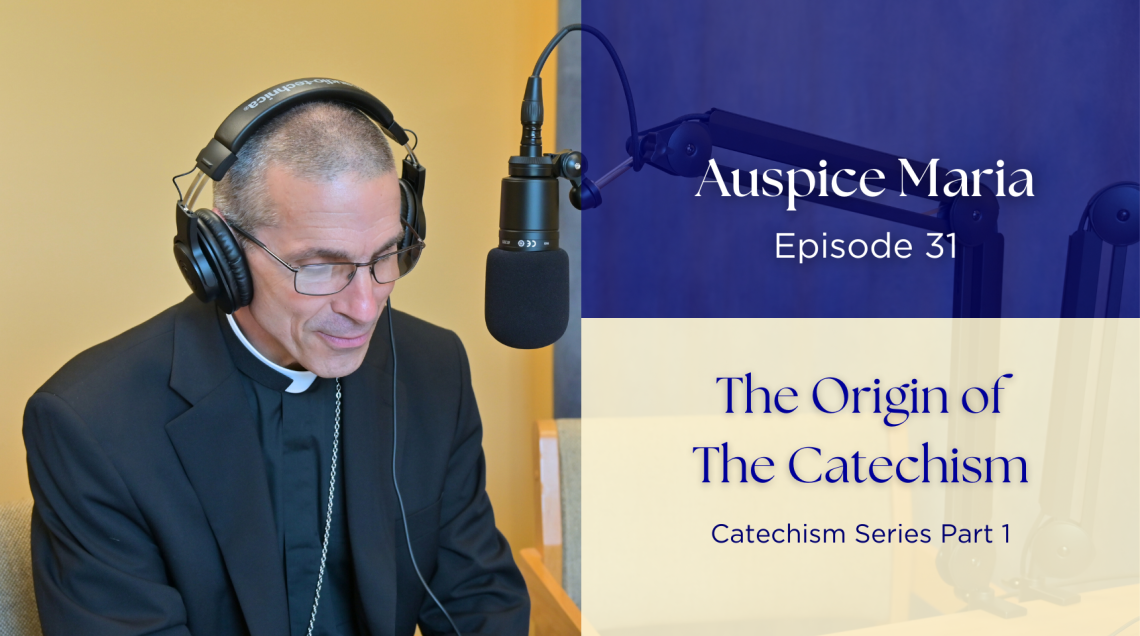
The Origin of the Catechism (Catechism Series Part 1) - Auspice Maria Ep. 31
Follow the Maine Catholic Podcast on:
Transcript:
Well, welcome back to the Auspice Maria podcast. I'm Bishop James Ruggieri of the Diocese of Portland in Maine. And today I'll be beginning what will be a prolonged series and exposition on the Catechism of the Catholic Church.
Today's really more of an introduction to the Catechism, and basically also to explain its layout, its structure, and the gift that it is to the Church. In coming episodes, I hope to delve into the sections with you, and it won't be necessarily paragraph by paragraph, but it will advance section by section, chapter by chapter.
And obviously as the Spirit moves, I'll highlight certain things that I feel would be helpful and beneficial, not only to those who are listening to this podcast, but also to myself, because as one who is charged to offer the podcast, I benefit from the preparations, as I think anyone who teaches, or whether it's a catechist, a Catholic school teacher, or a theology professor, priest preparing a homily, the person who prepares well, prays well in preparation really benefits himself or herself by that preparation.
So I'm looking forward to this myself, but I'd like to begin always with a prayer to the Holy Spirit, invoking the Holy Spirit to help us to open our hearts, open the hearts of all who listen. Spirit, come and inspire us and lead us forward in faith, hope, and love. And we ask all this through Christ our Lord. Amen.
So the Catechism of the Catholic Church is, it's a big book, a very big book, but it's not meant to be a book that we just leave on the bookshelf or reserve in a place, and it's only reserved for classrooms or experts. It's really meant to be a gift for all of the Church and all the members of the Church.
And it's meant to be a companion. It's meant to be something that you and I can return to when we have questions, perhaps when we're searching for some answers regarding the faith, or even when we're struggling with something, when we simply want to grow closer to the Lord.
I have found reading the Catechism, it's so clearly written that it just helps me to reflect deeper on what I'm reading, but also if it's thematic, for example, the Creed, whether it's Christ, the Holy Spirit, it just helps me to even delve more deeply into those theological themes.
But the Church really is entrusted in every age since the apostolic times with the sacred responsibility to guard, to proclaim, and to hand on what St. Paul refers to as the deposit of faith. The Gospel is not something the Church invents. It's not something we've made up. It's not a myth we're passing on.
With the Gospel, the good news is what we have received through the inspiration of the Holy Spirit, this beautiful revelation of Jesus Christ. It is a treasure entrusted to the Church, to her care, so that it may be proclaimed faithfully in every generation and in every culture.
St. John Paul II, he opens the apostolic constitution, fidei depositum, with words that set the tone for the catechism and in many ways for the church's mission itself. "Guarding the deposit of faith," he writes, "is the mission which the Lord entrusted to his church and which she fulfills in every age."
These words remind us that the Church does not exist for herself. She exists for you. She exists for me. She exists for future generations. She exists so that we can know Christ, we can love Him, we can live in His grace now, but also we can spend eternity with Him in heaven later.
St. John Paul II situates the Catechism in the light of the Second Vatican Council. He explains that the Council was not called primarily to condemn errors, but to present the faith more effectively so that the truth of the Gospel might shine forth and lead people to receive the love of Christ.
In other words, the Church desired not only to speak the truth, but to speak it in such a way that it could be received well by the human heart.
20 years after the council in 1985, St. John Paul II convoked what would be called an extraordinary synod or gathering of bishops. The bishops looked honestly at the pastoral needs of the world at that time and recognized that many people were searching for clarity.
Parents wanted to teach their children well, the faith. Catechists wanted a sure foundation. Priests wanted resources, especially to preach with confidence. And really ordinary believers simply wanted to know clearly what the Church teaches. So the bishops requested a catechism. And I'm going to read for you what is right out of the apostolic constitution.
St. John Paul II writes, "in this spirit on January 25, 1985, I," referring to St. John Paul II, "convoked an extraordinary assembly of the synod of bishops for the 20th anniversary of the close of the council. The purpose of this assembly was to celebrate the graces and spiritual fruits of Vatican II, to study its teaching in greater depth in order that all the Christian faithful might better adhere to it and to promote knowledge and application of it."
"On that occasion, the synod fathers (the bishops) stated, very many have expressed the desire that a catechism or compendium of all Catholic doctrine regarding both faith and morals be composed, so that it might be, as it were, a point of reference for the catechisms or compendiums that are prepared in various regions. The presentation of doctrine must be biblical and liturgical. It must be sound doctrine suited to the present life of Christians."
"After the synod had ended," St. John Paul II goes on to write, "I made this desire my own, considering it as, quote, fully responding to a real need of the universal church and of the particular churches, close quote."
So again, the bishops asked, St. John Paul II responded. And in 1986, he entrusted a commission of cardinals and bishops chaired by then Cardinal Joseph Ratzinger, who later became Pope Benedict XVI, with preparing this catechism. Bishops, theologians, catechists, and episcopal conferences from around the world collaborated.
And St. John Paul II later described the result as a "true symphony of the faith, a symphony of the faith" expressing the harmony of the universal church. The catechism is not the voice of one place or one culture, it is the voice of the whole church speaking with one heart.
So on October 11, 1992, St. John Paul II promulgated, meaning he disseminated, he officially authorized the publication of the Catechism.
He declared, "the Catechism of the Catholic Church is a statement of the Church's faith and of Catholic doctrine." Continuing, "I declare it to be a sure norm for teaching the faith and thus a valid and legitimate instrument for ecclesial communion. And then he referred to it as a sure and authentic reference text for teaching Catholic doctrine and particularly for preparing local catechisms."
So five years later, he promulgated the Latin typical edition. So this would be sort of the benchmark edition or the edition from which other translations would be derived, declaring that this Latin edition is the definitive text of the catechism and encouraging bishops to ensure that it is widely disseminated and well received as an outstanding gift to the people of God.
So let's talk about this a little bit more. What really is the catechism? It's not rules. It doesn't begin with rules, I should say, but it begins with relationship.
And interestingly, it opens in the prologue with the words of John 17 verse 3. "The words of Jesus, Father, this is eternal life, that they may know you, the only true God, and Jesus Christ, whom you have sent." John 17 verse 3.
Then it reminds us, in the prologue, "God infinitely perfect and blessed in himself in a plan of sheer goodness, freely created man to make him share in his own blessed life."
So this means that you and I were created for communion with God, for joy. We were created for this communion. We were created in love, out of love. We were created to belong.
So your life, my life is not a burden, a mistake that God just simply tolerates. Our lives are really gifts that God delights in.
The Catechism says that God draws close to us at every time and place and he calls us to seek him, to know him and to love him.
So I think that's really important because sometimes we may feel we're forgotten or we may feel alone. But please, we're not alone, especially in our questions. And God never abandons us in our struggles. God is closer to us than we can possibly even imagine.
It also tells us that Christ sent the apostles to proclaim the Gospel and to baptize all nations, importantly in the second paragraph of the prologue. And that those who have received this faith are called to hand it on.
So the faith is something I receive. I'm the beneficiary. I'm the recipient of apostolic preaching, of the transmission that happens through the power of the Holy Spirit through the Church. But it also means that I now, receiving this gift, I'm entrusted to pass it on.
So your faith, my faith, your witness, my witness really matters. We are part of this process, this beautiful living process of passing on this deposit of faith, this good news of salvation.
So the Catechism aims to present a real synthesis in the prologue number 11, an organic synthesis of the essential and fundamental contents of Catholic doctrine as regards both faith and morals.
Now that might sound like a mouthful, but basically, it strives to present to us what we believe, the deposit of our faith.
So if we think of our faith as being contained in this treasure trove, this very ornate treasure trove, the Catechism is that treasure trove, and it just simply is meant to be shared, opened, shared, and enjoyed. And enlightening ourselves, we then delight in what we read, what we study, what we learn, and we are moved to pass on this beautiful faith that we delight in.
It's structured around four pillars. We think of the catechism standing on four legs or four pillars. What we believe, the creed. How we celebrate, the sacraments. How we live our Catholic Christian faith, the moral life. And how we pray. So those are the four pillars of this beautiful catechism.
In a world that seeks to tell us at times, or sometimes strongly, sometimes subtly, that you define yourself by success, appearance, or productivity, the Catechism reminds us that your identity, my identity is received before it is achieved.
It's a great kind of little catchphrase. Our identity is received before it is achieved. So we don't achieve our identity. We don't achieve our worth, our value. It's God-given at creation, at conception.
We are loved before we perform. We are called before we prove. We belong before we accomplish.
So if we are maybe discouraged, weary, confused, or longing for deeper peace, a n invitation maybe begin here, begin with the truth of who we are in God.
And let's let the catechism be a steady companion on this journey of faith, this journey of self-discovery, this journey also of discovering who we are in relationship to Christ and his church, the community.
The prologue concludes with a beautiful pastoral principle. "The whole concern of doctrine and its teaching must be directed to the love that never ends. All the works of perfect Christian virtue spring from love and have no other objective than to arrive at love."
What a beautiful phrase, beautiful sentencing. "The whole of Christian doctrine and its teaching must be directed to the love that never ends."
So, this series exists for that reason. It's not to burden us with church teaching or to be simply like a classroom. But I'm really hoping that this series is a blessing both to you and to me.
And not to overwhelm us necessarily even with theological maxi ms, but really to help us to reflect again on who we are in relationship to a God who loves us infinitely.
So I hope I'm not seeking to complicate the faith, but I really want to help us all to rediscover and to re-appreciate its beauty.
So in the next episode, we'll begin with part one of the catechism, the profession of faith. And that's the creed that we proclaim every Sunday, every solemnity at Mass. And we'll listen to the God who speaks and draws near.
So I'd like to entrust this whole series, of course, to the Blessed Mother of God, Virgin Mary, Mother of the Incarnate Word and Mother of the Church.
And as I place it under her protection, I'm going to simply end with the Hail Mary, also asking for the intercession of St. John Paul II, who was such a catalyst in making this Catechism a reality.
Until we meet again next time in the podcast, I pray that the Lord bless you and sustain you. And again, let's conclude with the Hail Mary.
Hail Mary, full of grace, the Lord is with thee. Blessed art thou amongst women, and blessed is the fruit of thy womb, Jesus. Holy Mary, mother of God, pray for us sinners now and at the hour of our death. Amen.