


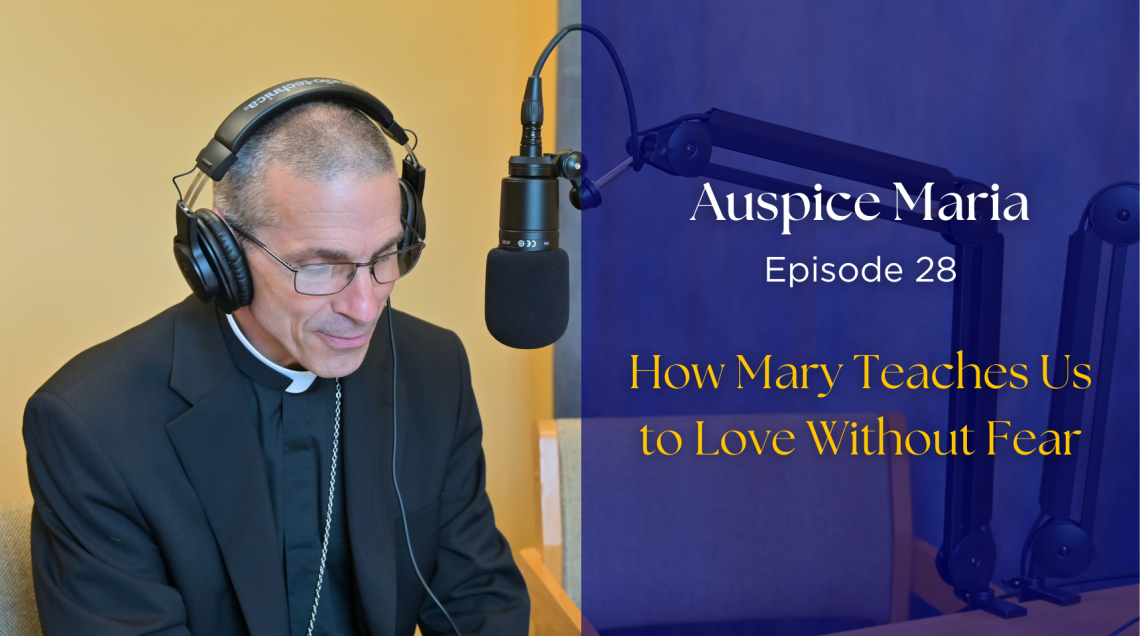
How Mary Teaches us to Love Without Fear - Auspice Maria Ep. 28
Follow the Maine Catholic Podcast on:
Transcript:
So welcome to the Auspice Maria podcast. I'm Bishop James Ruggieri of the Diocese of Portland in Maine. And this week, I'd like to talk about Mary, one of my favorite topics, and especially in light of the solemnity of the Immaculate Conception of Mary and also the feast of Our Lady of Guadalupe.
But before doing so, I'm going to kind of mix things up a little bit and begin with the Hail Mary, asking Mary to intercede for all of us that this podcast may bless us and bless all those who may be listened in the future.
Hail Mary, full of grace, the Lord is with thee. Blessed art thou amongst women, and blessed is the fruit of thy womb, Jesus. Holy Mary, Mother of God, pray for us sinners now and at the hour of our death. Amen.
So as I mentioned, today we'll talk a little bit about our Blessed Mother Mary. I'd like to reflect with you on Mary in light of these two great feasts that I mentioned, the Solemnity of the Immaculate Conception, which is December 8, and the Feast of Our Lady of Guadalupe, which is December 12.
One is, we could say, deeply doctrinal, reflecting on the mystery of Mary's beginning. The other is more rich with story, culture, and popular devotion, although they both refer to the same wonderful woman, the same mother of God, our mother. Yet at their heart, again, they reveal the truth. Mary shows us what the human person looks like when love is not ruled by fear.
So on the solemnity of the Immaculate Conception, again celebrated in the Church December 8th, the Church lifts her eyes to Mary in the solemn mystery of her beginning. She is the patroness of our diocese here in Portland, Maine, and also of the United States. And this feast, I think, becomes an opportunity not only to honor not just a dogma, of course, but to reflect on authentic love, because Mary embodies authentic human love.
The doctrine of the Immaculate Conception, proclaimed by Pope Pius IX in 1854, teaches that from the very first moment of her existence, her conception, by a singular grace and privilege of Almighty God and in anticipation of the merits of Jesus Christ, Mary was preserved free from all stain of original sin. This is not Mary's accomplishment, of course; it is the work of God's redeeming love applied in advance. Mary is the first fruit of the redemption accomplished by her son Jesus.
So in the Solemnity, the Mass, the first reading from the Mass is from the book of Genesis. And it reminds us why this feast, why this Solemnity matters. Well, after the sin of Adam and Eve, the harmony between God and humanity is shattered. Fear enters the human heart. Shame enters the human soul, and blame replaces trust. This is seen very clearly in chapter three of Genesis.
And yet, even there in humanity's darkness, God speaks a word of hope. And it's found in verse 15 of chapter three in Genesis: “I will put enmity between you and the woman and between your offspring and hers.” As we read this line again, removed many years from when it was first written, we read it now through the lens of Jesus Christ and his revelation.
Mary is that woman. From the very beginning, God prepared her as the one in whom sin would not exist so that the Savior could take flesh from a humanity not enslaved, not divided within itself. Mary reveals what God intends for humanity. She shows us what the human person looks like when love is not fractured by sin.
Saint John the Evangelist gives us the inspiration that unlocks what I would call unlocks Mary's interior freedom. In the first letter of John, in the New Testament, we hear John write to us, “There is no fear in love, but perfect love drives out fear, because fear has to do with punishment. And so one who fears is not yet perfect in love.” That's first letter of John chapter four, verse 18. There is no fear in love, but perfect love drives out fear. This is not poetic exaggeration. It is really a spiritual reality.
Fear is one of the most profound consequences of original sin. Fear of God—we see Adam hiding when God comes walking in the garden in chapter three after the original sin. Fear of rejection, as human beings we suffer from that. Fear of vulnerability. Fear of loss. And fear that I am not enough, again another really difficult struggle that many of us have, that we are just not enough.
So Mary, conceived without sin, is free from that interior tyranny of fear. She's not burdened by suspicion toward God. She does not shrink from his call. She does not negotiate with his will. She is capable of loving with an undivided heart, because nothing in her resists love. And so she can respond with what is perhaps the most astonishing act of human freedom recorded in the scriptures: “Behold, I am the handmaid of the Lord. May it be done to me according to your word.” That famous response that our Blessed Mother gives in response to the invitation of Gabriel—that's found in Luke chapter one verse 38.
So just for the important record, this is not passive resignation. Mary is not compelled to do this, to accept this responsibility of being the mother of the Savior, to be the handmaid of the Lord. This is the freedom of perfect love. Mary's response is made in love to love.
So to understand really how extraordinary Mary's freedom is, especially at this moment, we must speak honestly about the condition we live in after the fall, meaning after the original sin is committed. Though baptism removes original sin, a very important truth of baptism, its effects remain. And the Church calls this lingering wound of original sin concupiscence. Again, the sin is forgiven, washed away through the beautiful grace of baptism, but the lingering effects of original sin can be summarized in this one word, concupiscence.
Concupiscence is not simply temptation—that's more external, although it can be internal. However, concupiscence is more of an inner disorder that bends our desires away from God. It is why we often love imperfectly even when we sincerely want to love well and authentically.
Concupiscence affects the way we love in very concrete ways. For example, we love, we seek to love another, but we also often want to control. We desire communion with another, but there's also that fear, often underlying things, subtle, a fear of vulnerability. We desire intimacy with another, meaning that we allow another whom we love to see us as we are, but yet we hold something back. There's something sometimes within us that holds back from showing our true self to the other whom we love. We seek to be a gift to the one we love, but we sometimes feel the pull of selfishness.
So even our best love is often mingled with fear. Fear of being hurt, fear of being forgotten, fear of being disappointed, fear of surrender. And fear, among its many effects, fear makes a human being defensive. Why are we defensive? Because we want to protect ourselves. So fear makes us defensive in our relationships.
Mary stands before us as the one person other than Jesus who never experienced that interior fracture. Her surrender was never compromised by fear. She could give herself entirely in love because nothing within her resisted the gift of being loved by God and loving in return.
We live every day, it could be argued, between the tension of fear and love. The battle between grace and concupiscence plays out in our relationships, in our marriages, our families, our friendships, our discipleship, and in our interior lives.
St. John the Evangelist tells us that perfect love casts out fear, again reminding us of that scripture. But perhaps it helps to think in terms of maturity rather than instantaneous perfection. Again, this idea of perfect—making no mistakes, everything is done exactly right—this often is our thought of, when we think of perfection, is our idea. But reality is because we're human, we're not going to be perfect. Maybe we could think of this in terms of a mature love, a mature, authentic love.
Authentic love does not grow overnight. It grows as the person grows personally, spiritually, and emotionally. So as the adult grows personally, spiritually, and emotionally, that adult is capable now of even loving more authentically.
So Mary teaches us that love does not mature through emotional intensity. It's important to think that sometimes we may be deceived by this reality: “Oh, I just don't feel it.” But love is more than a feeling, of course. Love matures when we love freely without fear and with a desire to give ourselves away as a gift to the beloved. Authentic love desires to make oneself a gift for the other. Mary does this beautifully with God. She gives herself freely as a gift by saying yes.
Up to this point, everything we have reflected on about Mary's freedom, her trust, and her love comes alive also in a new and powerful way in the apparitions of Our Lady of Guadalupe. We've been talking about the Immaculate Conception, but I'd like to transition now to the beautiful story of Our Lady of Guadalupe. Again, same Mary, same Blessed Mother, same Mother of God.
In these apparitions of Our Lady of Guadalupe, Mary appears not in Nazareth, not in Jerusalem, but in the hills of Tepeyac, what is present-day Mexico, Mexico City. In the year 1531, she appears not to a king or a scholar, but to a humble indigenous man named Juan Diego.
Early one December morning, and actually it was December 9th, Juan Diego was walking to Mass. At that point, historically, liturgically, he was going to the Mass of the Immaculate Conception. When on his way, again early in the morning, he heard music like birdsong coming from a hill. And he saw a radiant young woman appear before him and spoke to him. And she spoke to him in his native language with great tenderness.
She appeared so beautifully as a mestiza, meaning a woman of mixed race, Spanish and indigenous. And she spoke the native language, the indigenous language of Juan Diego. And she said to him, among different things, she said, my dear little son Juanito, again I'm translating it, but she called him her son and she called him in a very Juanito, sort of this loving, tender way to address Juan Diego. She told him that she was the ever-virgin Holy Mary, mother of the true God.
Again, in Juan's day and in Juan's culture, there were false gods. Juan was part of a culture that had many false gods. And she asked that a church be built on that very spot so that she might show her love and compassion for all the people.
So interestingly, about 10 years earlier, the Spanish conquistadores had come and had conquered the Aztec people. And as things transpired, obviously Christianity came with the explorers. And so people started to convert, indigenous people started to convert to Christianity. Juan Diego is one of those converts.
And Juan, being the recipient of this apparition, the dialogue with Mary, he takes the charge. He takes this commission by Mary to go to the local bishop, who was Bishop Juan Zumarraga. He was a Franciscan. And imagine, again, let's put it into context, this indigenous man has no social status, comes to the local bishop, and has a story for him that he saw the mother of God and she asked for a church to be built on Tepeyac Hill.
It might sound like a ludicrous thing to us today if we were to put ourselves in the bishop's shoes, and indeed he did not believe Juan. He was respectful but he did not believe him. So Juan returned to the hill discouraged. Mary met him again. And he apologized for not being successful. And she reassured him, asked him to go back.
And well, how the story ends is, on December 12th when Juan was going actually to attend to his uncle who was gravely ill, he tried to go around the site where he had met Mary—this was the fourth time that she would appear to him those three previous times—because he was so fixed on getting to his uncle who was very sick. He was going to try to find a priest to attend to his uncle to administer the sacrament of anointing.
So he tries to avoid Mary, but so beautifully, she meets him in his attempted detour. Mary intercepts him on the road and spoke what I would call these very beautiful, famous words of hers. She tells him, “Am I not here who am your mother? Are you not under my shadow and protection?” Trying to assure him, Juan, it's okay, I'm here, I'm your mother. It will be well.
So she told him that his uncle was already healed and instructed him to climb to the top of the hill and gather flowers. Now, it was December, so the hillside was barren, but when he reached the summit, he found these Castilian roses in full bloom, totally out of season and totally out of seasonal context. So he gathered them in his tilma, which would be like his poncho, his cloak, and he wraps them up in them and he brings them to the bishop thinking, I have now the sign to validate my experience so that the bishop will build a chapel on that site.
So as he opens his cloak before the bishop, the roses fell to the floor and eyes were fixed on his tilma. Because on the tilma, it wasn't so much the roses that they were fixated on. It was the tilma, the miraculous image of Our Lady of Guadalupe, how the woman, this beautiful woman who had appeared to him these four times, how she looked, her appearance was captured on his tilma.
Now his tilma was made of cactus hair. And this image is miraculous. And it still hangs on the wall of the Basilica in Mexico City. And actually, it's almost 500 years old. And it really should not have survived this long based on the material of which it is made.
So the bishop and his attendants, they fall to their knees. They believe the story. A small chapel is built, and Juan spends the rest of his days attending to that chapel and telling the story of the apparitions.
But what's so striking in the apparitions of Guadalupe is it's not the what's so striking in these apparitions of our Lady of Guadalupe is really not so much the extraordinary, but we could say it's the tenderness that our Blessed Mother shows toward Juan to assuage him, to calm his fear. Mary does not command Juan Diego. She speaks gently to him. She reassures him. She treats him with dignity. She calls him my little son. She removes his fear. She heals his uncle or Jesus heals his uncle before he even asks for this. But she takes care of that with her son to make sure that his uncle is provided for.
This is the same Mary of the Immaculate Conception, the same Mary who exhibits great love without fear, the same Mary who invites others to love. Our Lady of Guadalupe shows us that perfect love casts out fear not only in heaven but here on earth, or let's say, mature love casts out fear, not only in theory, but in lived experience.
As the patroness of our diocese here in Portland, Maine, and as mother of the Americas, Mary does not merely protect us. She serves as the model of what grace can accomplish in a human life. She is the model for priests in giving their lives without reserve. She is the model for married couples in loving without fear. She is the model for parents in sacrificing without resentment. She is the model for young people in trusting God without delay. She is the model for the Church in belonging entirely to Christ.
And in a world marked by anxiety, division, and suspicion of love itself, Mary stands as living proof that human freedom is not found in autonomy, but in surrender.
So on the solemnity of the Immaculate Conception, on the feast of Our Lady of Guadalupe, we do not merely honor Mary, we look to her as our model and our hope. One day among the saints in heaven, we will love without fear. For now we practice that love imperfectly. That means we will say many times, I'm sorry. That means relationships will require regular repair. And that means surrender will be a daily choice.
However, my dear brothers and sisters, do not stop repairing those relationships that may be wounded by selfish love. Do not stop trying. Do not stop growing. Do not stop loving. May Mary, our Immaculate Mother and our Lady of Guadalupe, teach us how to trust as she trusted, how to love as she loved, and how to say without fear and without reserve, let it be done to me according to your word.
Thank you for listening to this Auspice Maria podcast, and I'd like to again a special shout out to my producer Jake for all his help and work. And I beg the Holy Spirit just to move our hearts more so that we may love without fear, may trust God unconditionally, and always recognize that we are loved unconditionally by our God. God bless you and until next time.