

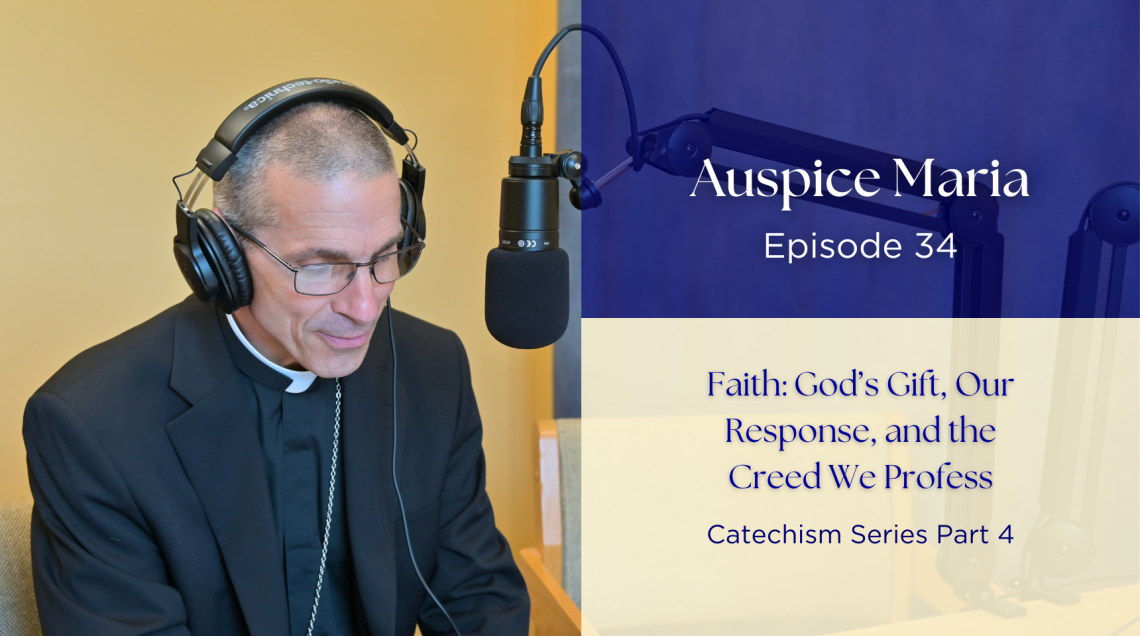
Faith: God’s Gift, Our Response, and the Creed We Profess - Auspice Maria Ep 34
Follow the Maine Catholic Podcast on:
Transcript:
Well, welcome to the Auspice Maria podcast. I'm Bishop James Ruggieri of the Diocese of Portland in Maine. And this week we continue with the series on the Catechism.
I'd like to talk today using the paragraphs from the Catechism on faith, the gift of faith. We're still in the 100s, the early part of part one of the Catechism.
But before that, I'd like to just invoke the Holy Spirit, the Holy Spirit's wisdom and understanding.
So come Holy Spirit, inspire us, open our hearts and minds, lead us forward in faith, hope and charity, and Lord, just bless those and bless all who hear this podcast. We ask all this in your holy name, Jesus, in the unity of the Holy Spirit, God forever and ever, amen.
So in the opening pages of the Catechism of the Catholic Church, the Church does something very beautiful and deliberate. She does not begin with rules, obligations, or doctrines to be memorized. She begins with God's initiative.
I think it's, again, a beautiful perspective of the Catechism. God's initiative. God reaches out, God creates, God reveals. God speaks first.
So creation itself is already an act of divine generosity. God creates everything out of nothing, not because he needs the world, but because he desires to share existence.
He creates the human person in his own image and likeness, male and female, capable of reason, freedom, love, and relationship. So creation is already a form of outreach, divine outreach by God.
But God does not stop at creation. The catechism reminds us that God continues to draw near through revelation, which is both mysterious but also tangible.
God reveals himself gradually, patiently, through covenants, prophets, and ultimately through his Son, the fullness of revelation.
Revelation reaches its fullness not in an idea, but in a person, in Jesus Christ. God does not merely speak about himself, he gives himself.
This brings us to the heart of the first part of the Catechism. As God speaks, as God gives himself to us in Jesus, a response is invited. We are invited into a divine dialogue.
That response is called faith. The Catechism expresses this with beautiful clarity in paragraph 143,
“By faith, man completely submits his intellect and his will to God. With his whole being man gives his assent to God the revealer. Sacred Scripture calls this human response to God, the author of revelation, ‘the obedience of faith.’” (CCC 143)
So faith then is not blind emotion. It is not a product of culture. It is not coercion. Faith is the free, personal, and total response of the human person to God who has first revealed himself.
The Catechism does not speak only about faith in an abstract way. It immediately situates faith within history and human lives.
Hebrews in chapter 11 offers a kind of litany of faith and highlights certain people of scripture. Catechism highlights Abraham in particular.
In paragraph 145, we are reminded that Abraham's story is not romanticized. It is radical.
Abraham is 75 years old when God calls him to leave his homeland, his family, and everything familiar to journey toward a land he does not know. This is not youthful idealism. It is a mature, costly decision.
And Abraham goes freely. God does not force him. Abraham hears and Abraham responds.
This matters because faith always involves freedom. Faith is never imposed. Faith is not inherited biologically. Faith is a personal act.
The Catechism then presents Mary, the mother of Jesus, as the perfect embodiment of the obedience of faith.
In paragraph 148, we are reminded Mary hears an invitation that exceeds human comprehension, the invitation to be the mother of God.
She does not see the entire path ahead, she does not receive guarantees about suffering, and yet she responds.
That beautiful line of Luke, the words of our blessed mother.
“Behold, I am the handmaid of the Lord; let it be done to me according to your word.” (Luke 1:38; CCC 148)
This is not passive resignation. It is active trust. Mary's let it be done, her fiat, is arguably one of the most courageous statements ever uttered by a human being. She entrusts her intellect and her will to God, even without full clarity about the cost.
At this point, the Catechism makes a very important clarification, one that is sometimes overlooked. Faith is not something we manufacture on our own. Faith is a gift.
In paragraph 153, the Catechism teaches, “Faith is a gift of God, a supernatural virtue infused by him.”
This matters pastorally. Many people quietly believe that faith is something they are supposed to generate by sheer effort. When they struggle, they may feel ashamed or inadequate.
The Catechism corrects this misunderstanding. There is such a thing as natural belief, of course, trust in human testimony, reliance on evidence, confidence in relationships, but supernatural faith, the ability to believe in the one true God as he has revealed himself, is a grace given at baptism, along with hope and charity.
This does not mean faith is static. Like every virtue, it must be exercised, nourished, and deepened. But it begins as a gift before there is growth.
Because faith is a gift, it is sometimes misunderstood as irrational. Throughout history, critics of religion have accused faith of hindering human progress rather than fostering it.
One of the most frequently cited examples is Karl Marx, who wrote in his Critique of Hegel's philosophy of Right, the quote, “Religion is the sigh of the oppressed creature, the heart of a heartless world, and the soul of soulless conditions. It is the opium of the people.”
Again, that famous line of Marx, the opium of the people.
So Marx viewed religion as a human response to real suffering that nevertheless functions as a sedative, reconciling people to oppressive conditions and thereby preventing revolutionary social change.
The Catechism responds to this critique not defensively, but confidently. Faith does not suppress reason. Faith seeks understanding.
In paragraph 158, the Catechism states, “Faith seeks understanding: it is intrinsic to faith that a believer desires to know better the One in whom he has put his faith.”
Faith desires knowledge, not ignorance. Faith does not fear truth. This is why the Catechism's treatment of the relationship between faith and reason that we find in paragraph 159 is very important.
Let me read the first couple of sentences of that paragraph:
“Though faith is above reason, there can never be any real discrepancy between faith and reason. Since the same God who reveals mysteries and infuses faith has bestowed the light of reason on the human mind, God cannot deny himself, nor can truth ever contradict truth. [Consequently, methodical research in all branches of knowledge, provided it is carried out in a truly scientific manner and does not override moral laws, can never conflict with the faith, because the things of the world and the things of faith derive from the same God. The humble and persevering investigator of the secrets of nature is being led, as it were, by the hand of God in spite of himself, for it is God, the conserver of all things, who made them what they are.]” (CCC 159
What the catechism is, if we were to continue to read that paragraph 159, what the catechism is saying here is remarkably simple and deeply reassuring.
When a person sincerely seeks truth, whether in physics, biology, medicine, history, or philosophy, that person is never wandering outside of God's domain.
The universe being studied is not independent of God. It exists because God created it and sustains it.
The laws of nature are not competitors to God's action. They're expressions of the order he has placed within creation.
This is why the catechism can say that the honest seeker of scientific truth is in a real sense being led by God himself, even if that person does not yet recognize it.
The scientist who studies the structure of matter, the physician who seeks to understand the human body, the researcher who patiently investigates the mysteries of the universe, all of them are engaging realities that ultimately come from the same divine source.
Truth cannot contradict truth because God cannot contradict himself.
Faith then does not ask us to close our eyes or silence our minds. On the contrary, faith encourages the full use of reason, confident that every genuine discovery of truth, whether it is found, wherever it is found, will ultimately harmonize with the God who is truth itself.
I'll read that paragraph again, Jake. Giving you a lot of edits, sorry.
Faith then does not ask us to close our eyes or silence our minds. On the contrary, faith encourages the full use of reason, confident that every genuine discovery of truth, wherever it is found, will ultimately harmonize with the God who is truth itself.
The Catechism is also deeply realistic. Faith does not shield us from suffering.
If we were to look at paragraphs 164 or 165, the Catechism acknowledges that faith is often lived in darkness and put to the test.
This is where faith becomes deeply personal.
Consider a person who receives a diagnosis of cancer, or a parent who watches a child drift away from the church, or a family facing sudden unemployment.
Faith does not sedate the pain of those experiences. It does not deny grief, fear, or uncertainty.
But faith gives perseverance. Faith allows a person to keep walking even when answers are absent.
Faith holds onto God's presence even when God feels silent and distant.
Faith clings not to explanations, but to trust.
As the Catechism says in paragraph 162, faith must be nourished or it can be lost.
Perseverance is not automatic. It requires prayer. The leaning on of scripture also requires the exercise of charity. Of course, the virtue of hope and the support of the church. At this point, the catechism makes a shift. Faith is personal but is never private.
In paragraph 166 we read, “No one can believe alone, just as no one can live alone.”
Faith is received from others and handed on to others. This is why the Church gives us the creeds. The creeds are not inventions of theologians. They are summaries of the Church's lived faith, forged in prayer, forged through persecution, often the fruit of councils, ecumenical councils in the Church's history, and also worship.
The Church gives us two creeds that we know well and each has a distinct origin and purpose.
The Apostles' Creed, as the Catechism explains, is a faithful summary of the Apostles' faith and arose from the baptismal profession of the Church of Rome.
Its authority comes from its close connection to the apostolic preaching and from the see of Peter which preserved and handed on this common faith.
It's a citation there for paragraph 194.
The Nicene Creed, on the other hand, draws its great authority from the fact that it emerged from the Church's first two ecumenical councils, the Council of Nicea in 325 and the Council of Constantinople in 381, where the bishops of the Universal Church at that time gathered to confess the faith together in response to doctrinal confusion.
There was great debate, great tensions at times, but yet the Holy Spirit prevailed, and especially clarity prevailed about the teaching of the divinity of Christ and the Holy Spirit.
So for this reason, it remains a shared confession of faith to the great churches of both East and West.
When we say I believe, we never mean I believe on my own terms. We mean I believe with the Church.
This becomes especially clear in the sacraments.
In baptism, parents and godparents profess the faith on behalf of a child.
In confirmation, the candidates profess the faith themselves.
At the conclusion of the profession of faith and the rite of baptism and confirmation, the celebrant proclaims, This is our faith. This is the faith of the Church. We are proud to profess it in Christ Jesus our Lord.
This wording is accurate and faithful to the official liturgical text of the Roman Rite.
This is our faith. This is the faith of the Church. We are proud to profess it in Jesus Christ our Lord.
It reminds us that faith is never isolated, it is ecclesial.
Then the Creed leads us to God the Father.
In Exodus chapter 3, in that beautiful encounter between Moses and God that happens through the burning bush experience, Moses asks a profound and reasonable question. Who are you?
And God's response to Moses, the famous response, I am who am, it's not an evasive response. It really reveals mystery. God simply is.
The Catechism unfolds this revelation beautifully.
God is truth and God is love.
Jesus tells us in John, chapter eight, verse 44, that the devil, on the contrary, is a liar and the father of lies.
So if evil is rooted in falsehood, then God, who is truth itself, is the source of all that is real, trustworthy, and enduring.
And God is love, not sentiment, but self-gift.
The Father eternally gives himself to the Son. That love is the Holy Spirit, and that love overflows into creation, redemption, and salvation.
Everything we are, everything we receive is gift.
Finally, the catechism asks, what does this faith change?
Well, in paragraphs 222 to 227, we learn about the implications of faith.
We learn that faith in one God reshapes everything, our gratitude, our trust, our dignity, our priorities, our hope.
The Catechism reflects on these implications, and it makes clear that believing is never merely intellectual.
Faith shapes how we see God, ourselves, others, and the world.
First, faith in one God leads to reverence and humility.
Recognizing God's greatness reminds us that God is not a projection of our desires, but the Holy One before whom we stand in awe.
Faith restores a sense of worship and guards us against reducing God to something manageable or convenient.
Second, faith forms a life of gratitude.
If everything we are and have comes from God, then nothing is merely earned or possessed by right.
Gratitude becomes a way of living, freeing us from entitlement and cultivating trust and joy.
Third, faith reveals the equal dignity of every human person.
Because there is one creator, there is one human family, and every person bears the image of God.
Faith therefore grounds our commitment to human dignity, solidarity, and care for the vulnerable.
Fourth, faith orders our relationship to created things.
Believing in the one God helps us to use the goods of the world rightly without turning them into idols and teaches us detachment when they begin to distance us from God.
Faith brings freedom rather than possession.
Finally, faith calls us to trust God in all circumstances, even in suffering and uncertainty.
The Catechism reminds us that faith means entrusting ourselves to God, not only when life is clear, but especially when it is difficult.
This trust does not eliminate hardship, but sustains hope and perseverance.
Together, these implications of faith show that it is not an abstract belief, but a lived orientation of the whole person toward God, shaping how we worship, give thanks, love others, use the world and its goods, and endure trials.
In the end, faith is not simply something we hold in our minds. It is something that holds us.
It begins with God who reaches out to us in creation and revelation, who speaks to us by name and who gives himself to us fully in Jesus Christ.
Faith is our response to that gift, sometimes confident, sometimes fragile, often tested, but always sustained by the God who is faithful, who is true, who is beauty itself, who is love.
When we profess the creed, whether together at Sunday mass or quietly in prayer, we are not reciting distant truths, we are placing our lives in the hands of the one true living God, Father, Son, and Holy Spirit, who created us, who redeemed us, and who sustains us.
Faith shapes how we see the world, how we endure suffering, how we love others, and how we trust when the path forward is unclear.
To believe then that it is not to escape reality, but to enter it more deeply confident that the God who is truth and love walks with us now and draws us toward the fullness of life he has promised.
Faith indeed is a gift.
I'd like to end by invoking the intercession of Mary, our mother, who again is a model of incredible faith, asking her to pray for us all.
Hail Mary, full of grace, the Lord is with thee. Blessed art thou amongst women, and blessed is the fruit of thy womb, Jesus. Holy Mary, mother of God, pray for us sinners, now and at the hour of our death. Amen.