



Bishop Calls for Statewide Unity During Lent - Bishop Ruggieri's Ash Wednesday Homily
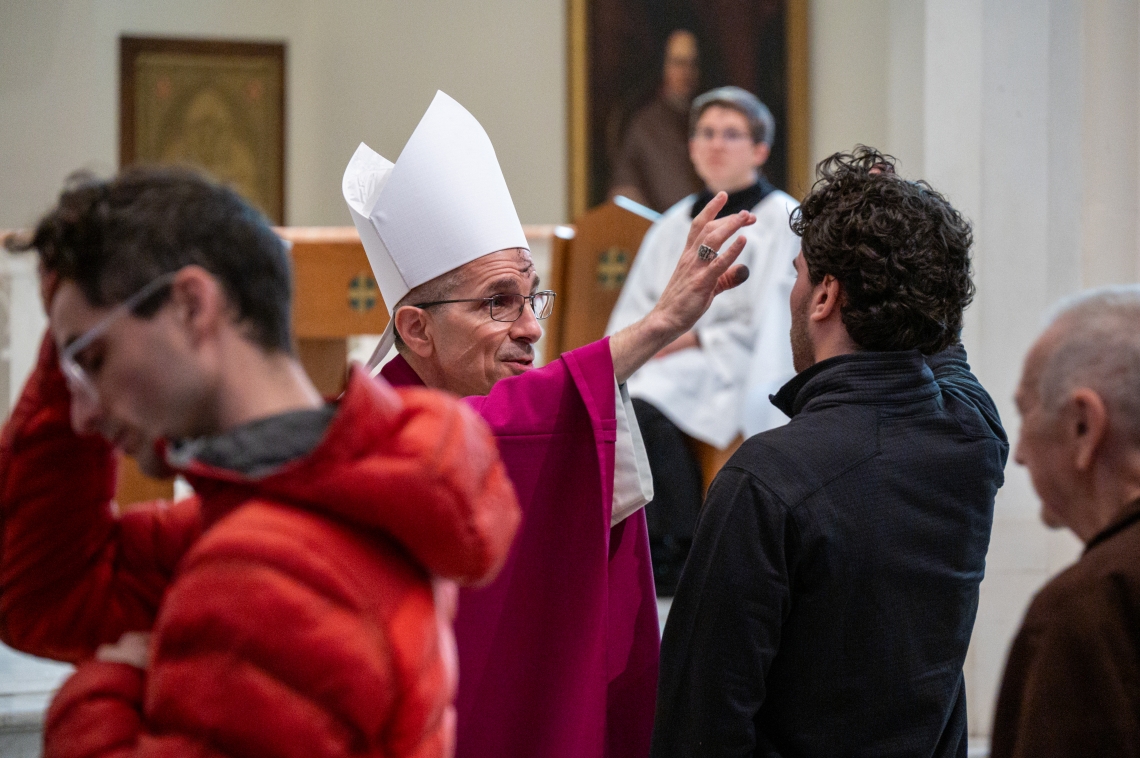
Transcript:
My dear brothers and sisters, every year on Ash Wednesday we hear the same readings, the same gospel passage, the same warning of Jesus: take care not to perform righteous deeds in order that people may see them. And yet, in a few moments, we will come forward and receive ashes on our foreheads, publicly, invisibly. We might ask ourselves, is this not contradiction? Jesus is speaking against hypocrisy today in the gospel. The Greek word that he uses for hypocrite is "actor," one who performs for applause. And He warns those to whom He is speaking against praying to be seen, fasting, to be noticed, and giving odds for recognition.
Now the Lord obviously is not condemning visible faith. He's not saying keep our faith hidden. But He is calling for a purified intention. And so the issue is not whether others see us. The issue is "why are we doing what we're doing?" Ashes are not part of a performance for us. They really are a confession.
In the scriptures, repentance was often communal. We think of the famous scene in Nineveh, the ancient city of Nineveh. Upon the preaching of Jonah, the whole city heard the message of repentance in conversion from the king to the animals. Daniel saw a board in sackcloth and ashes. Mordecai in the Book of Esther put on sackcloth and ashes in the midst of the city. Now, these were not private gestures. They were visible signs of people returning to the Lord. Hearts, obviously moved.
Well, today we do not place ashes on ourselves, which is another interesting reality of Ash Wednesday. We don't sign ourselves with ashes. We receive them. We receive the ashes, and that matters. Because we receive them as sinners, we receive them as members of the church, we receive them as part of a diocese that hopefully longs for renewal. Now St. Paul says clearly in the second reading, "we are ambassadors for Christ," as if God were appealing to us. He doesn't say to the Corinthians, "I'm an ambassador." He says, "we are ambassadors." The church is an ambassador.
And so what would it mean if the diocese of Portland entered Lent very consciously as one body, as one ambassador for Christ? not as recently individuals quietly trying to improve their lives, but really as a diocesan church turning together.
Imagine this with me for a moment. Imagine if every parish, if in every parish there was a commitment to deeper prayer. Imagine if families sought to reclaim some semblance of silence, time together, and perhaps even rediscover the scriptures in their homes. Imagine if confession lines grew longer, not because of fear of hell or because of shame, but rather out of a sincere desire for a change of heart. Imagine if forgiveness replaced resentment. And imagine if generosity overcame indifference.
Imagine if our civic leaders our schools, our workplaces, encountered Catholics who clearly, clearly had encountered Christ. Obviously, that would not be a superficial religion. That would be authentic conversion. So ashes remind us, "You are dust, and to dust you shall return." Ashes also call us to repent and believe in the gospel. These two truths together are very powerful. We are mortal, we are fragile, but we are called.
If we as a diocese truly repent, truly believe, truly turn to the Father, then something happens. Our parishes will become even more alive. Our charity will become more credible. Our witness becomes even more compelling. And our unity becomes visible. And when the whole diocesan church moves in one direction toward holiness, the culture around us feels it.
Ashes then are not hypocrisy. They are indeed solidarity. They are not a spiritual exhibition. They are a sign and a call for ecclesial conversion. And if this lent, the Diocese of Portland breathes as one great ambassador for Christ, then when Easter comes, it will not simply be a liturgical celebration. It will be a real experience of resurrection. Of resurrection, renewal, and new life.