


Divine Mercy Sunday Reflection by Father Steven Cartwright
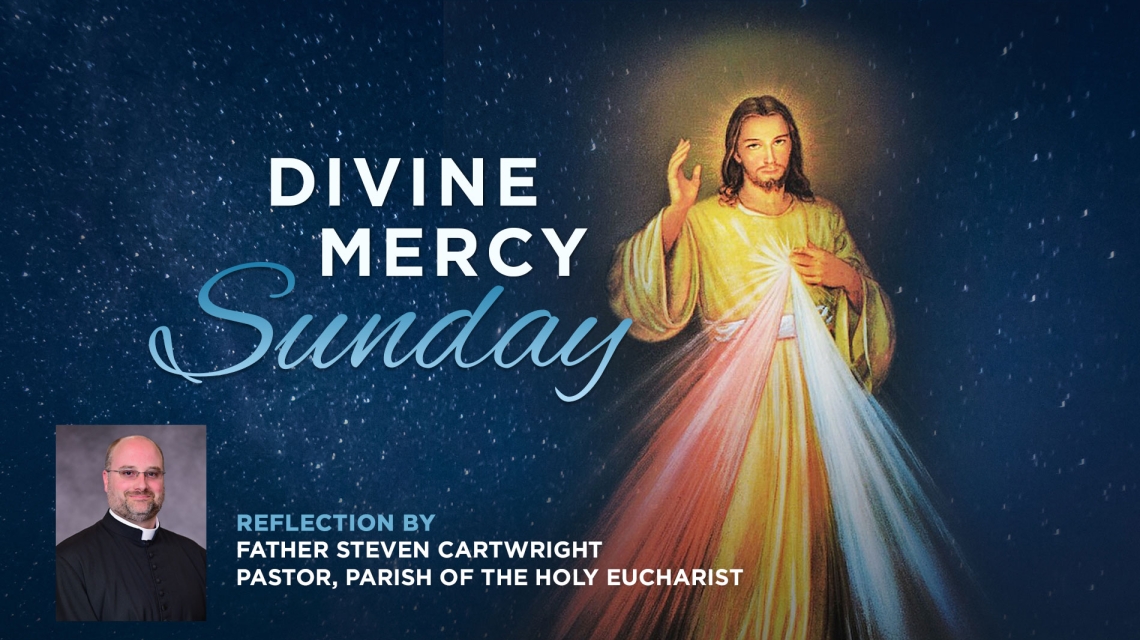
This weekend, the Church celebrates the great feast of Divine Mercy, a feast given to us through the revelations entrusted to St. Faustina Kowalska and formally established by St. John Paul II. It is not an optional devotion for a few but a profound reminder for all: the mercy of God is not simply one attribute among many, it is the very heart of the Gospel.
Today, we are invited to contemplate the Risen Christ, who returns to His disciples not with condemnation but with mercy. In the Gospel, Jesus appears to the apostles, those who had denied, betrayed, and abandoned Him, and His first words are words of peace: “Peace be with you.” He breathes the Holy Spirit upon them and entrusts them with the power to forgive sins. The first gift of the resurrection is mercy.
Yet mercy is not what seems to define our world today. Our society can be harsh, unforgiving, and quick to judge. A single mistake, spoken, posted, or remembered, can cling to a person for years. Public discourse is filled with outrage. Social media intensifies anger and division. People are labeled, dismissed, or “canceled” without any real chance for redemption. Even in our personal lives, old wounds linger, grudges and resentments take root, and forgiveness can feel beyond our strength. But this is not the way of Christ.
To bear the name “Christian” is to be marked by mercy. The Lord is clear: “Blessed are the merciful, for they shall obtain mercy” and “Forgive us our trespasses, as we forgive those who trespass against us.” These are not suggestions; they are the foundation of Christian life. Yet we know the truth: forgiveness is not natural. It is supernatural. Real mercy, especially toward those who have hurt us, is difficult. That is why this feast is so necessary. Before we can extend mercy, we must first receive it. Before we can forgive others, we must allow the Lord to heal and forgive us.
The Church, in her maternal care, attaches extraordinary graces to this day: through sincere confession, reception of Holy Communion, prayer for the intentions of the Holy Father, and complete trust in Jesus, the faithful may receive a plenary indulgence, the full remission of temporal punishment due to sin. God not only wants to forgive us; He desires to restore us. From this place of restoration, we are then sent out into the world as witnesses of mercy. Imagine our families shaped more by compassion than resentment. Imagine our parish and communities transformed by forgiveness instead of division. Imagine the freedom and peace that would enter our own hearts if we finally surrendered what we have been carrying for far too long. Divine Mercy is not weakness; it is the strength of God.
[The Parish of the Holy Eucharist will hold its] Divine Mercy Service this Sunday afternoon from 3–5 p.m. at Holy Martyrs. Bring to the Lord your sins, your wounds, and your burdens. Allow Him to speak His word of peace over your life. Strengthened by His grace, go and do likewise. For mercy is not only what we receive, but also what we are called to become.
- Father Steven Cartwright, pastor of the Parish of the Holy Eucharist in Falmouth