

The Word Made Flesh (Catechism Series Part 9) - Auspice Maria Ep. 39
Follow the Maine Catholic Podcast on:
Transcript:
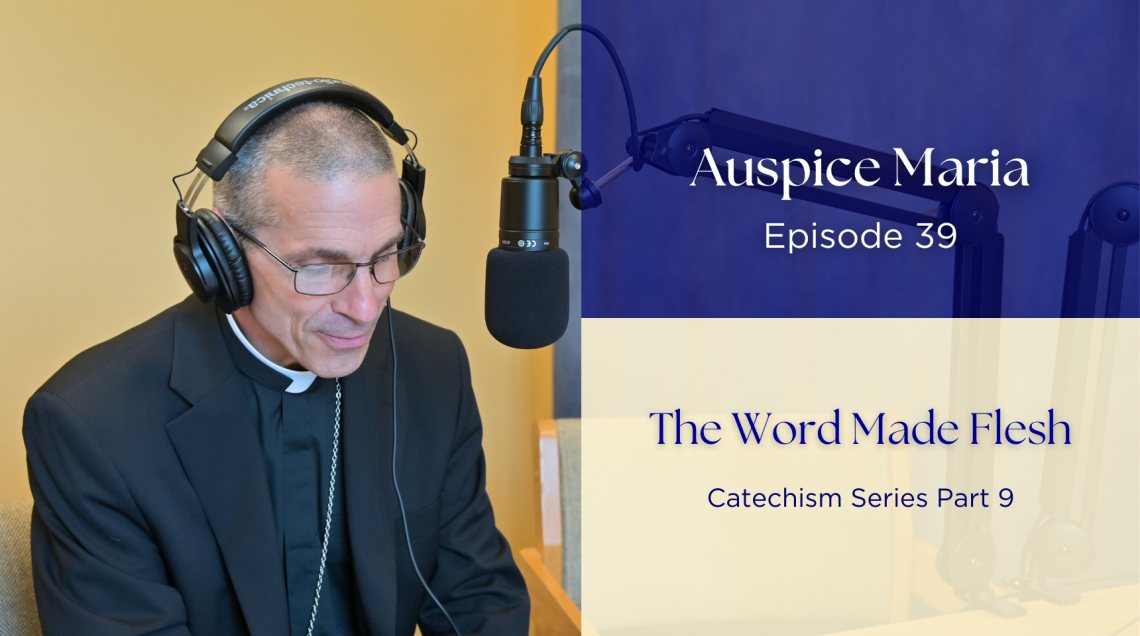
Welcome back to the Auspice Maria podcast. I'm Bishop James Ruggieri of the Diocese of Portland in Maine. Today we'll be talking about the Word made flesh, Jesus Christ. But in these last several episodes, we have been reflecting together on the opening articles of the Creed. We began with the mystery of God the Father Almighty, who is the creator of heaven and earth, of all things visible and invisible, as we proclaim every time we profess the Creed. We reflected on the beauty of creation and the dignity of the human person made in the image and likeness of God. We also spoke about the tragedy of sin and the way humanity, though created good, turned away from its creator. At the same time, we reflected on the mystery of the Trinity. God is communion, Father, Son, and Holy Spirit. And that mystery matters deeply for what we will consider today because the next movement of the Creed cannot be understood apart from the Trinity. The Son who becomes man is the eternal Son who shares fully in the life of the Father and the Holy Spirit.
Every year when Christmas approaches, many families set up a Nativity scene in their homes. And perhaps you do the same. Maybe you've inherited a set or you bought a set and that set, Nativity set comes out every year. Some people actually leave up their Nativity scenes all year. Well, the stable is arranged somewhere in the house, usually its own special place. Mary and Joseph, of course, are there. The shepherds, the angels surround the manger. And at the center of the manger scene lies the small figure of the infant Jesus.
It is really a beautiful tradition, yet because we see it so often, it is very easy to forget how astonishing it truly is. That small child in the manger is not simply a remarkable baby or a future teacher who will grow up to say wise things or be this notable historical figure. That child is the eternal Son of God, the one through whom the universe was created. That child is in a feeding trough. It's incredible to think of that reality. The one who sustains the stars allowed himself to be carried in the arms of his mother. The Church never loses her sense of wonder before this mystery. In fact, she marks it even within the liturgy.
Have you ever noticed what happens during the Creed at Christmas Mass? Every Sunday, we stand together and profess the Creed. Yet on Christmas, and interestingly, on the solemnity of the Annunciation, which is March 25th, something different happens. When the Creed reaches the words, “and by the Holy Spirit was incarnate of the Virgin Mary and became man,” the celebrant, the priest-celebrant, genuflects. The priest bends the knee.
You might say, why? Because at that moment, we proclaim one of the most astonishing truths ever revealed. God became man. The eternal Son of God entered human history. The Creator stepped into his creation. The invisible God became visible. The Catechism of the Catholic Church calls this mystery the Incarnation. It teaches that “the Church calls ‘incarnation’ the fact that the Son of God assumed a human nature in order to accomplish our salvation in it.” That's right from paragraph 461.
God did not remain distant from the world that He created. He did not simply send prophets to speak on His behalf. In Jesus Christ, God Himself entered our history. The Word became flesh. The Catechism explains, across paragraphs 457 to 460, several reasons why the Son of God became man.
First, He came to save us by reconciling us with God the Father. Sin had separated humanity from its creator, and only God Himself could restore that communion.
Second, the Son became man so that we might know the depth of God's love. In Jesus Christ, we see not an abstract idea of God, but the living face of divine love.
Third, He came to be our model of holiness, showing us what a truly human life lived in perfect communion with the Father looks like.
And then finally, the Son became man so that we might share in the divine life itself. Now the Catechism quotes a very memorable and powerful line from Saint Athanasius when it explains this mystery, and it's right out of paragraph 460. And the quote is, “For the Son of God became man so that we might become God.” This does not mean, of course, that we become divine by nature. Rather, through grace, we are drawn into the life of the Trinity. Through Jesus Christ, we are invited into communion with God Himself.
To understand the Incarnation correctly, however, the Church has had to answer a crucial question. Who exactly is Jesus Christ? Throughout the early centuries of Christianity, believers struggled to explain this mystery. Some thought that Jesus was divine, but not truly human, as if his humanity were only an appearance.
Others believe that he was merely a remarkable human teacher inspired by God but not truly divine. Now the Church rejected both of these views. The Catechism teaches clearly that Jesus Christ is true God and true man. And it's right out of paragraph 464.
He is one divine person with two natures, a divine nature and a human nature. This means that the humanity of Jesus is real. He truly experienced hunger, fatigue, friendship, suffering, and death. At the same time, his divinity remains fully intact. The eternal Son of God truly shares our human life while remaining fully God.
This mystery is also expressed in a word we recite every Sunday in the Creed: consubstantial. When we say that the Son is consubstantial with the Father, we mean that he shares the very same divine nature as the Father. The Son, of course, is not a creature. He is not a lesser being. He is true God from true God.
Now St. Paul reflects on this mystery in his letter to the Philippians when he speaks about Christ humbling himself and taking on human likeness. Though truly divine, the Son entered our condition in humility and love, even accepting death on a cross for our salvation.
But the Incarnation did not take place in isolation. God chose to enter the world through a particular human story, through a particular woman.
And now this brings me to speak about the Blessed Virgin Mary. The Gospel of St. Luke tells us that the angel Gabriel was sent to a young woman in Nazareth with a message that would forever change the history of the world.
Mary of Nazareth was invited to become the mother of the Savior. The angel Gabriel announced that the Holy Spirit would come upon her, that the child to be born would be called the Son of God. Mary's response is one of the most important moments in salvation history. She says, “Behold, I am the handmaid of the Lord, may it be done to me according to your word.”
With those words, Mary freely cooperates with God's plan. The Catechism explains that “the Son of God took flesh in the womb of the Virgin Mary by the power of the Holy Spirit.” We find that in paragraphs 484 to 486.
Mary's "yes" allows the Incarnation to take place within human history. Her obedience stands in contrast to the disobedience that marked the fall of humanity. And through Mary's faith, the Son of God enters the human family. The Incarnation also reveals something profound about our humanity.
When the Son of God became man, taking flesh from the Virgin Mary, He affirmed the goodness of human nature. Our humanity is not something to escape or reject. It is something God Himself has embraced, and this includes the human body. At different moments in history, even today, some groups have claimed that the material world is evil or that the body is something to be rejected.
In the Middle Ages, for example, the Albigensians believed that the physical world was fundamentally corrupt. And in that, the body was a prison from which the soul must escape. Astounding, but real. But Christianity teaches the opposite. The Word became flesh. Matter is not evil. The body is not evil. God created the physical world and declared it good.
And in the Incarnation, God Himself took on a human body. Saint Dominic Guzman saw the danger of the Albigensian era spreading in his time. In response, he founded the Order of Preachers, the Dominican Order, to proclaim the truth of the gospel and to defend the goodness of creation and the reality of the Incarnation. The Incarnation also helps us understand why the sacraments are physical.
Water in Baptism, bread and wine in the Eucharist, oil in the anointing of the sick. God uses material things to communicate grace. Matter becomes the instrument of sanctifying grace because the Son of God Himself entered the material world.
The Incarnation therefore changes the way we see everything. If God became man, then human life is not insignificant. Human life is not accidental. Every human person possesses immense dignity because the Son of God has united himself with our humanity. From the moment of conception to natural death, human life is sacred.
The Incarnation reminds us that God has entered the human family and has lifted up our humanity to an extraordinary dignity. The Incarnation also tells us that God is not distant from our struggles.
In Jesus Christ, God entered fully into the human condition. He knows what it means to suffer. He knows what it means to be rejected. He knows what it means to experience human weakness and pain. When we bring our struggles to God in prayer, we are not speaking to someone far removed from human life, someone disinterested, someone who has no idea or experience of what we are experiencing. We are speaking to the one who has lived it.
But the Incarnation is not only about God entering our humanity; it is also about God transforming our humanity. Through the life, death, and resurrection of Jesus Christ, humanity is healed and lifted up. And that's good news. This is why the Church bends the knee when she proclaims those words in the Creed, “and by the Holy Spirit was incarnate of the Virgin Mary and became man.”
Those words announce the mystery at the very center of our Catholic Christian faith. God has come among us. The Creator has entered creation. The Eternal has entered time. The Invisible has become visible. And because He has come among us, our humanity is not abandoned. Our humanity is redeemed. We are loved unconditionally by our Heavenly Father.
And that is truly good news. Thank you again for joining me in this Auspice de Maria podcast, and I want to end as always with a prayer to our Blessed Mother Mary, thanking Mary for her yes, for being that instrument by which Jesus Christ came into our human existence and through that saved us.
Hail Mary, full of grace, the Lord is with thee. Blessed art thou amongst women, and blessed is the fruit of thy womb, Jesus. Holy Mary, Mother of God, pray for us sinners now and at the hour of our death. Amen.