

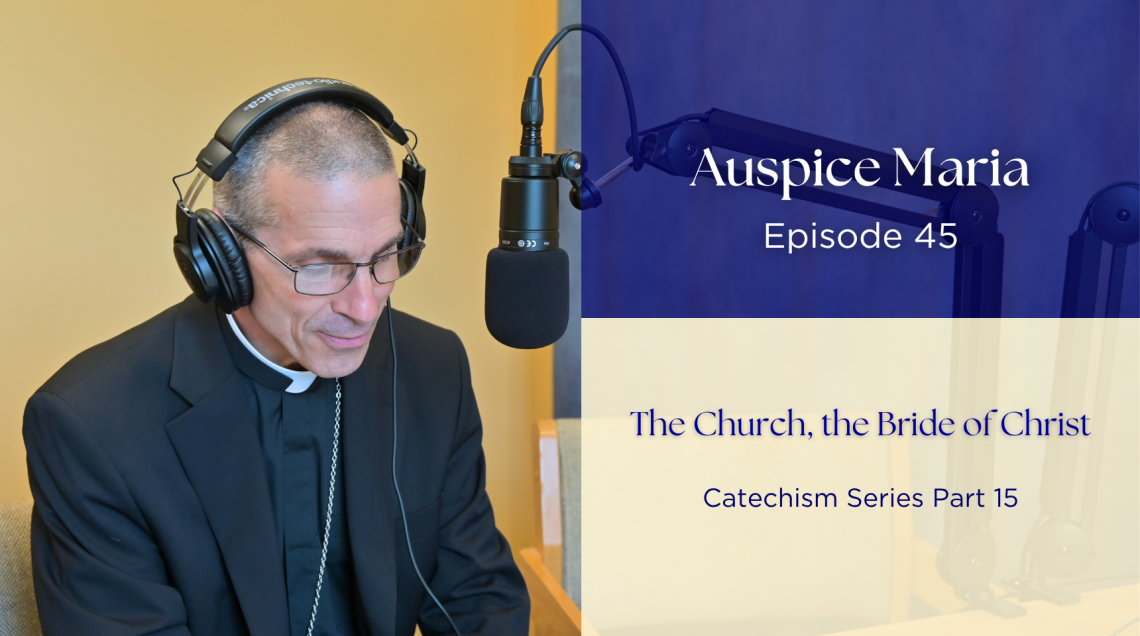
The Church, the Bride of Christ (Catechism Series Part 15) - Auspice Maria Ep. 45
Follow the Maine Catholic Podcast on:
Transcript:
Well, welcome back to the Auspice Maria podcast. I'm Bishop James Ruggieri of the Diocese of Portland in Maine. And we continue with our series on the catechism, this time coming to the article, I believe in the Holy Catholic Church. Before doing so, I'd like to just simply invoke the Holy Spirit, the spouse of Mary, really soul of the Church, as we'll get into a little later on in this podcast, to inspire us, inspire our listeners. So Holy Spirit, open our hearts, inspire us, inspire those who are listening to this podcast. May it be of some benefit for them in their daily life and in their life in the Church. And we ask all this through Christ our Lord. Amen.
So in the Creed when we profess, "I believe in the Holy Catholic Church," we are not first making a statement about an institution in the merely human sense. We are really professing faith in a mystery, a communion, a people gathered by God, united to Jesus Christ and animated by the Holy Spirit. And for each of us, this mystery becomes personal. Above all, through baptism. The Catechism teaches that one becomes a member of the people of God by faith in Christ and baptism, and that this people has Jesus Christ as its head. It also teaches that baptism unites us to Christ's death and resurrection. I'd refer you here to paragraphs 782 to 790 of the Catechism. That's why baptism matters so deeply. It is really foundational. To be baptized is to be claimed by Christ, marked as belonging to him and brought into a people not left alone as an isolated believer, but rather as part of a whole, a body.
As the Catechism says, "God willed to make men holy and save them, not as individuals, without any bond or link between them, but rather to make them into a people." And that's paragraph 781, citing Lumen Gentium, the great document on the Church of Vatican II. So when we begin speaking about the Church, it is fitting to begin there with baptism, with incorporation into Christ and his people with communion.
One of the striking things about the Catechism's paragraphs 748-810, which are the primary focus of this podcast, is how deeply they are shaped by the Second Vatican Council, especially by the dogmatic constitution on the Church, Lumen Gentium, that St. Paul VI promulgated on November 21, 1964. Its opening line is the line the Catechism itself uses to begin this section. And I quote, "Christ is the light of nations."
The Catechism then draws the conclusion, "the Church has no other light than Christ's." Again, taken from Lumen Gentium and paragraph 748. But those words of Lumen Gentium that the Catechism leads off with in this section, "Christ is the light of nations." really have so much meaning. And this is really a beautiful place to begin. The Church does not begin with herself. She begins with Christ. She receives from him, she reflects him, and she bears witness to him. And if we lose that perspective, we really lose the deepest truth about the Church.
Catechism says that the Church is in God's plan from the beginning. In response to sin, God does not abandon humanity. He begins to gather a people to himself. The Church is in God's plan, prefigured from the world's beginning, prepared in the Old Covenant and instituted by Jesus Christ. I refer you to paragraphs 759 to 763.
That history unfolds through Abraham, through Israel, through the covenants, through the law, prophecy, through the exile, and also the promise of restoration. The father prepared the Church in the Old Covenant by choosing Israel as his people and by announcing a new and perfect covenant. And so when we come to Jesus, we do not find a rupture in God's plan, but rather we find its fulfillment. Jesus gathers disciples around himself and gives them a share in his mission. He gathers intentionally twelve. And that number is purposeful. It evokes the twelve tribes of Israel and signals the renewed people of God gathered around Christ himself. The Catechism says that Christ instituted the Church by preaching the good news, inaugurating the kingdom, calling the twelve, and choosing, importantly, Peter as their head. I refer you to paragraphs 763 to 765.
The Church then is the people of God brought into fulfillment in Christ. She is prepared in the old covenant instituted by Jesus, manifested by the Spirit, and journeying toward her completion in glory. So the Church as the body of Christ, this is a very beautiful and a central image of these paragraphs of the Catechism, the image, again, of the Church as the body of Christ. It's not merely a metaphor, it expresses a real and living communion.
And the Catechism says, and I quote, "the Church is the body of Christ through the Spirit and His action in the sacraments above all the Eucharist. Christ, who once was dead and is now risen, establishes the community of believers as his own body." That's from paragraph 805.
Before saying that directly, the Catechism first says that the Church is communion with Jesus. It says that from the beginning Jesus associated his disciples with his own life and by communicating his spirit he mystically constituted as his body those brothers of his who are called together from every nation. Again, mystically constituted as his body all of humanity. The call is to all the nations. That is very important. The Church is not just a human association gathered around a great teacher. She is a people united in Christ by Christ through the Holy Spirit. The catechism then says that "the Church is united in him in his body." That's from paragraph 789.
So what does that mean? It means our communion with one another flows from our communion with Jesus Christ. The Church's unity is not first sociological. It's not a human phenomenon. It is Christological. It is sacramental. Christ is the source of unity. Within that unity, of course, there's real diversity. The Catechism says, "the body's unity does not do away with the diversity of its members from paragraph 791. So then in the summary, it says again, in the unity of the body, there is a diversity of members and functions. That summary statement is really an important Catholic principle. Unity in the Church is not uniformity. The one body includes many members, different vocations, many gifts, many responsibilities, and many forms of service.
So diversity is not opposed to communion when Christ is the head of the body. So the catechism reminding us of the words of St. Paul also draws out the pastoral consequence of this image, Church as the Body of Christ. And it is this, and I quote, "if one member suffers anything, all the members suffer with him," from paragraph 791.
So the image of the body is not abstract, it means the weak matter, the poor matter, the elderly matter, the suffering matter, the lonely matter, families matter, children matter, the Church cannot be indifferent to her own members because the body of Christ must care for its members. And then the Catechism quoting St. Paul's words to the Colossians says very simply, Christ is the head of the body, the Church.
In the summary at the end of this section, it adds, quote, "the Church is this body of which Christ is the head. She lives from Him, in Him, and for Him. He lives with her and in her." That's right from paragraph 807. It's a very helpful summary of the Church's identity. She lives from Christ, in Christ, and for Christ.
Another image, a very beautiful biblical image for the Church is the Church as the Bride of Christ. The Catechism itself explains explicitly that among the aspects that must be noted when speaking of the Church is this. And it develops this point directly and says, "the Church is the spotless bride of the spotless lamb." There's a reference there to paragraph 796.
The Church is the bride of Christ. "He loved her and handed himself over for her." That's a reference to paragraph 808.
Again, this image of the Church is the bride of Christ. Christ is the bridegroom. The Church is the bride. Gives some tenderness to our understanding of the Church. Christ does not merely govern the Church externally. He loves the Church. He gives himself for the Church. He sanctifies the Church. And drawing on St. Paul, the catechism says, "Christ loved the Church and gave himself up for her that he might sanctify her." That's from paragraph 796.
So this naturally leads us to Paul's letter to the Ephesians, chapter five, verses 21 to 33. The passage begins, "be subordinate to one another out of reverence for Christ." Then St. Paul goes on to say, "husbands, love your wives even as Christ loved the Church and handed himself over for her to sanctify her." Again, referring to Ephesians chapter five, verse 21, and also some emphasis on verses 25 and 26.
And this is where, though, some important clarity is needed. That passage is sometimes misunderstood. The governing principle of Ephesians 5 is not domination. It is self-gift. It is sacrificial love. Christ's headship over the Church is expressed through total self-donation. He gives himself for her holiness. That is the heart of the bridal image.
So the Church is the bride because she is loved by Christ, sanctified by Christ, and made fruitful by her union with Christ. She is not only structured, she is beloved. She is not only organized, she is cherished. She is not only governed, she is bound to Christ in covenant love.
Of course, every image has its limits. The Church is not literally a bride in a purely human social sense, but the image is deeply revealing and really is worthy of reflection. It tells us that the Church's deepest identity is relational. She lives from the love of Christ.
The third great image of the Church in this section is the Church as the temple of the Holy Spirit. In presenting us this image, the Catechism recalls an intriguing statement by St. Augustine, quote, "what the soul is to the human body, the Holy Spirit is to the body of Christ, which is the Church." That quote is found in paragraph 797 of the Catechism.
We're thinking about this, this is really a very extraordinary statement. It means that the Church is alive, not merely because she has plans, she has a structure, or she has activity or a history. She lives, exists, because the Holy Spirit dwells within her and animates her from within.
And the Catechism continues. The Holy Spirit is, quote, "the principle of every vital and truly saving action in each part of the body." He works in many ways to build up the whole body in charity, by God's word, by baptism, by the sacraments, by apostolic grace, by the virtues, and by charisms. That's from paragraph 798. It's a very strong passage in this section on the Spirit as the soul of the Church because it opens us naturally into the subject or to the subject of charisms.
The Catechism says, "whether extraordinary or simple and humble, charisms are graces of the Holy Spirit ordered to the Church's building up to the good of men and to the needs of the world." Again, a reference to paragraph 799. So whether extraordinary or simple or humble, charisms are graces of the Holy Spirit. Their origin is the Holy Spirit. And it adds that charisms are to be received with gratitude, but also that discernment is necessary and that "no charism is exempt from being referred and submitted to the Church's shepherds." A reference to the bishops and those who have authority. And again, reference paragraph 800 of the Catechism.
So this is a beautiful Catholic balance. The Spirit truly gives gifts, the Spirit truly renews, the Spirit truly raises up charisms, but at the same time, the Spirit also creates communion, order, discernment, and fidelity. So there's a balance to all of this. Inspiration, order, and also fidelity to Christ and the plan of the Church as a means of sanctification for the world.
The Church at the end of the section puts it beautifully, quote, "the Church is the temple of the Holy Spirit, the spirit is the soul, as it were, of the mystical body, the source of its life, of its unity, in diversity, and of the riches of its gifts and charisms." I refer you to paragraph 809.
That line I just shared with you is almost enough to support an entire meditation on the Church, the soul of the mystical body, source of its life, unity, diversity, and the riches of its gifts and charisms. There's so much there. And all of this really helps us to understand a very important statement in this section of the Catechism.
The Church is, quote, "in Christ like a sacrament or as a sign and instrument both of a very closely knit union with God and of the unity of the whole human race." I would refer you to paragraph 775, which beautifully cites Lumen Gentium, section one.
It's a really beautiful ecclesiological statement of the modern Church. The Church exists not for herself, she exists as a sign and an instrument of communion with God and of unity among human beings. The Church does not replace Christ. Christ alone is the Savior, but Christ wills to work through his Church. The Church is his body, his bride, his temple, and in him, she is the sacramental sign and instrument of salvation. This is why the Church matters so deeply in the plan of God. She is not an optional addition to the Gospel. She continues the saving work of Jesus Christ.
And so we return again briefly to baptism as we conclude this podcast. Through baptism, one is brought into the people of God, united to Christ, and inserted into the communion of the Church. Catechism gives all three dimensions. One becomes a member of the people of God by faith in Christ and baptism. Through baptism, one is united to Christ's death and resurrection. And through the Spirit and the sacraments, Christ establishes believers as his body.
This means that the baptized are called into a real ecclesial life. They are members of Christ's body loved by the bridegroom and enlivened, inspired by the Holy Spirit. They belong to a people whose head is Christ, whose law is the new commandment of love, and whose mission is to be the salt of the earth and the light of the world.
So when we say, "I believe in the holy Catholic Church," we are saying something rich and beautiful, mystical. We are saying that God has not left humanity scattered. In response to sin, he began gathering a people to himself. He prepared that people in the old covenant. He fulfilled that gathering in Jesus Christ. He united believers to himself as his body. He loved the Church as his bride. He filled her with the Holy Spirit, making her his temple. And through baptism, this mystery becomes our own. We are brought into communion with Christ and into communion with one another. We are made participants in a greater reality than ourselves.
The Church is holy because she belongs to God, because Christ is her head, because the Holy Spirit is her life, and because she has been gathered into the Father's plan. And then the Catechism closes this subsection with a really beautiful Trinitarian vision. And I quote, "Hence, the universal Church is seen to be a people brought into unity from the unity of the Father, the Son, and the Holy Spirit." That's from paragraph 810, quoting also Lumen Gentium, section 4.
So the Church is not merely assembled by human effort. She is gathered into the very life of the triune God. And through baptism, that mystery becomes ours.
We are so blessed, my brothers and sisters. Thank you for listening to the Auspice Maria podcast. I'd like to conclude again asking Our Lady Mary, Mother of the Church, to pray for all of us. Hail Mary, full of grace, the Lord is with thee. Blessed art thou amongst women and blessed is the fruit of thy womb, Jesus. Holy Mary, Mother of God, pray for us sinners now and at the hour of our death. Amen.