

The Traditions and Faith of Sacramentals and Funerals (Catechism Series Part 29) - Auspice Maria Ep 59
Follow the Maine Catholic Podcast on:
Transcript:
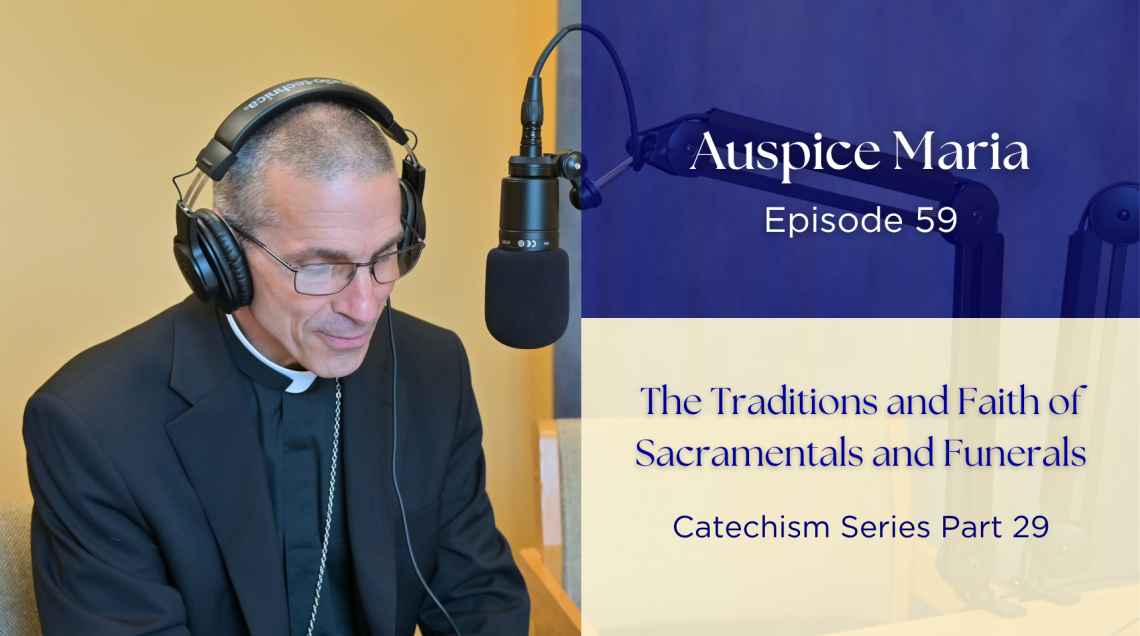
Welcome back to the Auspice Maria podcast. I'm Bishop James Ruggieri of the Diocese of Portland in Maine. And this week our podcast will be on the sacramentals and Christian funerals: holiness in life and hope in death. And I'm referring specifically to paragraphs 1667 to 1690. And it's actually - it's sort of a very important movement in these podcasts because we conclude part two of the Catechism of the Catholic Church. We're actually halfway through the Catechism. There are two more parts; which my hope is that we will continue through this series of podcasts to really beautifully walk through the Catechism and glean and learn from its wisdom. But before anything, again, I'd like to just start with a prayer asking the Holy Spirit's guidance and wisdom.
Holy Spirit, comforter of our souls, giver of grace, life within us, we pray for your wisdom, we pray for the gift of right judgment, and we pray, Lord, that as we listen together to this podcast, that again, you may touch and open our hearts. Bless all those, Lord, who hear this podcast and continue to build up your church in love.
So again, in this episode, we conclude part two of the Catechism, the celebration of the Christian mystery. And over the course of this part, we have reflected on the liturgy. We've reflected on the seven sacraments and the ways Christ continues to sanctify his church. We began with the sacraments of initiation: baptism, confirmation, and the Eucharist. We continued with the sacraments of healing: penance and the anointing of the sick. We then reflected on the sacraments at the service of communion: holy orders and holy matrimony.
Now, at the end of part two, the Catechism interestingly turns to chapter four in the title, "Other Liturgical Celebrations." The paragraphs that we're going to delve into offer two main topics: sacramentals and Christian funerals.
First, let's talk about sacramentals. The Catechism teaches that the Church has instituted sacramentals. They are, quote, "sacred signs which bear a resemblance to the sacraments," from paragraph 1667. So they are not sacraments — an important distinction. Sacramentals are not sacraments. The seven sacraments were instituted by Christ, and they confer grace by the power of Christ acting in them. Sacramentals are instituted by the Church. They do not confer grace in the same way as the sacraments, but by the prayer of the Church, they prepare us to receive grace and dispose us to cooperate with it — a very important distinction, again found in paragraph 1670.
This distinction is important. A blessed rosary, holy water, a medal, a blessing, or a pilgrimage is not magic — important things in our Catholic Christian life. So sacramentals do not work apart from faith, prayer, conversion, and the life of the Church. They are signs that help us live the gospel in the ordinary circumstances of life. They remind us that daily life is under God's blessing. And the Catechism says sacramentals are instituted for the sanctification of ministries in the Church, certain states of life, many circumstances of Christian living, and the use of things helpful to us. Paragraph 1668.
They usually include a prayer and often a visible sign, such as the laying on of hands, the sign of the cross, or the sprinkling of holy water, which recalls baptism. Examples are close to everyday Catholic life. Again, these are some examples of sacramentals: the blessing of persons, meals, homes, religious articles, churches, altars, bells, sacred vessels, and vestments. There are also blessings connected with persons consecrated to God, religious profession, and certain ministries of the Church. I refer to paragraphs 1671 to 1672. Sacramentals also include forms of popular piety, such as the rosary, the stations of the cross, pilgrimages, processions, the veneration of relics, visits to shrines, and the wearing of medals. Paragraph 1674.
So these practices matter because human beings are not pure spirits. As we talked early on about our anthropology, understanding the human person — we are embodied. We remember through signs. We pray with gestures. We touch holy water. We make the sign of the cross. We hold a rosary. We light candles. We bless food. We bring our children to be blessed. So the Church, as mother — as a mother — knows that grace touches the whole person. So, beautifully, sacramentals help us in our embodied living out of our Catholic Christian faith.
So at the same time, sacramentals must always lead us toward Christ and the sacraments. And the Catechism says popular devotions, and I quote, from paragraph 1675, "extend the liturgical life of the Church, but do not replace it." And that's important because the rosary should deepen our love for the mysteries of Christ. Holy water should remind us of baptism. A pilgrimage should renew our desire for ongoing conversion. A religious medal should remind us to live under the protection of God, also under the perhaps intercession, or invoking the intercession, of a particular saint. Again, these things are not to replace the need for prayer, for repentance, the need that we have as Catholics to go to Mass, to go to confession, and to practice charity. So again, they connect us, they remind us, they help us in our living out of our Catholic Christian faith as embodied persons.
The Church also speaks of exorcism in this section. I know that's a word that perhaps you hear quite often. I know there are some podcasts, or there's some — there's some websites about this. I would just say proceed with caution if you have an interest in this area, or if you're listening to exorcists who are perhaps having — have podcasts or have YouTube channelsin a simple form.
Exorcism is a part of baptism. It's interesting, but every baptism includes an exorcism. We're not saying the baby is possessed — it's important to keep that in mind. Now, a solemn exorcism, or also major exorcism as it's called, it may be performed only by a priest with the permission of the bishop. That's an important distinction. That's paragraph 1673. So the Catechism is very careful here as it talks about exorcism and the rite of exorcism. Psychological illness is not the same as demonic possession, and the Church always proceeds with prudence. And this is very practical wisdom. I think as we talk about, again, exorcism, sort of under this section of sacramentals, there's a lot more that can be said about this. I just simply want to offer simple advice that the Church proceeds with prudence and wisdom.
Second, I'd like to talk now about Christian funerals, sort of as we wind up this part two of the Catechism. The Catechism turns from the sanctification of daily life through sacramentals to the Church's prayer at the hour of death. And this, I think, is a very fitting way to conclude part two. So the sacraments and sacramentals along the way accompany the Christian from new birth and baptism to the final journey towards the Father's house. I really like the trajectory that the Catechism places us on.
Baptism is the beginning. Our death really is not the end, of course, but is the end of our earthly life in this journey toward our Father's house. In paragraph 1680, it says that all the sacraments, especially the sacraments of initiation, have their goal the final Passover of the child of God, which through death leads him into the life of the kingdom.
So let's talk now about a Christian funeral. It is not a sacrament. The Catechism says that the Christian funeral confers neither a sacrament nor a sacramental on the deceased. It's important, since he has passed beyond the sacramental economy. Sacraments, sacramentals, blessings — these things are for the living, not for the deceased. Still, though, as we talk about Christian funerals, still the Christian funeral is a liturgical celebration of the Church — very important — from paragraph 1684. The funeral expresses communion with the deceased, invites the community to pray, and proclaims eternal life to those who gather. This is why the Christian funeral rites matter. They are not simply a celebration of memories. They are not only a gathering for closure. They are the prayer of the Church for one of her children. At the funeral, we commend the deceased to the mercy of God. We comfort the grieving with Christian hope. We proclaim Christ crucified and risen. We remember that death is real, grief is real, but death does not have the final word.
The Order of Christian Funerals includes several moments: prayer with the family, the funeral liturgy, and the rite of committal at the cemetery or place of burial. And the Catechism highlights four principal elements: the greeting of the community, the liturgy of the word, the Eucharistic sacrifice when the funeral is celebrated in church, and the final commendation. Those things are found in paragraphs 1686 to 1690.
I'd like to talk about the homily now in the rite of Christian funeral. The Catechism, citing the order of Christian funeral, says that the funeral homily must, "avoid the literary genre of funeral eulogy." It's not the entire quote, but it's an important element. The homilist is to avoid creating a genre of a funeral eulogy. Instead, the Catechism says, the purpose of the homily is to "illumine the mystery of Christian death in the light of the risen Christ," paragraph 1688.
So this does not mean we ignore the life of the deceased. It means we see that life in the light of Christ. The funeral is not only about what the person did; it is about what Christ has done and what Christ promises to those who belong to him, specifically his death and resurrection.
When the funeral includes Mass, "the Eucharist is the heart of the paschal reality of Christian death," paragraph 1689. In the Mass, the Church offers the sacrifice of Christ and prays that the deceased may be purified from sin and admitted to the fullness of the kingdom. So this is why a funeral Mass is such a gift. The funeral Mass is not only remembrance, it is intercession, it is communion, it is hope. The funeral Mass, my dear brothers and sisters, and I repeat this, is such a gift.
Finally, the Church commends the deceased to God. The Catechism calls this "the last farewell," the final commendation before the body is brought to its tomb, in paragraph 1690. This farewell is very tender, but it is not hopeless. Often very sad, however, we entrust the person to God because we believe in the resurrection of the body and the life of the world to come.
So this brings us to Christian burial and the all-important question of cremation. Now, the Catechism does not address cremation in this section, but the Church has given clear teaching. The Church prefers the burial of the body because it expresses faith in the resurrection and reverence for the body. The body of the deceased was once washed in baptism, anointed with sacred oil, fed with the Eucharist, and made a temple of the Holy Spirit. The body is not a shell to be discarded. It is part of the person's history, dignity, and Christian identity.
Cremation is permitted, provided it is not chosen for reasons contrary to the Christian faith. And reasons contrary to Christian doctrine would include, for example, choosing cremation as a denial of the resurrection of the body, choosing cremation as rejection of the dignity of the human body, also choosing cremation as an expression of belief in reincarnation or absorption into the universe, or as a deliberate rejection of Christian funeral rites and Christian hope.
Cremation is permitted when it is chosen for legitimate reasons, and when the cremated remains are treated with reverence and buried or entombed in a sacred place. The Church teaches that cremation does not prevent God from raising the body to new life. At the same time, the cremated remains must be treated with the same reverence we give to the body. They should be buried or entombed in a sacred place, such as a cemetery, a mausoleum, or a columbarium.
Now, importantly, the Church does not permit scattering ashes in the air, on the land, or at sea, nor should ashes be divided among family members, kept permanently at home, or placed in jewelry or keepsakes, because these practices can obscure the dignity of the person, weaken the Church's prayerful remembrance of the dead, and suggest ideas contrary to Christian faith.
Now, this teaching is not meant to burden grieving families. It really is meant to protect reverence, faith, and hope. When a family buries the body or the cremated remains of a loved one, they perform a work of mercy. They give the deceased a place of prayer. They give the family and the Church a place of remembrance. They say, in a very visible way, that this person is not forgotten, that the body matters, and that we await the resurrection.
So, my dear brothers and sisters, as we conclude part two of the Catechism of the Catholic Church, we see the tenderness of the Church. She blesses homes, meals, objects, journeys, ministries, and persons. She teaches us to pray with signs. She accompanies us in life. She prays with us and assists us in deliverance. And when death comes, she does not abandon her children. She gathers, prays, offers the Eucharist, commends the deceased to God, and lays the body or the cremains to rest in hope.
Sacramentals teach us that ordinary life can be touched by grace, and Christian funerals teach us that death itself is held within the mystery of Christ. In life and in death, the Church points us to Jesus, who sanctifies His people, comforts the grieving, and promises the resurrection of the body and the life of the world to come.
It is so good to be Catholic. We are very blessed, my dear brothers and sisters.
So, I'd like to just conclude this podcast by offering a Hail Mary to Our Lady, again asking Mary, Mother of the Church, to pray for us and to continue to accompany us through this journey of life on the way to heaven.
Hail Mary, full of grace, the Lord is with thee. Blessed art thou amongst women, and blessed is the fruit of thy womb, Jesus. Holy Mary, Mother of God, pray for us sinners now and at the hour of our death. Amen.
Thank you for listening. God bless you.