

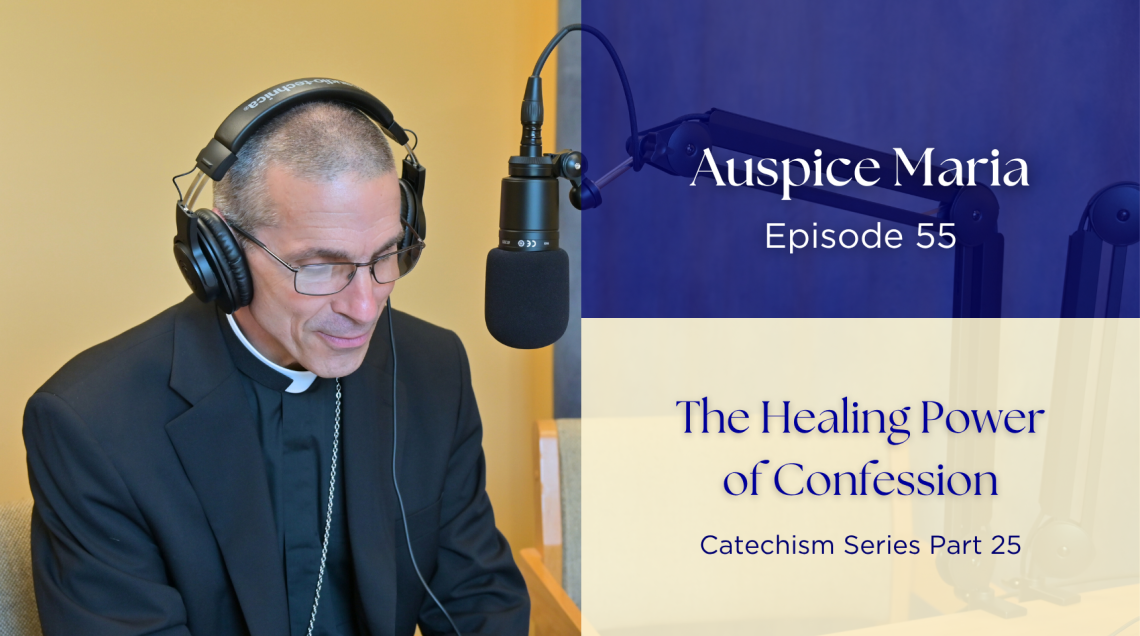
The Healing Power of Confession (Catechism Series Part 25) Auspice Maria Ep 55
Follow the Maine Catholic Podcast on:
Transcript:
Welcome back to the Auspice Maria podcast. I'm Bishop James Ruggieri of the Diocese of Portland in Maine, and we've been talking in our last several episodes on the sacraments of initiation: baptism, confirmation, and the Holy Eucharist. I'd like to today move now into one of the sacraments of healing, the sacrament of reconciliation or confession, or sometimes known as penance. Before that, though, I just simply want to invoke the Holy Spirit. Holy Spirit, come upon us. Encourage us. Be with us. Make our hearts more contrite, truly contrite for our sins, so that like the prodigal son, may we have a great desire to return home always to you when we have strayed. And when in your house, Lord, help us to just love you more. We ask all this through Christ our Lord. Amen.
So we have been talking about baptism, confirmation, and the Eucharist. And just a quick review: through baptism, we are reborn in Christ. Through confirmation, we are strengthened by the gift of the Holy Spirit. Through the Eucharist, we receive Christ Himself, the source and summit of the Christian life. Now that Catechism brings us the sacraments of healing. There are two: the sacrament of penance and reconciliation, and the anointing of the sick. In this particular episode, as I mentioned, we are talking about the sacrament of penance or reconciliation, and precisely in the Catechism, we are in Part Two, Section Two, Chapter Two, Article Four, the sacrament of penance and reconciliation, specifically, again, paragraphs 1,420 to 1,498.
So we begin with a simple truth: baptism gives us new life, but it does not remove every weakness. The Catechism says that the new life received in Christian initiation has not abolished, and I quote, "the frailty and weakness of human nature, nor the inclination to sin that tradition calls concupiscence," close quote, and that's from paragraph 1426. Interesting word, concupiscence. Concupiscence is not sin itself. It is the wounded inclination within us that pulls us towards sin. We want to love God, but we become distracted. We want to forgive, but resentment grows. We want to live with integrity, but selfishness, pride, anger, lust, greed, or indifference can take root.
This is why the Christian life is always a life of conversion. Conversion is not only the first turning toward God, it is the ongoing return of the heart to the Father. It's an important point to keep in mind: conversion is the ongoing return of the heart to the Father. The Catechism says that Christ's call to conversion continues to resound in the lives of Christians, paragraph 1428. This second conversion is not a denial of baptism. It is the way baptismal grace continues to heal and renew us.
The Catechism gives us one of the most powerful images of conversion, and that is found in the parable of the prodigal son. And what I'm going to kind of quickly recount is from paragraph 1439. And the parable of the prodigal son is found in Luke's Gospel, chapter 15, verses 11 to 32. So this parable is really a beautiful image of conversion. The Catechism talks about how the son, it really shows that through the son's journey, this process of conversion. The son is fascinated by a false sense of freedom. He wants to be free. He wants to leave his father's house. And actually, he does leave the house, thinking that leaving is going to make him happier. He wastes his inheritance. He experiences misery and utter humiliation. Then he reflects, in perhaps his lowest moment, he reflects on what he has done and, very importantly, decides to return to his father. He confesses his sin. And before he can fully explain himself, the father runs to meet him. It's one of the more memorable scenes in the scriptures. The father runs to meet his prodigal son, his returning son. Scripture tells us he embraces him, he kisses him, he clothes him, puts a ring on his finger, restores him, and then has this big party to celebrate his return.
Now, this is the first movement of the sacrament: coming home. Confession begins before we actually even enter the confessional. It begins when grace awakens the heart. It begins when we can say, "I have sinned." It begins when we stop hiding, stop rationalizing and justifying, and let the Father call us home.
To understand why this matters, we also have to speak honestly about sin. Sin is not merely a mistake or a weakness. Sin actually wounds our relationship with God, with the Church, with others, and even within ourselves. Mortal sin is grave, serious. The Catechism teaches elsewhere that mortal sin destroys charity in the heart by a grave violation of God's law and turns the person away from God. That's not found in the paragraphs I'm talking about today, but it is found in paragraph 1855. And 1857 talks about, for a sin to be mortal, what does that mean? For a sin to be mortal, three conditions must be present: grave matter, something serious, serious matter; full knowledge, consciousness, awareness; and deliberate consent, a consent of the will. Now, venial sin is different. It wounds charity but does not destroy charity. It weakens the spiritual life. It makes us more vulnerable to further sin, and it does need healing. And that's from paragraph 1,855, again, not in this section, but important because it gives us some insight about the nature of venial sin.
So this distinction is not meant to make us anxious. It is really meant to help us see reality clearly. Some sins seriously rupture communion with God. Other sins wound and weaken that communion. All sin needs mercy. All sin needs healing. And Christ has given the Church a sacrament precisely for that healing. The Catechism teaches that Christ instituted the sacrament of penance for sinful members of His Church, especially for those who, after baptism, have fallen into grave sin, have lost baptismal grace, and have wounded ecclesial communion, from paragraph 1,446. So this sacrament offers, quote, "a new possibility to convert and to recover the grace of justification," that's from paragraph 1,446.
Let's look now at the sacrament itself. The Catechism gives us a clear description: those who approach the Sacrament of Penance obtain pardon from God's mercy for the offense committed against Him and are at the same time reconciled with the Church, paragraph 1422, importantly also referencing the document on the Church, Lumen Gentium, from Vatican II, Section 11. Now this is important because confession is reconciliation with God and with the Church. So what does that say? It says that sin is never only private, even hidden sin wounds the body of Christ. Grace restores us not only as isolated individuals, but as members of Christ's body.
The sacrament has several names, each revealing part of the mystery. It is called the sacrament of conversion because it makes sacramentally present Jesus' call to return to the Father. It is called penance because it consecrates the sinner's personal and ecclesial steps of conversion. It is called confession because disclosure of sins is an essential element to the sacrament. It is called forgiveness because through the priest's absolution, God grants pardon and peace. It is called reconciliation because it restores communion with God and the Church. Those descriptive terms are from paragraphs 1423 to 1424.
So the acts of the penitent are contrition, confession, and satisfaction, and the penitent is the one who goes or seeks the sacrament. Contrition is sorrow of the soul and detestation, or in other words repugnance, I know, not words that we usually use, repugnance for the sin committed, together with the resolution not to sin again. So a couple of things: one is really deep sorrow for the sin committed, regret even, and then a resolution at the same time not to sin again. So sometimes they come together, the two realities, recognition, repugnance, and resolution. Sometimes it takes a while. However, this sorrow is very important. True contrition needs sorrow. The sorrow may arise from love of God above all else, which is called perfect contrition if the reason for my sorrow is because I love God. Or it may come from the recognition of sin's ugliness and fear of judgment. Sometimes sorrow results because of fear, like, "Oh my, what have I done?" And now being afraid of the consequences of that sin in my relationship with God, my eternal destiny, and that is imperfect contrition. Imperfect contrition comes first and foremostly, "I'm sorry for my sin or my sins because of my love for God." But even imperfect contrition is a gift and can begin a real movement back to God. These things are found in paragraphs 1,452 to 1,453.
So confession means naming our sins honestly before the priest. Catechism says that confession of sins, even from a simple human point of view, frees us and helps our reconciliation with others, paragraph 1455. It also teaches that all mortal sins, of which one is conscious, after serious examination must be confessed in kind and number, paragraph 1456. So this should really not be heard as a legal burden, but really as spiritual truthfulness. We bring the wound into the light so Christ can heal it. We don't keep it hidden.
Satisfaction is the penance given by the priest. Absolution forgives sin, but the disorder caused by sin also needs healing. The Catechism says that one must do what is possible to repair harm done to another, and that the penitent must still recover full spiritual health by making satisfaction for sin. Now, a penance maybe a prayer, maybe an act of charity, this is all part of the satisfaction, self-denial, service, or another appropriate work. So satisfaction or penance can take different forms, and it's not a price paid for forgiveness. It's not like we're paying for the forgiveness that the priest has given to us. Forgiveness is mercy, it's free. Penance, this is really, I think, a good image that the Church, or the reality of penance, is. Penance may be seen as medicine. So I receive the absolution, and now making this satisfaction, almost like I'm grateful, Lord, for this gift that you've given to me, and now I'm going to demonstrate that by making amends. By, again, you can't make up for certain sins, of course, but by doing this act of penance, it's almost like it flows from my thanksgiving to God for the great gift I've been given. Penance, again, could be seen as medicine.
Well, how should we prepare for confession? A good confession begins with an examination of conscience. We can examine our lives by the Ten Commandments, using those as a guide, the Beatitudes found in Matthew chapter 5. We could look at the Great Commandment to love God and neighbor. How does that apply to our lives? How have we been honoring that commitment? We can look at the 14 works of mercy, the corporal and the spiritual, and how are we doing with those? Are we even consciously aware that there are works of mercy? We can look at the teachings of the Church. Are we actually concerned about following those? Are we following the teachings of the Church, the major teachings of the Church on faith and morals? And are we looking at the duties of our state in life, meaning examining one's conscience could be considering one's vocation? And am I, the big question, am I fulfilling the responsibilities of my vocation faithfully? Well, we might also ask, for example, have I placed God first? Have I worshipped faithfully? Have I honored the Lord's name? Have I kept Sunday holy? Have I respected my family, my body, my marriage, my promises, my neighbor's dignity, my words, my possessions, and the poor? Have I forgiven others? Have I forgiven myself? Have I told the truth? Have I sought purity of heart? Ultimately the question, have I loved as Christ asked me to love?
So the Church requires the faithful who are conscious of serious sin to receive the sacrament of reconciliation at least once a year. That's from the Catechism paragraph 1457. But if we are conscious of mortal sin, and this is important, if we are conscious of mortal sin, we should not delay. We should come to confession as soon as possible, especially before receiving Holy Communion. Very important: we should not receive Holy Communion in a state of mortal sin. More frequent confession, even of venial sins, is also strongly recommended because it forms conscience. Frequent examination helps to form our conscience. Frequent confession gives us strength through the sacramental grace to fight evil tendencies, and frequent confession allows Christ to heal us and helps us progress in the life of the Spirit, from paragraph 1458.
Now, let's consider for a moment the priest's role in the sacrament. So the priest is not there as a judge in the ordinary human sense, nor as someone curious about our failures. He's not there to get all the dirt on our lives or on others. He is acting in the person of Christ. He is a minister of Christ and of the Church. The Catechism says the confessor, the priest, is not the master of God's forgiveness, but its servant, very important, from paragraph 1466. And I think also important to remember, the priest is not a counselor. He, again, is acting in persona Christi. So confession isn't meant to be a counseling session. It is meant to be an opportunity to be reconciled to Christ and His Church by the confession of our sins. If counseling is needed, that should really happen outside of the sacrament of reconciliation. Of course, there might be some counsel given by the priest, but confession is not meant to be a counseling session. And I think it's important to note that the seal of confession in the sacrament, the seal of confession, is absolute. What is confessed in the sacrament is placed under sacred silence. The priest cannot repeat what he hears in confession. That's from paragraph 1467.
So lastly, let's talk about living a life of conversion. We've talked about conversion, we've talked about how the sacrament of reconciliation helps us on this path of conversion, this life of conversion. Now let's talk about living a life of conversion. Confession is not only an occasional spiritual cleaning, it belongs to the whole way of life. It's integral. If the prodigal son teaches us how to come home, the life of conversion teaches us how to remain close to the Father's house. How do we stay home? Once we're home, let's stay home now. We will always need mercy, but grace also trains the heart. It teaches us to recognize sin sooner, resist temptation more honestly, repair harm more quickly, and love God more freely. Again, remember, we're always contending with concupiscence, this inclination to sin. However, that struggle with concupiscence, I'm not saying it ever ends, but it becomes more and more manageable the more we stay in this life of grace, the more we seek to live this life of grace, this life of a constant, ongoing conversion.
The Catechism says interior repentance can be expressed in many ways, especially through fasting, prayer, and almsgiving. So in this life of conversion, these spiritual practices, fasting, prayer, and almsgiving, can be very helpful to us, because these are simply not Lenten practices. They are ordinary Christian remedies. Prayer turns the heart back to God. Fasting loosens the grip of disordered desires. Almsgiving turns us outward toward the needs of others. Together, these three, prayer, fasting, and almsgiving, help us resist the illusion that happiness is found in self-indulgence, resentment, control, or excessive attachment to material things.
So a life of conversion also deepens our love for the Church and for the sacraments. Now remember, sin wounds, sin isolates, grace restores communion. Regular confession helps us become more honest before God, more humble before others, and more grateful for the Church as a mother who keeps opening the door of mercy to her children. The Eucharist nourishes that restored life. The word of God enlightens the conscience. The community of faith importantly helps us persevere when we are weak. Conversion also changes the way we see the poor. A hardened heart can pass by suffering without being moved. A converted heart, though, learns to recognize Christ in those who are hungry, lonely, imprisoned, abandoned, unborn, elderly, sick, or forgotten. Works of mercy are not optional decorations added to Christian life. They really are the fruit of a heart reconciled and being reconciled to God.
This is where indulgences can be understood more clearly. I'd like to talk a little bit about indulgences, because that has come up in different times, especially in last year's the Great Jubilee. The doctrine of indulgences is closely linked to the effects of the sacrament of penance, and this is, again, referenced to paragraph 1471. And I'll be talking about paragraphs 1471, pulling information from that paragraph, to 1479. So these paragraphs found in between as well, again, back to indulgence. And an indulgence is not merely forgiveness of sin. Sin itself is forgiven through God's mercy, ordinarily in the sacrament of penance. The Catechism defines an indulgence as, quote, "a remission before God of the temporal punishment due to sins whose guilt has already been forgiven," close quote, that's from paragraph 1471, citing a document of St. Paul VI on indulgences.
Now, that means sin has consequences. Even after guilt is forgiven, the wounds and disorder caused by sin still need purification. Through indulgences, the Church applies the treasury of the merits of Christ and the saints to assist the faithful in this healing and purification. Indulgences may be partial or plenary, and they may be applied to oneself or even to the dead. So this is not mechanical, it's not a transactional thing. An indulgence belongs within a sincere life of conversion. The usual conditions include sacramental confession, Eucharistic communion, prayer for the intentions of the Holy Father, and detachment from sin. Opportunities for indulgences may be connected to a jubilee, a pilgrimage, special prayers, works of mercy, or particular holy places. Again, I reference the Great Jubilee Year of 2025, it offered many, many such opportunities. However, in 2026, interestingly, during the special Jubilee Year marking the 800th anniversary of the death of Saint Francis of Assisi, the Church also offered a plenary indulgence under the usual conditions for the faithful who participate in specified Franciscan places and celebrations. But indulgences, like confession itself, should always lead us back to the heart of the Gospel.
So God desires our healing. The Father wants us home. He not only wants to pardon the sinner, but he also wants to restore the son or daughter. He wants to heal what sin has disordered, purify what has become attached, and teach the heart to love again. So again, it's a plea, but if you have been away from confession for a long time, please do not be afraid to return. The sacrament is not a place of shame, it is really a place of mercy. And you do not need perfect words. Sometimes people, if it's been a long time, they haven't been to the sacrament, "I don't know what to do, Father." There's no perfect words that are needed. And the other thing that's really important is you do not need to have everything figured out, everything tidy and in order. No, the sacrament helps us to order things properly. I would simply encourage you, when you come back to confession, just keep it a simple beginning. "How do I begin, Father?" Very simply: "Bless me, Father, for I have sinned," and then, "It has been a long time since my last confession." If you go regularly, I would encourage you, please ask for deeper conversion, for a deeper desire to grow in love for Christ and his people, the Church. Ask the Lord to reveal not only obvious sins, but also habits, habits of pride, resentment, selfishness, maybe spiritual laziness, indifference to the poor, attachment to comfort, and lack of charity. Confession is not only for crisis, it really is for growth and holiness.
The prodigal son, we have to remember, he did not heal himself in the far country and then come back all tidy. He was a mess when he came home. He rose and he returned to his father. And that is what conversion means. That is what the sacrament of penance and reconciliation makes possible. In this sacrament, Christ meets the sinner with mercy, he restores what sin has wounded, he reconciles us with the Church, and he gives us strength to begin again. The Christian life is not the life of those who never fail. It is the life of those who, by grace, keep returning to the Father. And every time we return with a contrite heart, we discover again the truth at the center of the Gospel: the mercy of God is greater than our sin.
Thank you for listening to the Auspice Maria podcast. And I just would like to, again, end with a Hail Mary, asking Our Lady to intercede for us as we pray. Hail Mary, full of grace, the Lord is with thee. Blessed art thou amongst women, and blessed is the fruit of thy womb, Jesus. Holy Mary, Mother of God, pray for us sinners now and at the hour of our death. Amen.