

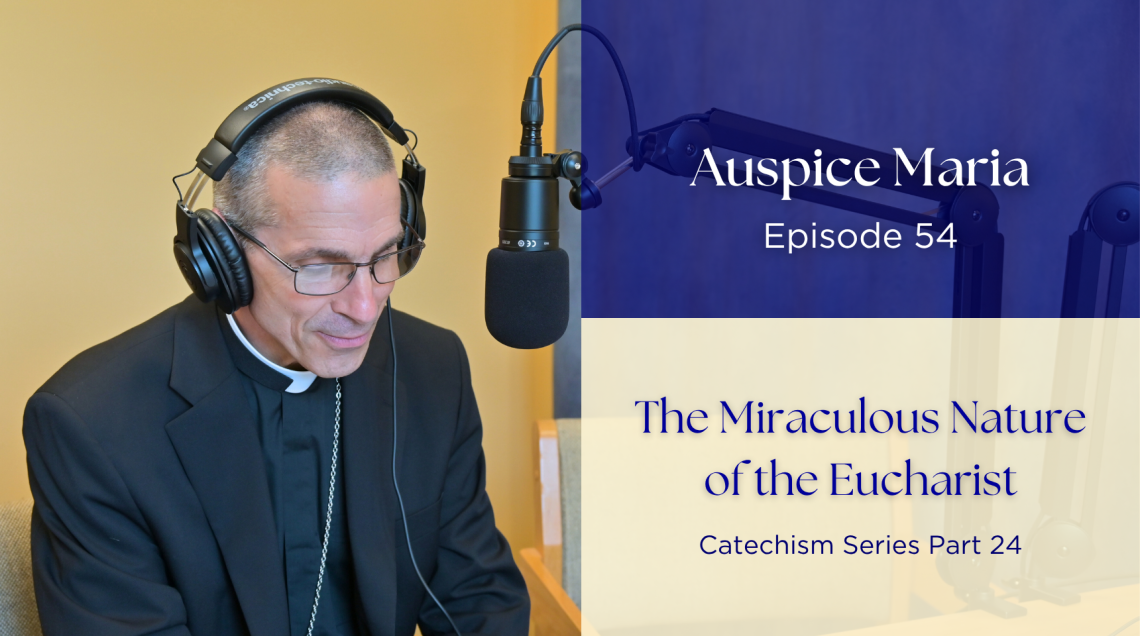
The Miraculous Nature of the Eucharist (Catechism Series Part 24) - Auspice Maria Ep. 54
Follow the Maine Catholic Podcast on:
Welcome back to the Auspice Maria podcast. I'm Bishop James Ruggieri of the Diocese of Portland in Maine. And today I'll be talking about the sacrament of the Most Holy Eucharist. And before we do that, though, I'd like to offer a prayer in thanksgiving for this wonderful sacrament and asking the Holy Spirit to open our hearts to its inspiration. That all may be blessed to listen to this podcast.
In the name of the Father, and of the Son, and of the Holy Spirit, amen. O gracious and merciful God, as we come before you, we ask your blessing, open our hearts and minds to your wisdom, and deepen our appreciation for this most wonderful sacrament. We ask all this through Christ our Lord, amen.
So we continue our journey through part two of the Catechism of the Catholic Church, the celebration of the Christian mystery. We remain in section two, the seven sacraments of the Church, chapter one, the sacraments of Christian initiation. And having reflected on baptism and confirmation, we now come to article three, the sacrament of the Eucharist.
The paragraphs for this episode are 1322 to 1419. Baptism, confirmation, and the Eucharist belong together. Baptism gives us new birth in Christ. Confirmation strengthens us with the gift of the Holy Spirit. The Eucharist brings Christian initiation to its sacramental fullness.
The Catechism says, and I quote, "The Holy Eucharist completes Christian initiation," right from paragraph 1,322. "In the Eucharist, those who have been raised to the dignity of the royal priesthood by baptism and configured more deeply to Christ by confirmation participate with the whole community in the Lord's own sacrifice." Again, another quote from paragraph 1,322.
And the Lord's own sacrifice, that phrase, the Lord's own sacrifice, matters. The Eucharist is not simply one prayer among many. It is not merely a sacred symbol, a devotional practice, or a reminder of something Jesus once did. The Eucharist is Christ himself, his sacrifice made present, his body and blood given as food, his risen life poured into the Church.
The Catechism, quoting the Second Vatican Council document, Lumen Gentium, the Constitution on the Church, Section 11, states, "The Eucharist is the source and summit of the Christian life."
So everything in the Christian life flows from the Eucharist and everything leads back to it. Our prayer, our works of charity, our preaching, our ministries, our family life, our suffering, our service to the poor, our desire for holiness, all of it finds its source and summit in Christ who gives himself to us in the Eucharist.
The Catechism also says that in the Eucharist is contained, and I quote, "the whole spiritual good of the church, namely Christ himself." And that is a partial quote from paragraph 1,324. And it cites this beautiful document in Vatican II, Presbyterorum Ordinis on the priesthood, section 5.
So let's consider the Eucharist theologically first, but let us not begin with abstract words or some lofty thoughts, but let's begin in the upper room. On the night before he died, Jesus gathered with his apostles.
He knew what was coming, betrayal, abandonment, suffering, the cross, and yet on that night, he did not leave his church merely with an idea, a memory, or a set of instructions. He took bread and wine, simple bread and wine, gave thanks, and gave himself.
The Catechism teaches that at the Last Supper, on the night he was betrayed, Jesus instituted the Eucharistic sacrifice of His Body and Blood in order to continue or perpetuate the sacrifice of the Cross through the ages until He comes again, and to entrust to the Church the memorial of his death and resurrection. That's a lot. That's from paragraph 1323, and it cites the Constitution on the Sacred Liturgy, Sacrosanctum Concilium, particularly section 47.
So that is the first door into the mystery. The Eucharist begins with the love of Christ who gives himself completely. He gives himself in the upper room as he institutes the Eucharist. He gives himself on the cross in obedience to the Father.
He gives himself in every mass, not by dying again, but by making present the one sacrifice by which the world is redeemed. That is why the Eucharist is called the memorial of the Lord's passion.
Now, for us, memory often means looking backward. We remember a person, an event, or a moment that is gone. But in the liturgy, memorial means something stronger. The Catechism says, "The Eucharist is the memorial of Christ's Passover, the making present and sacramental offering of His unique sacrifice in the liturgy of the church," from paragraph 1,362.
So the sacrifice of Christ happened once for all. It is never repeated. It doesn't have to be repeated. Yet in the mass, that one sacrifice becomes present to us sacramentally, so that its saving grace may touch our lives now.
This is also why the Eucharist is truly the holy sacrifice, and sometimes we refer to the Mass as the holy sacrifice of the Mass. The Catechism teaches, "The sacrifice of Christ and the sacrifice of the Eucharist are one single sacrifice." That's paragraph 1367, actually drawing on a reference from the 16th century Council of Trent, very important.
Christ offered himself once on the cross in a bloody manner. Now in the mass, that same sacrifice is offered in an unbloody and sacramental manner. The priest does not replace Christ. Christ is the true priest, the great high priest. Christ is the true offering. Through the ministry of the ordained priest, the church is joined to the self-offering of the son to the father.
The Eucharist is also thanksgiving. The word Eucharist means Thanksgiving. At every Mass, the Church gives thanks to the Father through Christ in the Holy Spirit. We give thanks not because life is always easy, but because God is faithful. We give thanks for creation, redemption, sanctification, forgiveness, hope, and the promise of eternal life.
And the Eucharist is the real presence of Christ. Christ is present in many ways in His Church, in His Word, in the prayer of the faithful, in the poor and suffering, in the sacraments, and in the person of the minister.
But the Catechism teaches that he is present above all under the Eucharistic species, because there Christ, God, and man makes himself holy and entirely present. In that last sentence, a quote from paragraph 1374, by the consecration the bread and wine become the body and blood of Christ. The Church calls this change transubstantiation. That's from paragraph 1376, and again, citing the Council of Trent.
Transubstantiation. What appears to our senses remains bread and wine, that appears to our senses. It looks like bread, smells like bread, looks like wine, smells like wine, tastes like wine. But after the consecration, the deeper reality is that these substances have been changed. Christ is truly, really, and substantially present. Body, blood, soul, and divinity.
Now, let's consider the Eucharist ecclesiologically, from the point of view of the Church. What does the Eucharist do for the Church? The Eucharist does not only nourish individual souls, but it forms the Church. The Catechism says that the Eucharist is "the efficacious sign and sublime cause of communion in the divine life and of the unity of the people of God by which the church is kept in being," and that's from paragraph 1325. That is a striking phrase, by which the church is kept in being.
The Eucharist is not simply something the Church does after she already exists. The Eucharist makes the Church more deeply herself. So the Eucharist makes the Church more deeply herself. Every mass reveals the Church as communion.
We are gathered by Christ, not by personal preference or social similarity. We stand before the Father as people redeemed by the same cross, nourished by the same Lord, and animated by the same Spirit. At mass, the parish is not merely a collection of individuals sitting in the same building. The Eucharist draws us into one body.
This is why the Eucharist is never only me and Jesus. It is, even though it is profoundly personal, of course, receiving communion is a very personal, moving moment. Holy Communion is communion with Christ and communion with and in His body, the Church.
The Catechism teaches that the Eucharist is also the sacrifice of the Church. The Church, which is Christ's body, participates in the offering of her head. The faithful unite their praise, sufferings, prayer, work, and daily lives to Christ's total offering. It's a beautiful image. We bring it all when we come to Mass, and we unite it with Christ himself as he offers himself to the Father for the salvation of the world.
Now, that means the mass gathers up the whole life of the people of God. Again, let's think particularly here and personally. A mother's exhaustion, a father's worry, a young person's questions, an elderly person's loneliness, the grief of a widow, the labor of a worker, the repentance of a sinner, the quiet fidelity of someone caring for a sick spouse.
None of this is outside of the Eucharist. When brought to the altar and united to Christ, the ordinary and painful realities of life can become part of an offering of love.
The Eucharist also sends the Church outward. It commits us to charity, reconciliation, and mission. The Catechism says plainly, in paragraph 1397, "The Eucharist commits us to the poor." We cannot receive the body of Christ at the altar and remain indifferent to the suffering members of Christ's body in the world.
Eucharistic communion must become Eucharistic living. Mercy for the wounded, patience in our own families, concern for the hungry, reverence for human dignity, and willingness to forgive.
The Eucharist also expresses the visible communion of the Church. Because Holy Communion signifies communion in Christ and in the Catholic faith, receiving communion is never merely a private gesture.
This is why the Church approaches questions of Eucharistic sharing with Christians not in full communion with the Catholic Church, with both reverence and pastoral care. So the Church is the sacrament of unity, therefore it both longs for unity and tells the truth about the unity that is not yet complete.
So you may read in missalettes sometimes guidelines for receiving communion. This is really what I'm talking about here, what the Catechism is talking about. Normally there's not intercommunion. There are some extraordinary circumstances when non-Catholics can receive, but again I would direct your attention to the Catechism for those references, it's actually in canon law.
But the point is this, that because, again, what the Eucharist means to the Church, and what the Eucharist means for the faithful who receive it, it is not only a symbol of unity, actually the cause of unity. So, coming to receive the Eucharist, we come with a common Catholic Christian faith.
Again, it's a very deep, deep topic, but well worth exploring if it's something that is of interest to you. I would like to now consider the Eucharist personally and spiritually. What does the Eucharist do in the one who receives?
The Catechism says in paragraph 1091, "Holy Communion augments our union with Christ." That is the principal fruit. Jesus gives himself to us as food for the journey. Beautiful image.
He does not only teach us from a distance, he comes near, he enters our lives, he strengthens what is weak, he heals what is wounded, and deepens the life of grace first received in baptism. The Eucharist preserves, increases, and renews the life of grace. It separates us from sin, it cleanses us of past venial sins, preserves us from future mortal sins, strengthens charity, and deepens our communion with the Church. Again, that connection to the Church. Those things can be found in paragraphs 1392 to 1396.
So importantly, the Eucharist is not a prize for the perfect, if it were, none of us would be receiving. It is food for disciples who know they need the Lord. At the same time, because the Eucharist is so holy, we must receive it with reverence and the right disposition.
St. Paul warns against receiving the body and blood of the Lord unworthily, very important, found in 1 Corinthians, his first letter to the Corinthians, chapter 11, verses 27 through 29. The Catechism therefore teaches that anyone conscious of grave sin must receive sacramental absolution, meaning must go to confession, before coming to Holy Communion. That's found in paragraph 1,385.
This is not meant to push people away. It's actually an invitation, an invitation to come truthfully. If we need confession, if we need to go to the sacrament of reconciliation, the Lord is not closing the door. He's actually opening the way back for us.
We prepare for Holy Communion by faith, repentance, prayer, and reverence. We observe the Eucharistic fast, which the Church says is one hour before receiving Holy Communion, or it might be easier to think of it one hour before Mass starts.
We listen to the word of God. We join our hearts to the sacrifice being offered. We come forward, not casually, hopefully consciously, but we come forward humbly, praying with the church, "Lord, I am not worthy that you should enter under my roof."
The church also encourages frequent reception of Holy Communion when properly disposed. The Catechism says that the Church warmly recommends, nice wording the Catechism uses, warmly recommends that the faithful receive Holy Communion whenever they participate in the Eucharist and obliges them to receive at least once a year during the Easter season. That's from paragraph 1389.
So the Eucharist draws us into adoration too, which is beautiful. Many have a devotion outside of the mass to the Eucharist by participating in Eucharistic adoration. Because Christ remains truly present under the Eucharistic species, the church worships him in the blessed sacrament outside of mass.
The catechism says, "He is to be honored with the worship of adoration." And that's a quote from paragraph 1418, actually citing a work of Saint Paul VI. So Eucharistic adoration flows from the mass and leads back to the mass. Again, that ebb and flow flows from the mass back to the mass.
In silence before the Lord, hearts are softened, burdens are placed before Him, and love is renewed.
Finally, the Eucharist is a pledge of future glory. In every Mass, we are already joined to the liturgy of heaven and given a foretaste of the heavenly banquet, yet another beautiful image. The Catechism says that "by the Eucharistic celebration, we already unite ourselves with the heavenly liturgy and anticipate eternal life," from paragraph 1,326.
So if you have been away from Mass, perhaps for months or maybe even years, I would simply encourage you, please hear this as a heartfelt invitation. Come home. Come home to the Eucharist.
Begin by coming to Mass, maybe sitting quietly, listening, praying. Let the Lord meet you. If you need to go to confession, do not be afraid. The mercy of Christ prepares us to receive the gift of Christ himself.
If you come to Mass regularly, I would just simply ask you to consider asking our Lord for a renewed Eucharistic faith. Ask the Lord to free you from routine, because even though we're so blessed to have access to Mass still, easily, it can become routine for us. So ask the Lord to free you from routine and awaken more gratitude.
If you receive Holy Communion, receive with reverence, receive with humility and love, receive consciously aware of what and who you are receiving. If you are not yet Catholic or not yet able to receive communion, I would simply, again, encourage you, let the mystery draw you deeper.
Come and see. Ask questions. Let your hunger for God become prayer. The Eucharist is not a thing the Church possesses. The Eucharist is the Lord who gives himself to the Church. At every altar, Christ gathers his people, offers himself to the Father, feeds us with his body and blood, and sends us into the world as witnesses of his love.
This is why the Church lives from the Eucharist. This is why the Eucharist is the source and summit. This is why we come to mass, because Christ is here, Christ is offered, Christ is received, and Christ sends us forth for the life of the world.
Thank you so much for listening, and I'd like to end by simply asking our Blessed Mother Mary to intercede for us as we pray. Hail Mary, full of grace, the Lord is with thee. Blessed art thou amongst women, and blessed is the fruit of thy womb, Jesus. Holy Mary, Mother of God, pray for us sinners now and at the hour of our death. Amen.