

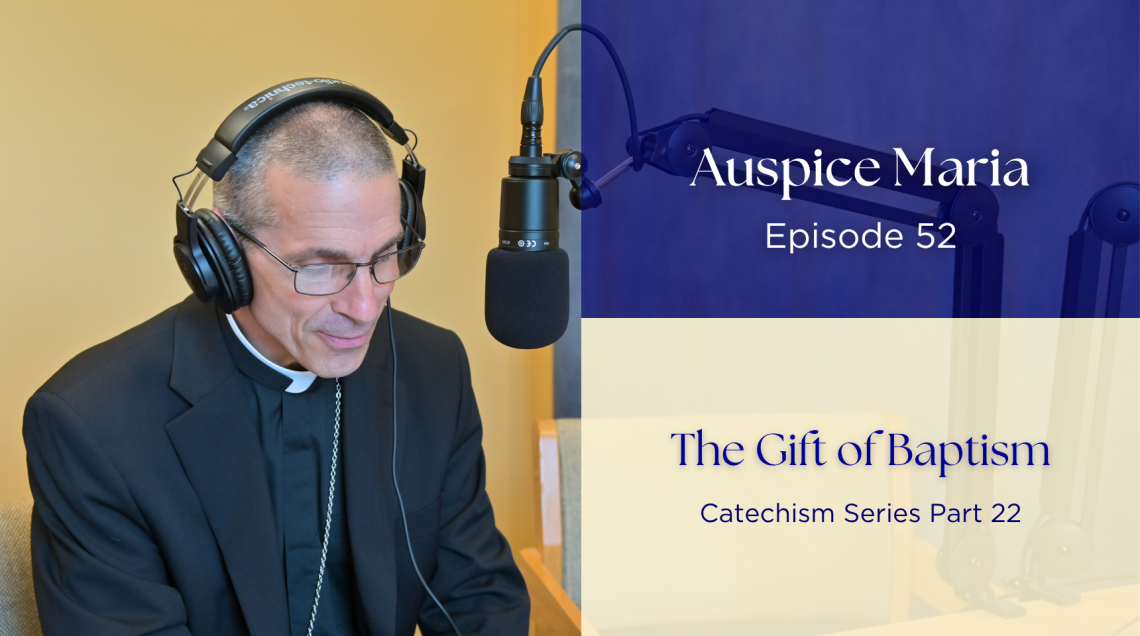
The Gift of Baptism (Catechism Series Part 22) - Auspice Maria Ep 52
Follow the Maine Catholic Podcast on:
Transcript:
Welcome back to the Auspice Maria podcast. I'm Bishop James Rugiri of the Diocese of Portland in Maine, and we have begun part two of the Catechism of the Catholic Church, which talks about the sacraments primarily, but it's entitled The Celebration of the Christian Mystery. So today we continue and we focus particularly on baptism, the all-important sacrament of baptism.
But before we do that, I would just like to offer a prayer to the Holy Spirit, inspiring, asking for the inspiration that we need to be inspired to understand, love, practice more fervently the faith that we have been blessed to receive.
So let us pray in the name of the Father and of the Son and of the Holy Spirit. Amen. Holy Spirit, fill our hearts, fill our lives, open our minds, and help us to appreciate more deeply the great gift of baptism that you have given to us. And for those who are not baptized, Holy Spirit, stir up a desire for baptism within them.
We ask again that the Holy Spirit inspire all who are listening to this podcast and inspire the words of the podcast. And we ask all this through Christ our Lord. Amen.
So we've been reflecting on the liturgy as the work of Christ and the work of the Church joined to Him. We have also reflected on the signs, the symbols, the words, actions, the times, and the sacred places through which the Church celebrates the mystery of Christ. Now I'd like to move from the liturgy in general to the seven sacraments.
In paragraph 1210, the Catechism gives us the list. Baptism, confirmation, the Eucharist, penance, the anointing of the sick, holy orders, and matrimony. These sacraments touch important moments of Christian life. Birth, growth, healing, and the mission to the life of faith.
I'm going to go back, Jake, and just read that sentence again, these two sentences. These sacraments touch the important moments of Christian life. They touch birth, growth, healing, and mission.
The Catechism traditionally groups the seven sacraments in three ways. First, there are the sacraments of Christian initiation, baptism, confirmation, and the Eucharist. Second, there are the sacraments of healing, penance, and the anointing of the sick. Third, there are the sacraments at the service of communion and mission, holy orders, and matrimony. And that list can be found in paragraph 1211.
So in this episode, we begin with baptism. The Catechism says, holy baptism is the basis of the whole Christian life, the gateway to life in the Spirit.
And continuing, the door which gives access to the other sacraments. That's found in paragraph 1,213. Through baptism, we are freed from sin, reborn as sons and daughters of God, made members of Christ, incorporated into the church, and made sharers in her mission.
Baptism is not merely a naming ceremony. It's not just something that we do out of religious custom or family tradition. Nor is it really a time for photographs of perhaps cute babies wearing baptismal garments and then post-baptismal celebration. I mean, everything, of course, has its place.
But really, baptism is the beginning of new life in Christ. It is the sacrament through which a person is brought into communion with Christ and into the life of his Church. The word baptism comes from a Greek word meaning to plunge or immerse.
The Catechism says that this plunging into water symbolizes burial into Christ's death, from which the baptized person rises with him as a new creature, and that's in paragraph 1214.
Now, from our experience, of course, we know water can cleanse, it can refresh, sustain life, but also we know that water has the potential to cause great destruction. In baptism, water becomes the sacramental sign of death and life, death to sin and new life in Christ.
This meaning unfolds throughout salvation history, and the Catechism reminds us of the blessing of the baptismal water at the Easter vigil, which highlights important moments in salvation history when water was instrumental, from the waters of creation, the flood, the crossing of the Red Sea, the crossing of the Jordan, and finally, the baptism of Jesus in the Jordan.
All of these prepare for the sacrament Christ gives to his church. And after his resurrection, Jesus is very clear. He commands the apostles, go therefore and make disciples of all nations, baptizing them in the name of the Father and of the Son and of the Holy Spirit.
And he also exhorts them to teach them to observe his commandments. That's found towards the end of Matthew's gospel, actually the very end, Matthew 28, verses 19 to 20, and in paragraph 1,223 of the Catechism.
The church has obeyed that command from the very beginning. We see this with Peter on the day of Pentecost. Peter tells the crowd, repent and be baptized every one of you in the name of Jesus Christ for the forgiveness of your sins. That's a quote from Acts 2 verse 38. So baptism is inseparable from faith, conversion, forgiveness, and incorporation into the church.
How is baptism celebrated? Well, the essential right is actually quite simple, but yet very profound. The Catechism says that baptism is performed by immersion in water or by pouring water over the head while invoking the Most Holy Trinity, the Father, the Son, and the Holy Spirit. And that's from paragraph 1,278.
Now, the Church's form is clear. And we've heard it, if we've been to a baptism, we've heard it, I'm sure, pronounced. And it is.
"I baptize you in the name of the Father, and of the Son, and of the Holy Spirit." Now, each time the celebrant of the sacrament is pouring water over the head of the one being baptized, or, in rarer occasions, immersing the person in the water, dunking the person in the water three particular times.
Now, water must be used and the Trinitarian formula must be spoken. Now, ordinarily, the ministers of baptism are bishops, priests, and deacons, the ordained. But in the case of necessity, it's interesting. Anyone, even a non-baptized person, can baptize, provided that the person intends to do what the Church does and pours water while using the Trinitarian formula.
Now, this shows how deeply the Church desires salvation and new life for every person. Again, any person can baptize in the case of an emergency, provided, again, the person intends to do what the Church does, pours water over the one being baptized while using that Trinitarian formula.
The Church also teaches that baptism is necessary for salvation because Christ commanded it and because baptism is the ordinary sacramental way by which we are reborn in Christ and incorporated into the Church. That can be found in paragraph 1,257. Now at the same time, the Church entrusts the unbaptized to the mercy of God. The Catechism says, "God has bound salvation to the sacrament of baptism, but he himself is not bound by his sacraments." That's a direct quote from paragraph 1257.
It's a great quote to ponder. God has bound salvation to the sacrament of baptism, but he himself is not bound by his sacraments.
So meaning that baptism is necessary for salvation, however, God in His greatness, His omnipotence, is not bound by this. Let me explain a little bit more.
Because the Church speaks also of baptism of blood, meaning those who die for their faith and who are not baptized. Baptism of desire, those who desire to be baptized but perhaps never receive baptism before they die.
And the hope that God can save those who through no fault of their own, that's a very important clause, do not know Christ or his church, yet sincerely seek God and strive to do his will as they understand it. So sort of the person of goodwill who does not know God nor really knows the church through no fault of his own, and again that might seem a little difficult to comprehend in today's day and age.
But yet, again, it entrusts to the mercy of God all people of goodwill. We can find those sort of caveats in the Catechism from paragraphs 1,258 to 1,260. It's really interesting to consider this. Baptism is necessary. But again, as the Catechism points out, God is not bound by his sacraments. God can work outside of his sacraments.
Continuing, regarding children who die without baptism, the church entrusts them to the mercy of God and invites us to hope in his saving love. Now, this does not lessen the urgency of baptism, nor is it meant to scare parents. Rather, it deepens our trust in God's mercy and our responsibility to proclaim the gospel. So which really brings me to the question, why do we baptize infants?
The Catechism teaches that children are born with a fallen human nature and affected by original sin. Actually, every person born is born with original sin. A fallen human nature and affected by original sin. They also need the new birth of baptism to be freed from the power of darkness and brought into the freedom of the children of light. Paragraph 1250.
Infant baptism shows us something essential about grace. This is, again, another intriguing reality. Before we choose God, God chooses us. Before a child can profess faith personally, the Church professes faith for the child.
And the child is welcomed into the life of Christ. If you've ever been to an infant baptism, that's precisely what happens. The parents and the godparents profess the faith in which the child is baptized, the faith of the church in which the child is baptized. They profess that faith for that child because the child is incapable of professing the faith. However, here comes the serious responsibility of the parents.
It means that parents and godparents have this tremendous responsibility. The catechism says that for the grace of baptism to unfold, the help of parents is important, and so is the role of the godfather or godmother. Who, catechism says, "who must be firm believers able and ready to help the newly baptized on the road of Christian life?" From paragraph 1,255.
And I know that many times sponsors, godparents, are chosen because there's maybe some friendship, some family tie, maybe even some sense of responsibility or obligation. I was the godparent to his child, so therefore it makes sense that he's the godparent to my first child. However, again, we have to consider the role of the godparent.
Godparents sponsors are not honorary witnesses. It's not a title of honor or of distinction in and of itself. Godparents are chosen to help the baptized person live the faith of the Church. They're supposed to model the faith.
And so I would just encourage, if you're contemplating who to choose for your godparents, really pray about that, because it's such an important ministry in the life of your son and daughter. And I'd like to say a word to parents who have not yet baptized their children. I would just simply want to encourage you, with great charity and clarity, please contact a local parish.
Maybe speak with a priest, a deacon, or the baptismal coordinator, because baptism is incorporation into Christ and into the Church. And that means it belongs within the life of a community. A parish helps parents prepare. And it is so beautiful to raise your child in a community of faith. I mean, obviously, the first community the child will grow in is the family unit.
Immediate family unit. However, having a spiritual family, a spiritual community, is also extremely, extremely important. So I would just encourage parents who have not yet baptized their children to really pray about that. And maybe through this podcast, you might be moved to consider baptism for your son or your daughter.
Let me talk a little bit more too about the effects of baptism, and maybe this will hopefully stir up some greater appreciation in all of us for this wonderful sacrament. The effects of baptism are really profound. First, baptism forgives sin. The Catechism teaches that by baptism all sins are forgiven, original sin and all personal sins, as well as all punishment for sin, from paragraph 1,263.
So nothing remains that would hinder a person from eternal life. Nothing remains that would impede entry into the kingdom of God as a result of being baptized. Now, of course, the longer we live, we sin, so thus we have the sacrament of reconciliation, which I will get to at another time.
If you think about it, at the moment of baptism, there's nothing impeding that soul from entering eternal life. All sin is washed away. Yet baptism does not remove every weakness. That's important to note. The baptized still experience suffering, illness, death, frailty, and the inclination to sin, which you may have heard the word used before. It's called concupiscence.
The Christian life remains a real journey of conversion. That's, I think, the key point to walk away with is that, yes, baptism does forgive original sin, removes original sin, all personal sins, if we have any at that point. However, it does not remove or it does not abolish that effect of sin, concupiscence, which is that inclination to sin, that attraction to sin. As a result, we commit personal sins.
However, again, not to get discouraged, not to get fearful, it's very important to recognize that we're on this journey of conversion. It's a process. Constantly turning and returning to Christ is a part of this process of holiness.
Well, the second beautiful effect of baptism, it makes us a new creation. The Catechism says that baptism makes the baptized person an adopted son of God, of course, adopted daughter of God too. Also, a partaker of the divine nature, a member of Christ, a co-heir with him, and a temple of the Holy Spirit. From paragraph 1265, what a great image, a temple of the Holy Spirit.
This is the dignity of every baptized person. Our deepest identity is not what we achieve, not what we possess or control. Our deepest identity is received. We are beloved sons and daughters of the Father in Christ. Third great effect of baptism, it incorporates us into the church. The Catechism says, baptism makes us members of the body of Christ. Paragraph 1267.
We do not belong to Christ privately or in isolation. I can't say that enough. We belong to Christ as members of His Body, His Church. We are joined to other believers in faith, worship, communion, and mission.
Fourth, baptism establishes a real communion among Christians. The Catechism teaches that baptism is the foundation of communion among all Christians, including those not yet in full communion with the Catholic Church.
And that it constitutes a "sacramental bond of unity" among all those who are reborn through it. And that's from paragraph 1,271. And it cites a very important Vatican II document, the decree on ecumenism, meaning ecumenism is Christian unity or the striving of Christian unity.
And the document is called Unitatis Red Integratio, and it cites section 3 and section 22. Again, the Vatican II document, the Decree on Ecumenism.
However, this does not erase real divisions among Christians. Unfortunately, they still exist. But it reminds us that valid baptism creates a true, though imperfect, communion. Fifth effect, baptism gives an indelible spiritual mark. The Catechism says that baptism seals the Christian with an "indelible spiritual mark," or character. Sometimes we talk about the character, the sacramental character of baptism.
Which consecrates the baptized person for Christian worship. Because this mark cannot be erased, baptism cannot be repeated. Very interesting. Once that soul is marked with this indelible mark through baptism, we cannot repeat it. It is once and once only.
This is why, I think very importantly, the anniversary of our baptism matters. Now, many Catholics, I presume all Catholics, know their birthday. Some may remember their graduation date. Hopefully, spouses, you remember your anniversaries, or there could be some problems if you don't. And most likely, priests and deacons, bishops, we remember our anniversaries of ordination.
But yet, I think if you were to ask the people in your parish, what day were you baptized? You may find some who know it, but I would dare say that the majority do not.
Yet if we think about this, baptism is the day we were reborn in Christ. It is the day we were marked as belonging to Him. It is the day the life of grace was poured into us. It's a really important day. I would encourage you to try to find out. It's not a real difficult process. It's just a matter of calling the church where you were baptized and making a request for your baptismal record.
So if you are baptized, I would encourage you, rediscover the gift you have received. Thank God for your baptism. Again, maybe be inspired to learn the date. Pray for your parents if they're deceased or if they're alive. Pray for your godparents, again, likewise, if they're deceased or if they're alive. And I think very importantly, pray for the priest or the deacon who baptized you.
Renew your baptismal promises with sincerity. Actually, every time we bless ourselves with holy water, it's an opportunity to renew our baptismal commitment to Christ in the Church.
So if you are not baptized, again, with all charity and kindness, I'm just saying maybe this teaching will stir something in your heart. Baptism is not simply joining an institution. It is receiving new life in Christ and entering the communion of His Church.
Speak with a Catholic priest if you're interested. Ask questions. Maybe speak with a fellow Catholic or a person that you know is Catholic and practicing. And maybe that's where the journey to baptism will begin for you. But I would encourage you, if the Spirit so moves you, please begin the journey. You're most welcome.
And if you are a parent whose child has not been baptized, I would hear this not as pressure, but really as an invitation. The Church desires to welcome your child into the life of the Church. Again, I'd encourage you to contact the local parish and allow the community of faith to walk with you.
And you see, sometimes people think, oh, my child's like four or five. She's too old now for baptism. I'll let her decide later.
No, no, I think parents you have every right at four, five, six, seven, eight to seek baptism for your child, and even beyond. I mean, granted, the older your child is, the more that hopefully your child's will would be inclined to this beautiful sacrament. And that happens really through a conversation and also exposure to the Church. I think the more a child is exposed to the Church, the more the beauty of the faith is appreciated and grows in the heart and mind of the child. Again, the first steps are simple. Simply contact the local parish and let the community walk with you.
So baptism is the gateway. It is the beginning. It is the sacrament of new birth through water and the Holy Spirit. Through baptism, Christ claims us as his own. The Father receives us as beloved children. The Holy Spirit dwells within us. And the Church welcomes us into the family of faith. What a gift.
Thank you for listening to the Auspice Maria podcast. And I want to just conclude by offering a Hail Mary, asking our Blessed Mother to intercede for us as we pray. Hail Mary, full of grace, the Lord is with thee. Blessed art thou amongst women, and blessed is the fruit of thy womb, Jesus. Holy Mary, Mother of God, pray for us sinners now and at the hour of our death. Amen.