


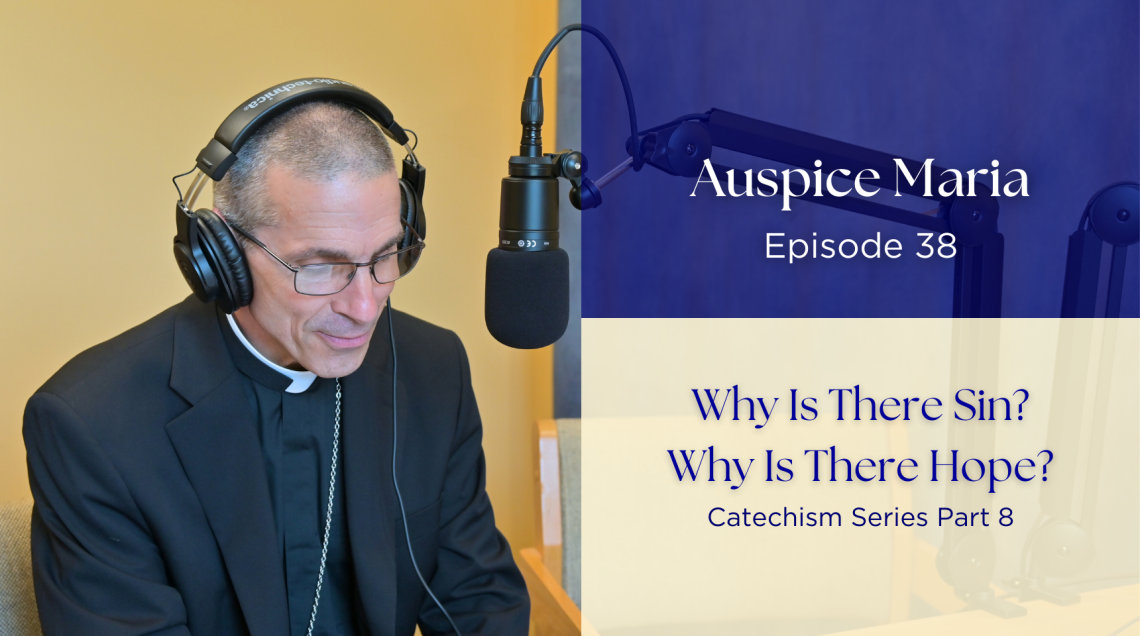
Why Is There Sin? Why Is There Hope? (Catechism Series Part 8) - Auspice Maria Ep 38
Follow the Maine Catholic Podcast on:
Transcript:
Welcome back to the Auspice Maria podcast. I'm Bishop James Ruggeri of the Diocese of Portland in Maine. And as we continue this series of the podcast on the catechism, this week I'd like to address the question, "why is there sin?" And also, "why is there hope?" We're referring to paragraphs 385 to 412. And again, this first part of the catechism that focuses on the creed, what we believe in as Catholics.
So before I begin, of course, just want to invoke the Holy Spirit as always and ask all who are listening maybe to ask the Holy Spirit too to help them. If there's anything they need to hear today, particularly through their listening of this podcast, that the Spirit would enlighten them and perk their ears and hearts to it. So Holy Spirit, come inspire us, inspire those who listen to this podcast. May it bless them and keep us all humble in your service. We ask all this through Christ our Lord. Amen.
So there's a question, I would call it a perennial question, that runs across generations. And it appears sometimes in philosophy classrooms. It may appear in hospital rooms. It may emerge in conversations that are just after acts of violence and reflecting people who are just really befuddled by the evil sometimes that is apparent in our world. And it rises sometimes quietly in the examination of conscience that a person may make at the end of a day or before preparing for the sacrament of reconciliation.
Sometimes the question is spoken aloud. Sometimes it remains unspoken. But it really is a heavy question. Why is there sin in the world? And the related question, why is there evil? Perhaps beneath the question lies another. Well if God created everything good, where did all this come from? This referring to the imperfections that we see around us as a result of sin and the presence of evil.
Well the church does not ignore that question. She does not minimize it. She does not offer a superficial answer either, and nor will I because it's a very deep question. Instead, she places it within the larger horizon of redemption. Before speaking about sin, the Catechism reminds us of something essential. It begins not with darkness, but with Christ.
As the Catechism teaches in paragraph 389, “The doctrine of original sin is, so to speak, the ‘reverse side’ of the Good News that Jesus is the Savior of all men," Of course, women included in that as well. Continuing, "that all need salvation and that salvation is offered to all through Christ.” (CCC 389)
And that is where the church begins, correctly so. The question of sin only makes sense in the light of salvation. The wound only makes sense in the light of the healer, Jesus. And the fall only makes sense in light of the Redeemer. And so before we begin to examine the wound, we return to the beginning.
God created heaven and earth. He created the visible and the invisible. He created man and woman in His image and likeness. Now, the universe is not an accident. It is not morally indifferent. It is good. And Genesis in those creation accounts, particularly the first creation account in Genesis 1, is very clear with that. God saw how good it was. And that's repeated throughout those first six days of creation. The Catechism is clear as well in paragraph 311. “God is in no way, directly or indirectly, the cause of moral evil.” (CCC 311)
So creation flows from wisdom and love. Humanity was created in original holiness and justice. There was harmony with God, harmony within the human heart, harmony between man and woman, and harmony with creation itself. So the question becomes even sharper. If everything was created good, why is there sin?
And again, back to the Catechism paragraph 390. “The account of the fall in Genesis 3 uses figurative language, but affirms a primeval event, a deed that took place at the beginning of the history of man.” (CCC 390)
So, again, reading that, the account of the fall in Genesis 3, which tells us how men and women fell into the temptation of Satan, uses figurative language, sort of reads like a story, doesn't explain it theologically detail by detail, but through the use of story tells us how it happened and refers to this primeval or this initial event, initial deed. And so something happened, we are told. Humanity did not remain in that state of original justice.
Paragraph 397 states, “Man, tempted by the devil, let his trust in his Creator die in his heart…”
So at the root of sin, sin is not merely the breaking of a commandment. It is the breakdown of trust. Now, freedom is essential to love. Without freedom, there can be no communion. We cannot truly love another person if we are not free. But freedom carries the possibility also of refusal.
The Catechism describes what lurks behind that refusal, paragraph 391. “Behind the disobedient choice of our first parents lurks a seductive voice, opposed to God…” (CCC 391)
Now Scripture and tradition identify this source of the seductive voice as Satan. And the Church teaches very clearly in the Catechism in paragraph 391, "that Satan was at first a good angel, made by God: ‘The devil and the other demons were indeed created naturally good by God, but they became evil by their own doing.’” (CCC 391)
So this is not a dualism. Satan is not equal to God. Satan is a creature. And the Catechism clarifies, found in paragraph 395, the power of Satan is nonetheless not infinite. God remains sovereign. So 395 tells us “The power of Satan is, nonetheless, not infinite.” (CCC 395)
That's very important because God is the sovereign one. God is the creator of all. God is more powerful than Satan.
Yet the first human beings misused their freedom. They lost original holiness and justice. Human nature was not destroyed, but it was wounded, deeply wounded. And in paragraph 404, Catechism explains, “Original sin is transmitted by propagation to all mankind, that is, by the transmission of a human nature deprived of original holiness and justice.” (CCC 404)
It's very important because sometimes people, this is not fair. I didn't commit that original sin. Why am I wounded by it? Well, original sin, of course, is not a personal fault committed by each of us. It is a state in which we are born. Baptism truly washes away original sin. And the Catechism teaches in paragraph 405, “By imparting the life of Christ's grace, Baptism erases original sin and turns a man back towards God…” (CCC 405)
Yet, in paragraph 405, “The consequences for nature, weakened and inclined to evil, persist in man and summon him to spiritual battle.” (CCC 405)
So this consequence, where man is weakened, woman is weakened and inclined to evil, is known as concupiscence. Concupiscence remains. The inclination towards sin remains. It is not itself sin, but it inclines us, it inclines the human person towards sin.
I don't want to be abstract here, but I'd like to talk about it from an experiential point of view. For example, a parent resolves to respond patiently to her child and yet chooses to be irritable when confronted by a situation that may be a repetitive situation, but is challenging and so she chooses irritation as opposed to patience. Another example, a husband or a wife desires harmony and they desire more connection in their relationship. However, pride stiffens the conversation. So they try to draw closer, talk more intimately about things, maybe even areas that they may disagree in, and pride can stifle or stiffen the conversation, even though one or both is desiring that deeper connection, that honesty and that ability to listen to the other.
Also, a person may be very committed to honesty and integrity, but finds himself constantly giving in to the temptation to exaggerate when he's in a conversation with another to make himself look good or to exonerate himself perhaps from any blame or fault. And then someone sincerely wants to forgive another person. It might be very desirable in their heart, yet they choose to hold on to that resentment, that lingering resentment.
Now, St. Paul describes the struggle classically in the letter to the Romans, chapter 7, verse 15. “What I do, I do not understand. For I do not do what I want, but I do what I hate.” (Rom 7:15, NABRE)
We could say in a nutshell that is concupiscence, the wound within the will.
Why is there sin in the world? Because freedom is real and because freedom has been wounded. But sin is understood fully only in the light of revelation. And here we come back to this very important point found in 387 of the Catechism. “Without the knowledge Revelation gives of God we cannot recognize sin clearly and are tempted to explain it as merely a developmental flaw, a psychological weakness, a mistake…” (CCC 387)
So in Christ, we see both the seriousness of sin and the greater seriousness of mercy. And so we arrive at the center, redemption. Let's listen to St. Paul's words found in Colossians, his letter to the Colossians chapter 1, verses 15 to 20. Now scholars think that these words were pre-Pauline and he just adopted them and adapted them to his letter. They're beautiful. It's a hymn.
St. Paul writes or shares,
"He is the image of the invisible God,
the firstborn of all creation.
For in him were created all things in heaven and on earth,
the visible and the invisible,
whether thrones or dominions or principalities or powers;
all things were created through him and for him.
He is before all things,
and in him all things hold together.
He is the head of the body, the church.
He is the beginning,
the firstborn from the dead,
that in all things he himself might be preeminent.
For in him all the fullness was pleased to dwell,
and through him to reconcile all things for him,
making peace by the blood of his cross
[through him], whether those on earth or those in heaven." (Colossians 1:15–20 (NABRE))
All things, St. Paul tells us, were created through him. All things hold together in him, we are told. And all things are reconciled in him, in Christ.
So redemption is not an afterthought. It's not God saying, "how am I going to fix this mess that man has gotten into?" God is totally in control of things.
And the catechism concludes this section by quoting St. Leo the Great, one of the fathers of the early church. “Christ's inexpressible grace gave us blessings better than those the demon's envy had taken away.” (CCC 412)
It's a wonderful line found in paragraph 412. And it reminds us, “Where sin increased, grace overflowed all the more.” (Rom 5:20; cf. CCC 412)
So in Christ, we are not merely restored, we are elevated. We are made sons and daughters in the Son. So the perennial question, why is there sin, ultimately leads us to the cross. There we see the seriousness of evil and we see something greater than evil. We see mercy. Sin leads to death. Love transforms death into life.
Yet concupiscence remains. Yes, we struggle. Yes, we see evil in the world and sometimes in ourselves. But please, let's never forget, God's grace is greater. Now, this is not sentiment. This is truly the gospel that we proclaim. God's grace, God's love given to us through Christ is greater.
Thank you for listening, and again, I'd always like to end by asking our Lady to intercede for us as we pray. Hail Mary, full of grace, the Lord is with thee. Blessed art thou amongst women, and blessed is the fruit of thy womb, Jesus. Holy Mary, Mother of God, pray for us sinners, now and at the hour of our death. Amen.