


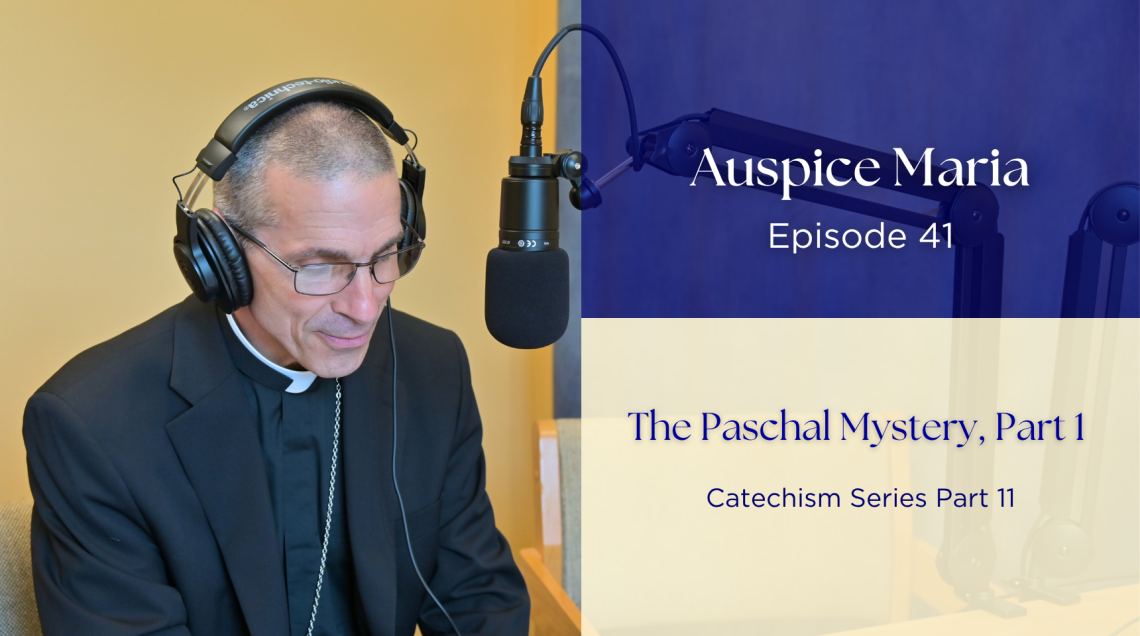
The Paschal Mystery, Part 1 (Catechism Series Part 11) - Auspice Maria Ep. 41
Follow the Maine Catholic Podcast on:
Transcript:
Welcome back to the Auspice Maria podcast. I'm Bishop James Ruggieri of the Diocese of Portland in Maine. We continue with our series on the Catechism, and I'd like to entitle this particular episode, The Paschal Mystery, Part 1. Before though, I'd like to offer a prayer asking the Holy Spirit to inspire this podcast and all those who are able to hear it.
So Lord, please pour out your Holy Spirit upon us. Bless all those who may hear this podcast. May it be a blessing for them. But above all, Lord, we humbly submit to your will. We pray again for your continued blessing and guidance in our lives. May we always appreciate the great work of love that Christ has done for us. We make this prayer through Christ our Lord. Amen.
So there are probably moments in life when a quiet question rises in the heart. Does God really love me? Not in theory, not in general, but me. Me here in my life right now, just as I am. Sometimes that question comes in a hospital room. Sometimes it comes after a failure. Sometimes it comes in silence at the end of a long day. Into that question, the gospel gives us a clear and definitive answer.
For God so loved the world that he gave his only son so that everyone who believes in him might not perish, but might have eternal life. That's the famous line from John's Gospel, chapter three, verse 16.
Everything we believe flows from this as Christians. God so loved the world. And if we want to understand that love, we cannot remain at the level of ideas. We must look at what Christ lived.
Over these past episodes we have been walking through the Creed. We have reflected on creation, on the dignity of the human person, on the mystery of the Trinity, and on the Incarnation. Now we arrive at the center, the Paschal Mystery. This is not simply something we study, but something we are invited to enter.
It is a life given, a love poured out, a death embraced, and victory won. The catechism reminds us that the mysteries of Christ's life are not distant events. They are realities that draw us into communion with him. And so today, we do not simply analyze the life of Christ. Let's consider this a walk with him.
Jesus begins his public ministry in a way that may seem very surprising. He steps into the waters of the Jordan. He who is without sin enters into a baptism meant for sinners. The Catechism teaches that Jesus' acceptance of his baptism is on his part the acceptance and inauguration of his mission as God's suffering servant. That line comes from paragraph 536. It is on his part the acceptance and inauguration of his mission as God's suffering servant. He does not remain distant from us. Jesus enters into our condition and this is how God loves, not from above but from within.
Immediately after, he goes into the desert where he is tempted. There the catechism tells us, Jesus is the new Adam who remained faithful just where the first Adam had given into temptation. And that comes from paragraph 539. So when humanity failed, Jesus remains faithful.
And that faithfulness leads to our redemption. So where humanity failed, Jesus remains faithful. And his faithfulness leads to our redemption. It is a safe generalization to say that many people sincerely desire to live a good life. They want to be patient, faithful, and to do what is right.
And yet there is often a quiet struggle within, a kind of resistance, a fatigue that sets in when we try again and again and still fall short. That experience is deeply human and it is precisely there that Christ meets us, not at a distance, not with judgment, but with solidarity. He enters the struggle and remains faithful within it. He does not remove the struggle immediately, but he transforms it, giving it meaning and opening a path through it.
As Jesus begins to preach, everything centers really on one reality, one central theme, the kingdom of God. The kingdom of God lies at the heart of Jesus' preaching. But Jesus does not describe the kingdom in abstract terms. He speaks about seeds, about nets, about fields, about bread, images of ordinary, everyday realities. And through them, he reveals that God is acting now, that his reign is already present. The Catechism explains that, quote, Jesus accompanies his words with many mighty works and wonders and signs which manifest that the kingdom is present in him. That's from paragraph 547.
Where the sick are healed, the kingdom is present. Where sins are forgiven, the kingdom is present. Where dignity is restored, the kingdom begins to take root. This is not only a future promise, it is a present reality, a new way of living, a new way of loving authentically. It is a quiet transformation that begins within the heart and extends outward into families, communities, and the world. And so beautifully transforms and converts the culture in which we live. But as the gospel unfolds, the tone begins to shift. Jesus begins to speak openly about his suffering, about rejection, about death.
In paragraph 572, the Catechism tells us that Jesus announced that he would suffer death by violence, and yet he does not turn away. Jesus walks towards Jerusalem. In Luke chapter 9, we hear how Jesus resolutely determinedly walked towards Jerusalem or began this long journey in Luke that stretches over the next chapters of Jesus journeying to Jerusalem, journeying to the cross, journeying to his resurrection. And yet he does not turn away from this suffering again. At the center of everything stands the cross. And it must be said clearly, the cross is not simply suffering.
It is love revealed. The cross teaches, and I quote the Catechism, Jesus did not experience reprobation as if he himself had sinned, but in the redeeming love that always united him to the Father, he assumed us in the state of our waywardness of sin. That's from paragraph 603.
Jesus takes upon himself what is not his. He carries what belongs to us.
And he does this freely as the Catechism teaches, by embracing in his human heart the Father's love for men, Jesus loved them to the end. For greater love has no man than this, that a man lay down his life for his friends. Again, the Catechism teaches by embracing in his human heart the Father's love for men, Jesus loved them to the end for greater love has no man than this, that a man lay down his life for his friends. That's from paragraph 609. So this is really essential. The cross is not something done to Jesus. It is something Jesus freely accepts and embraces out of love, out of obedience, out of a desire that none of us be lost.
What appears as abandonment, in truth, is the deepest expression of His loving obedience to the Father. On the cross, Christ does not simply endure suffering, He transforms it. What appears to be defeat becomes the place of victory. In that moment, love reaches its fullest expression, holding nothing back, Jesus giving everything, even to the point of death. I remember at different times standing at the bedsides of people who were near death.
The room was often very quiet except for the sounds of maybe medical machines that were needed for the person's comfort or just to keep the person alive. The family was often gathered in the room, sometimes seated around the bed, sometimes simply standing along the wall.
There was a stillness that comes when words are no longer enough. In that moment, what mattered was not explanation, but what mattered was presence, simply being there. I as a priest really could say nothing, nothing new, nothing that would change the situation before us. And in that moment or in those moments, I understood something more deeply about the cross. God does not stand at a distance from our suffering. God enters it. He remains even to the end.
The Catechism teaches, and I quote, by his obedience unto death, Jesus accomplished the substitution of the suffering servant who makes himself an offering for sin. Close quote, paragraph 615.
Jesus stands in our place. He offers himself for us. And it also teaches, quote, the sacrifice of the cross is unique. It completes and surpasses all other sacrifices, close quote, paragraph 614. Nothing more is needed. Nothing can be added. On the cross, everything is given. Everything is fulfilled. The love of God is revealed, not as an idea, but as a gift poured out completely for the life of the world. And then Jesus dies, truly dies. His body is taken down, given to his mother, and then placed in the tomb. And then comes silence.
Silence. And the Church knows the silence. It's very beautifully lived every year liturgically on Good Friday and on Holy Saturday. On Good Friday when that liturgy begins, the altar is bare. The priest celebrant comes into the Church in silence. The Church waits.
And it is a silence that can feel very heavy, even unsettling. It is the silence of unanswered questions as we gaze upon the cross.
It is a silence of grief, silence of waiting, without knowing really what comes next, although we know the story, but one can only imagine the silence of that first Good Friday that led into Holy Saturday.
And yet, it is not empty silence, because even here God is at work, hidden but present, bringing about something greater than we can yet see. So today, I simply tried to walk through some of these paragraphs of the catechism with you that really help us to walk with Christ to the cross. These paragraphs have led us to the cross, have led us to the death of Jesus, have led us to his body being taken down and buried in the tomb. And now we wait. We wait like the church waits on Good Friday and Holy Saturday for the great feast of Easter, the resurrection. We wait.
We have seen, hopefully, that the Paschal Mystery is not first about suffering. It really is about love, a love that enters our human condition, a love that remains faithful, a love that gives everything. And this love is not distant. This love is offered to you now in your life, in your struggles, in your questions.
God so loved the world. And that includes, my dear brothers and sisters, that includes you and me.
Well, thank you for listening to the Auspice Maria podcast. And as always, I would like to just end this by offering this Hail Mary to Our Lady, asking for her intercession and her help. And again, before doing that, just a special shout out to my producer, Jake, for all his kind assistance and expertise in making this podcast possible.
Hail Mary, full of grace, the Lord is with thee. Blessed art thou amongst women, and blessed is the fruit of thy womb, Jesus. Holy Mary, Mother of God, pray for us sinners now and at the hour of our death. Amen.