

Entering the Life of Christ (Catechism Series Part 10) - Auspice Maria Ep 40
Follow the Maine Catholic Podcast on:
Transcript:
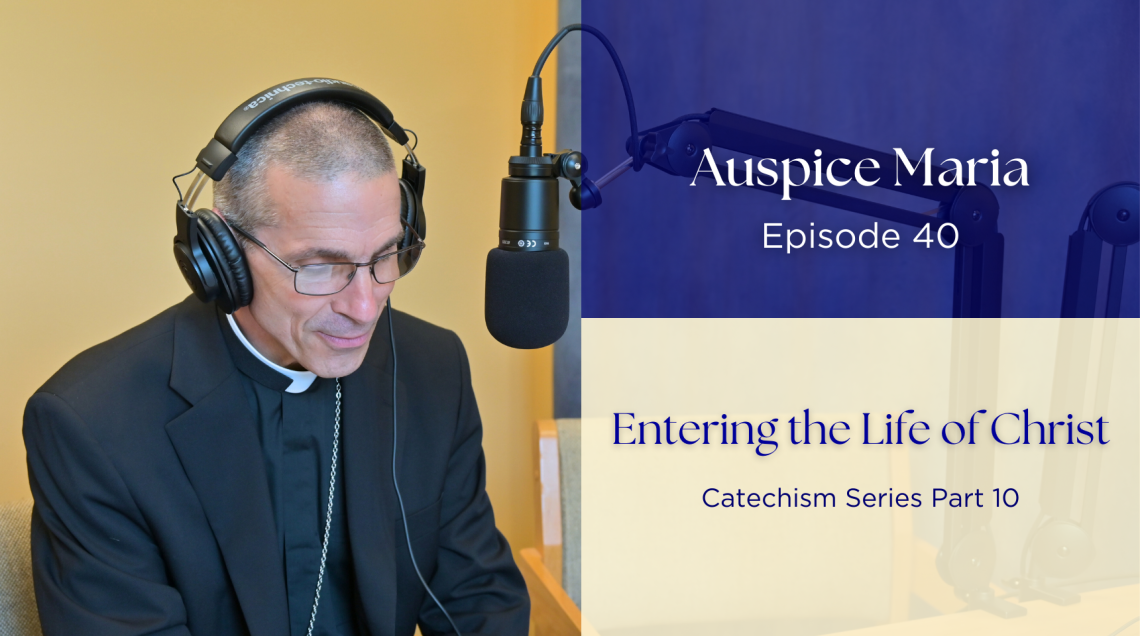
Well, welcome back to the Auspice Maria podcast. I'm Bishop James Ruggieri of the Diocese of Portland in Maine. In the last several episodes on the Catechism, we have been slowly walking through the Creed. We began with the mystery of God the Father, the Creator of heaven and earth. We reflected on creation, on the dignity of the human person, and on the mystery of the Holy Trinity, Father, Son, and Holy Spirit.
Then we arrived at one of the central mysteries of the Christian faith, the Incarnation. The eternal Son of God did not remain distant from the world He created. The Word became flesh and entered our history.
So today I would like to continue that reflection by speaking about what it means to enter the life of Christ. And before that, of course, we invoke the help and the inspiration of the Holy Spirit to inspire this podcast by our listeners.
So the Catechism reminds us that the events of Jesus' life are not merely historical moments of the past. Rather, they are mysteries that invite us into communion with Him.
As the Catechism beautifully teaches in paragraph 521, “Christ enables us to live in Him all that He Himself lived and He lives it in us.”
Trying to repeat that it's kind of a very dense sentence from paragraph 521: “Christ enables us to live in Him all that He Himself lived and He lives it in us.”
So in other words, the life of Jesus is not simply something we observe. It is something we are invited to enter.
And the beginning of that life leads us first to the woman through whom the mystery of the Incarnation unfolded. So the story of salvation as it unfolds in the Gospel begins quietly in the town of Nazareth.
There, God prepares a young woman for a unique mission in human history. The Catechism explains that God prepared Mary in a singular way for this role.
It teaches, citing the Vatican II document Lumen Gentium, specifically Lumen Gentium, paragraph 56, and I quote, “The Father of mercies willed that the Incarnation should be preceded by assent on the part of the predestined mother,” close quote.
So from the moment of her existence, Mary of Nazareth was preserved from original sin. And this is what the Church celebrates each year on December 8th, the Solemnity of the Immaculate Conception.
Sometimes this teaching is misunderstood. People occasionally think the Immaculate Conception refers to the conception of Jesus. In fact, it refers to Mary herself.
From the beginning of her life, God prepared her to become the Mother of His Son. Because the Child she bore is truly the Son of God, the Church calls Mary Theotokos, a Greek word meaning God-bearer or Mother of God, as the Catechism explains in paragraph 495.
“Called in the Gospels the ‘Mother of Jesus,’ Mary is acclaimed by Elizabeth, at the prompting of the Spirit, and even before the birth of her Son, as ‘the mother of my Lord.’ In fact, the One whom she conceived as man by the Holy Spirit, who truly became her Son according to the flesh, was none other than the Father's eternal Son.”
So everything in Mary's life leads to the moment when the angel Gabriel announces God's plan. Mary responds freely on her own accord with those extraordinary words recorded in the Gospel of Luke.
The Catechism describes this moment as the obedience of faith. Mary entrusts herself completely to the will of God.
We hear that same trust expressed in the Magnificat, Mary's beautiful prayer of praise, when Mary visits Elizabeth in those opening lines: “My soul proclaims the greatness of the Lord, my spirit rejoices in God my Savior.”
So Mary recognizes that the God who has been faithful to His people through generations is now fulfilling His promises. Through her, yes, the eternal Son of God enters human history. The Word takes flesh from her.
And as the Catechism teaches in paragraph 457, “The Word became flesh for us in order to save us by reconciling us with God.”
So after the infancy narratives, something remarkable happens in the Gospels. There is silence.
We hear of the birth of Jesus, the visit of the shepherds, and the Magi, the presentation in the temple, and the flight into Egypt. Later, we hear of the 12-year-old Jesus in the temple.
But after that, nearly 30 years of His life are summarized in just two verses. St. Luke tells us in chapter 2, verses 51 to 52: “He [Jesus] went down with them, Mary and Joseph, and came to Nazareth and was obedient to them. And His mother kept all these things in her heart, and Jesus advanced in wisdom and age and favor before God and man.”
Those two verses summarize most of the earthly life of Jesus before His public ministry begins. Again, after the infancy narratives, from the point of the public ministry beginning, those two verses summarize approximately, we could say, maybe almost 30 years.
And the Catechism offers a profound insight. “The hidden life at Nazareth allows everyone to enter into fellowship with Jesus by the most ordinary events of daily life.” It's from paragraph 533.
So for nearly 30 years, the Son of God lived quietly in a small village. He worked, He prayed, He lived within a family.
Now imagine for a moment a morning in Nazareth. The village slowly awakens, tools are gathered, bread and breakfast is prepared, and the ordinary work of the day begins.
And among the people of that village is the Son of God. He's not preaching yet, He's not performing miracles yet. Simply living, living obediently, living with His parents, earthly parents Mary and Joseph, and working beside Joseph, listening to Mary, sharing the rhythms of daily life.
The Gospels also remind us that Jesus was obedient to Mary and Joseph, and that's very important because the Catechism reflects on this obedience. In paragraph 532, “Jesus' obedience to His mother and legal father fulfills the fourth commandment perfectly.”
And those hidden years prepared the humanity of Christ for the mission that would unfold later. The obedience He lived, He learned in Nazareth would one day reach its fullness in the Garden of Gethsemane when Jesus would say, “Not My will, but Yours be done.”
So Joseph likely died sometime before the beginning of Jesus' public ministry, since he is no longer mentioned in the Gospel narratives. It is possible that Jesus remained in Nazareth to care for Mary during those years, sanctifying the ordinary rhythms of human life.
Again, just taking care of His mother, who at that time most likely was a widow.
When Jesus begins His public ministry, the focus of His preaching is very clear, the kingdom of God. The kingdom of God lies at the heart of Jesus' preaching.
But Jesus really defines the kingdom through abstract explanations. Instead, He reveals it through parables drawn from everyday life, stories based on everyday life experiences.
The kingdom is like a pearl of great price. The kingdom is like a net cast into the sea. The kingdom is like seed planted in a field. The kingdom is like yeast that leavens the dough.
So imagine a crowd gathered around Jesus in a small village. Fishermen stand nearby, their nets drying in the sun. Farmers listen with soil still on their hands. Mothers hold their children while they listen. And Jesus points to the ordinary things around them and says, “The kingdom of God is like this.”
Through these simple images, Jesus reveals something profound. The kingdom is not merely a future reality, it is the reign of God entering human history.
And the Catechism explains that Jesus accompanies His preaching with signs and miracles that reveal the presence of the kingdom. In paragraph 547, the Catechism says, “Jesus accompanies His words with many mighty works and wonders and signs which manifest that the kingdom is present in Him and attest that He was the promised Messiah.”
So where God's mercy heals and restores, the kingdom begins to appear. Where forgiveness replaces resentment, the kingdom is present.
Where human dignity is honored, the kingdom begins to take root. The kingdom is the culture born from God's love, a culture of truth, mercy, justice, and communion, and Jesus invites every person to enter it.
This brings us back to the theme of this episode, entering the life of Christ. The Catechism reminds us that the mystery of Christ's life are not simply events from the past. They remain living realities that continue to touch our lives today.
Paragraph 521 states, “Christ enables us to live in Him all that He Himself lived, and He lives it in us.”
Through grace, the life of Christ becomes present in us. We can share in Mary's trust and be inspired by it.
We can live the quiet fidelity of Nazareth thinking of the beautiful marriage of Mary and Joseph in which Jesus was reared and taught and grew and learned. We can participate in the kingdom's mission.
And as we do, our lives gradually become conformed to His. The story of Jesus is not simply a story we remember. It is a life that we are invited to share.
It is a life that we are invited to share. So little by little, day by day, we are invited to enter the life of Christ.
Thank you for listening and I'd like to end with a Hail Mary invoking our Blessed Mother Mary's intercession and her inspiration that, like her, we too may be obedient in faith to the Father's will.
Hail Mary, full of grace, the Lord is with thee. Blessed art thou amongst women and blessed is the fruit of thy womb, Jesus. Holy Mary, Mother of God, pray for us sinners now and at the hour of our death. Amen.