

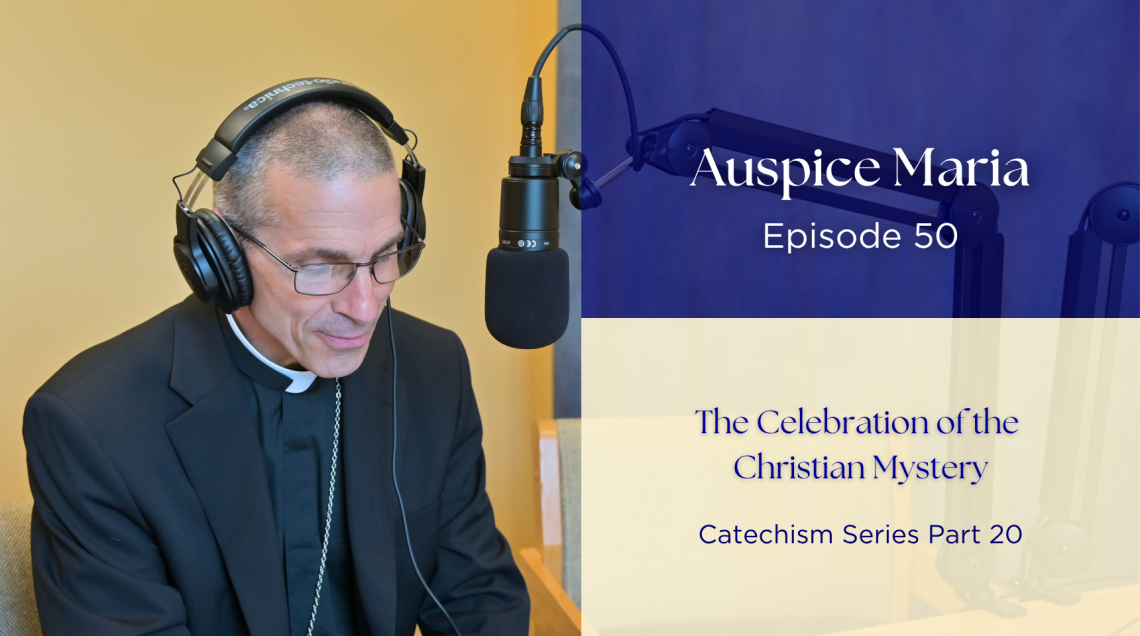
The Celebration of the Christian Mystery (Catechism Series Part 20) - Auspice Maria Ep. 50
Follow the Maine Catholic Podcast on:
Transcript:
Welcome back to the Auspice Maria podcast. I'm James Ruggieri of the Diocese of Portland. And as we continue our podcast, we're moving now into a new part of the catechism of the Catholic Church.
The first part we've been working and expounding on, talking about, reflecting on the profession of faith. We have reflected on the creed and what the Church believes, on the mystery of the Father, the Son, and the Holy Spirit, and also importantly on the Church as one, holy, Catholic, and apostolic.
Now we move into part two of the Catechism entitled The Celebration of the Christian Mystery.
But before that, I just would like to begin with a prayer invoking the Holy Spirit to help us, to inspire us, open our hearts, to bless all those who listen to this podcast.
Come Holy Spirit, fill our hearts, fill our hearts with your love, your peace, enkindle in us that gift of understanding. And Lord, may we simply be your instruments, instruments of salvation for the world, the salvation that Christ has won for us. We ask all this through Christ our Lord. Amen.
So as we move into part two, this movement really is important because the Christian faith is not simply something we profess with our lips or hold in our minds. The mystery of Christ is also celebrated. It is made present. It is received. It is lived.
What the Church believes, the Church celebrates. And what the Church celebrates, the Church is called to live.
The Catechism begins the second part by placing the liturgy within the whole plan of salvation. The mystery we profess in the Creed is the mystery the Church celebrates in her worship. The Father sends the Son and the Holy Spirit for the salvation of the world. Christ accomplishes that salvation, above all, through his paschal mystery, his passion, death, resurrection, and ascension.
Then, in the age of the Church, that saving mystery continues to be communicated through the liturgy and the sacraments. The Catechism states this clearly. I quote from paragraph 1067. It says, “For this reason, the Church celebrates in the liturgy, above all, the Paschal mystery by which Christ accomplished the work of our salvation.”
Now, this is important. The liturgy is not, first of all, something we create. It is not simply a religious ceremony or a communal gathering or a sacred memory of things long past. It is the celebration of the saving work of Christ.
Christ died and rose once for all, yet the grace of that mystery is communicated to us now through the church's liturgical and sacramental life.
The word liturgy originally meant a public work or a service performed on behalf of the people. In Christian tradition, the catechism says it means, and I quote, “the participation of the people of God in the work of God.” And that's from paragraph 1069.
Through the liturgy, Christ, our Redeemer and High Priest, continues the work of our redemption in, with, and through his church. Another reference to paragraph 1069.
The liturgy is the work of Christ and the work of the church, but not in the same way. Christ is the principal actor. The church is joined to him as his bride and body.
The Catechism, quoting the Second Vatican Council, teaches that the liturgy is “an exercise of the priestly office of Jesus Christ,” and that every liturgical celebration is “an action of Christ the priest and of his body, which is the Church.”
Now, those are found in paragraph 1070, but very importantly, citin g the Constitution on the Sacred Liturgy, a Vatican II document entitled Sacrosanctum Concilium, and it refers to Sacrosanctum Concilium, section 7, paragraphs 2 and 3.
That's a very important document. If you're really interested more in what the Vatican Council taught about liturgy and how principally liturgy is the source and summit of our faith, it's a wonderful document to read, to study, to look at important and solid commentary on. Again, Sacrosanctum Concilium.
So here, I think it's important to notice the particular emphasis. In the liturgy, the Church shares above all in Christ's priestly work. She offers worship to the Father through Christ and receives the sanctifying grace of Christ. This worship then forms the Church for prophetic witness and royal service in the world.
In other words, the liturgy does not turn us inward, it draws us into Christ so that we can be sent outward in mission, charity, and service.
That is why the Catechism also says that the liturgy is “the summit toward which the activity of the church is directed,” and, again, another quotation, “the font from which all her power flows.” That's from paragraph 1074, again, referring to Sacrosanctum Concilium, section 10.
So everything the Church does leads towards worship, toward communion with God, and everything the Church does flows from worship because the Church receives her life from Christ.
At the same time, the Catechism reminds us that the liturgy does not exhaust the entire activity of the Church. Evangelization, faith, and conversion must precede it. Mission and charity must flow from it. The liturgy is never isolated from life. It is where disciples are formed, nourished, healed, and sent.
The Catechism also gives us an important word for how we should understand and teach the liturgy. And that word is mystagogy. It's an important word that's also a part of the OCIA process, this order of Christian initiation of adults. Mystagogy is the period that follows the reception of the initiation of the sacraments on the part of the elect.
In talking about mystagogy, the catechism says liturgical catechesis aims to initiate people into the mystery of Christ and then explains that this means moving from the visible to the invisible, from the sign of the thing signified from the sacraments to the mysteries. There's a lot there, and it's found in paragraph 1075.
So that is what we are trying to do in this episode. Again, a challenge but worthy to be undertaken. We are not merely explaining religious rituals. We are seeking understanding. We see visible signs that communicate the invisible grace of Christ. The Catechism then helps us to see that the liturgy is the work of the Most Holy Trinity.
The Father is the source and goal of the liturgy. He blesses us in Christ with every spiritual blessing. Our worship is a response to that divine blessing. In the liturgy, the Church blesses the Father in adoration, praise, and thanksgiving, and asks the Father to send the Holy Spirit upon the gifts, upon the faithful, and upon the whole world.
Christ is also at work in the liturgy. He is not absent. He is not merely remembered. He acts. The catechism teaches that Christ now acts through the sacraments he initiated in order to communicate his grace, his divine life.
The sacraments are visible signs made up of words and actions accessible to our human nature, but they do more than point to grace. By the action of Christ and the power of the Holy Spirit, they make present the grace they signify.
This is the sacramental realism of the Catholic faith. Christ's paschal mystery is not repeated. It does not need to be repeated. But because Christ is risen and lives forever, his saving mystery is not trapped in the past.
In the liturgy, the one sacrifice of Christ is sacramentally made present. So we are not returning to Calvary as spectators. Christ brings the grace of his cross and resurrection to us.
Here we also see the importance of apostolic succession, something we talked about in the previous episode. Christ sent the apostles, filled with the Holy Spirit, to preach the Gospel and to communicate the fruits of salvation through the sacrifice and the sacraments.
The Catechism teaches that apostolic succession “structures the whole liturgical life of the Church and is itself sacramental, handed on by the sacrament of holy orders.” Paragraph 1087.
So this connects beautifully with what we have already professed in the Creed, belief in the Holy Spirit and belief in the one holy Catholic and apostolic Church.
The Church is not the owner of the sacraments, she is their faithful steward. Through apostolic succession and holy orders, Christ provides His Church with ordained ministers who serve the sacramental life of the Church, each according to the grace and character of His ordination.
The Holy Spirit is essential in all of this. The Catechism calls the Holy Spirit the “artisan of God's masterpieces, the sacraments of the New Covenant.” That's found in paragraph 1091.
The Spirit prepares the Church to encounter Christ. The Spirit recalls the mystery of Christ. The Spirit makes the mystery of Christ present here and now. The Spirit unites the Church to the life and mission of Christ.
So this brings us now to two important liturgical words: anamnesis and epiclesis.
Anamnesis means remembrance, but not merely mental recollection. The liturgy remembers God's saving deeds in a way that draws the Church into them. The Church recalls the whole economy of salvation, creation, covenant, prophecy, incarnation, passion, resurrection, ascension, and the gift of the Spirit. In the liturgy, memory becomes participation.
Epiclesis means invocation. It is the prayer by which the Church asks the Father to send the Holy Spirit. In the Eucharist, the priests ask the Father to send the Spirit so that the gifts may become the body and blood of Christ, so that those who receive them may become a living offering to God.
And the Catechism teaches that together the anamnesis and the epiclesis are at the heart of each sacramental celebration, most especially the Eucharist. That's from paragraph 1106.
So the liturgy is not just remembering, it is remembering and invoking. It is proclaiming what God has done and begging the Father to send the Spirit so that the power of Christ may be present and fruitful in the Church today.
From there, the Catechism moves more specifically to the sacraments. It reminds us that the whole liturgical life of the Church revolves around the Eucharistic sacrifice and the sacraments. It's a quote from paragraph 1113 and again an important reference citation of Sacrosanctum Concilium, section 6.
The Church recognizes seven sacraments: baptism, confirmation, Eucharist, penance, anointing of the sick, holy orders, and holy matrimony.
The sacraments are the sacraments of Christ because they were instituted by Christ and draw their power from him. They are also the sacraments of the Church. The Catechism says they are “of the Church,” and in a double sense, this is important, in a double sense by her and for her, meaning by the church and for the church. Paragraph 1118.
They are by the church because Christ acts in and through the church by the Holy Spirit. They are for the church because the sacraments make the church. Again, paragraph 1118.
Sacraments are also sacraments of faith. They presuppose faith, but they also nourish, strengthen, and express faith.
Quoting Sacrosanctum Concilium, section 59, catechism says, and I quote, “The purpose of the sacraments is to sanctify men, to build up the body of Christ, and finally to give worship to God.” That's from paragraph 1,123.
So the sacraments sanctify all people, men and women, all young people, children. They build up the body of Christ and finally give worship to God.
That is why the Church is very careful with the liturgy. And this is really important. The sacraments do not belong to the personal preference of the minister or the community.
The Catechism says, and I quote, “No sacramental right may be modified or manipulated at the will of the minister or the community,” paragraph 1,125.
This is really important for us to grasp. It's not rigidity, it is really reverence. The Church receives the sacraments as gifts from Christ.
Finally, the Catechism gives one of the most concise definitions of what a sacrament is, and this is from 1131.
The sacraments are efficacious signs of grace instituted by Christ and entrusted to the Church by which divine life is dispensed to us.
They are efficacious because Christ himself is at work in them. And the Catechism teaches that the sacraments act "ex opere operato," by virtue of Christ saving work, not because of the personal holiness of the minister. Another important point regarding sacraments.
They work not because of the personal holiness of the minister, but by virtue of Christ's saving work.
This does not mean the sacraments work mechanically or magically. It means their power comes from Jesus, from Christ, who is faithful to his promises.
At the same time, the fruit received in the soul depends on the faith, the openness, and the disposition of the person receiving the sacrament.
This is really consoling and also very challenging, consoling because Christ is faithful even when his ministers are weak. Challenging because we are called to receive the sacraments with faith, conversion, humility, and love.
The fruit of sacramental life is both personal and ecclesial. Personally, the sacraments give us life in Christ. Ecclesially, they build up the Church in charity and mission.
The liturgy reveals why the Church is not merely an organization that speaks about salvation. She is, in Christ, the visible sign and instrument through which the saving grace of the Paschal Mystery is proclaimed, celebrated, and communicated to the world.
That is the great transition we begin in this part of the Catechism. We move from the mystery professed to the mystery celebrated.
We profess Christ crucified and risen. In the liturgy and sacraments, the same Christ continues to act, to sanctify, to heal, to forgive, to nourish, and to send His Church forth in the power of the Holy Spirit.
Well, thank you for listening again to this episode of Auspice Maria.
And I'd like to conclude as always invoking Mary, Mother of the Church, Mother of God, as we pray.
Hail Mary, full of grace. The Lord is with thee. Blessed art thou amongst women, and blessed is the fruit of thy womb, Jesus. Holy Mary, Mother of God, pray for us sinners now and at the hour of our death. Amen.