

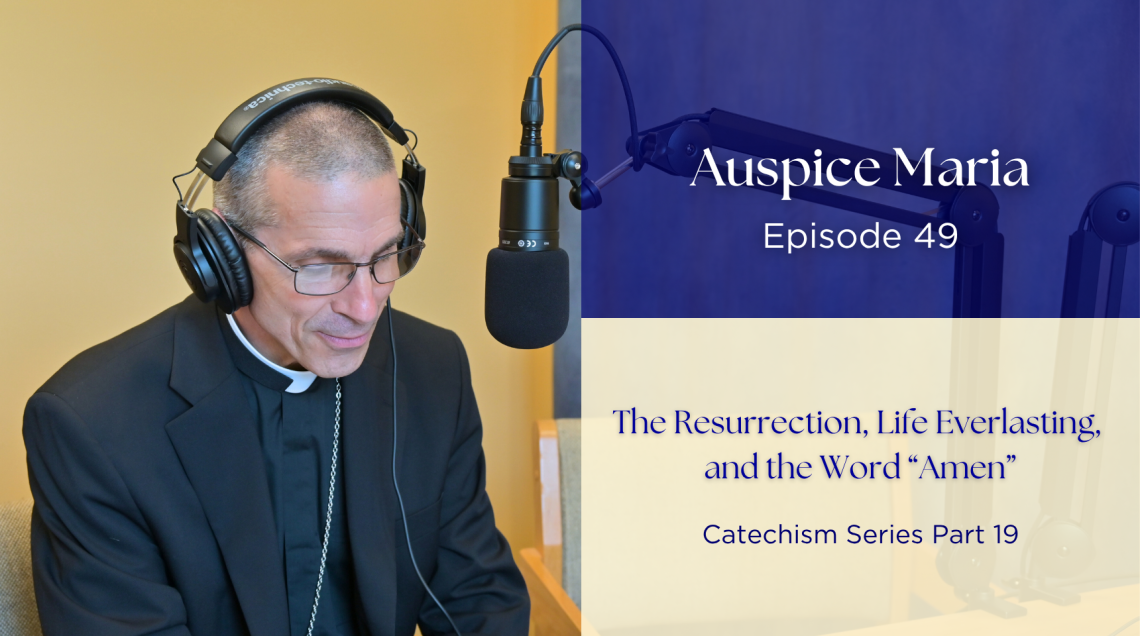
The Resurrection, Life Everlasting, and the Word “Amen” (Catechism Series Part 19) Auspice Maria 49
Follow the Maine Catholic Podcast on:
Transcript:
Welcome to the Auspice Maria podcast. I'm Bishop James Ruggeri of the Diocese of Portland in Maine, and today we resume our series on the Catechism of the Catholic Church, talking about these articles of the Creed, or these points of the Creed: the resurrection of the body, life everlasting, and the word Amen, which really brings us to a beautiful conclusion to the first part of the Catechism, which has expounded on the articles of the Creed.
Our paragraphs today for consideration are paragraphs 988 to 1065. As always, I'd like to just begin with a prayer, asking the Holy Spirit to inspire this podcast and all who listen to it.
In the name of the Father, and of the Son, and of the Holy Spirit. Amen.
Holy Spirit, come to us, be with us, inspire this podcast, and bless all those who listen to it. And help us all to grow in deeper appreciation for this beautiful faith, this Catholic faith that we are so privileged to share in. We ask all this through Christ our Lord. Amen.
So in our last episode, we reflected on the communion of saints and the forgiveness of sins. We saw that the Church is not only a visible community on earth, but a communion, a communion in Christ that reaches beyond death. The saints in heaven intercede for us. We pray for the dead. Mary, Mother of the Church, accompanies us. And through baptism and the apostolic ministry of reconciliation, Christ continues to pour out the forgiveness of sins.
So now the Creed brings us to its final articles: I believe in the resurrection of the body and life everlasting. Amen.
These words bring the whole profession of faith to its conclusion. The Christian faith does not end in an idea, memory, or a vague spiritual hope. It actually ends in the living God who loves us unconditionally, who created us body and soul, redeemed us in Christ, and promises the resurrection of the body and eternal life.
The Catechism says that belief in the resurrection of the dead has been an essential element of the Christian faith from its beginnings. I have a quote here from Tertullian, an early writer in the Church. He said, “The confidence of Christians is the resurrection of the dead. Believing this, we live.” And that's a reference also to paragraph 991. That quote from Tertullian is found there.
This is not small doctrine. It really does shape how we understand the human person, death, suffering, hope, and the future of creation itself.
A powerful Gospel passage to begin with as we delve into this mystery is the raising of Lazarus that's found in John chapter 11. Now, Lazarus of Bethany has died. His sisters Martha and Mary are grieving the loss of their brother, but also perturbed that Jesus took so long to arrive there.
When Jesus arrives, Martha says to him, “Lord, if you had been here, my brother would not have died.” Jesus responds, “Your brother will rise.” Martha answers with faith in the future resurrection: “I know he will rise in the resurrection on the last day.”
Then Jesus gives, we could say, maybe one of the more important and incredible revelations of the Gospel. He says, “I am the resurrection and the life. Whoever believes in me, even if he dies, will live.” That's found in John chapter 11, verses 21 and also 23 to 25, this beautiful exchange with Martha.
Jesus then raises Lazarus from the tomb. Yet Lazarus' experience must be distinguished from the resurrection of Jesus. These are two different realities. Lazarus is restored to earthly life. He returns to the same mortal condition. He will die again one day. His raising, though, is a sign. It is a miracle. It really is a manifestation of Jesus' authority as God over death, but it is not yet the glorified resurrection promised at the end of time.
Jesus' resurrection, though, is different. Jesus does not simply return to ordinary earthly life. He rises in a glorified body. He is truly embodied. His disciples, over the 40 days of his resurrection appearances, see him. He can be touched. He eats with his disciples. And yet, his risen body is no longer subject to death, corruption, or the ordinary limitations of earthly mortal life.
Christ's resurrection is the principle and source of our future resurrection. It's a reference to paragraph 655, kind of going back a little bit earlier in the catechetical text, and then also 995. So what happened in him is what God promises to accomplish in us. What Jesus experiences is really our hope.
This is why the Church professes the resurrection of the body. Christianity does not teach that the body is a disposable shell, or that salvation means escaping material creation. Not at all. The human person is a unity of body and soul.
Death separates soul and body, but this separation is not God's final word. The Catechism teaches that at death the soul is separated from the body, but in the resurrection God will give incorruptible life to our body, transformed by reunion with our soul, in reference to paragraph 997. As Christ is risen and lives forever, so all will rise on the last day.
The resurrection of the body also gives meaning to how we live now. So our bodies do matter. What we do with our bodies matters. Love, sacrifice, chastity, service, suffering, work, our care for the poor, and the reverent treatment of the sick and dying all matter.
The body is not outside the spiritual life. Again, it's not something that we should run away from or really want nothing to do with. It is part of the human person whom God has created. We are, again, body and soul. And also, this is part of who we are as redeemed by Christ through his death and resurrection.
And also, this human body is a temple of the Holy Spirit. Our souls are animated by the Holy Spirit, the Holy Spirit that we receive so beautifully at our baptism. But our souls are embodied. We are embodied souls.
So the Catechism then leads us to what tradition often calls the last things. We go from talking about the resurrection of Jesus and the resurrected state to the last things, and these would be death, judgment, heaven, and hell. It also speaks of the return of Christ in glory.
Now these teachings on the last things are not meant to produce fear for its own sake. They are really meant to awaken truth, hopefully to spur us onto conversion, wanting to better our lives for Christ, for heaven. Hopefully the discussion around these last things, or our contemplation or meditation on these last things, inspires hope within us and also instills responsibility, if that's something that indeed we need more awareness of.
Now, death is a consequence of sin, but because of Christ, death has been transformed. For those who die in Christ, death becomes a participation in the death of the Lord so that they may also share in his resurrection. Some references to paragraphs 1006 to 1010.
Christian hope does not deny the pain of death. Death indeed is real, and the associated grief resulting from death is real. But Christ has entered death, and he's conquered it from within. Therefore, the Christian can face death not as annihilation, but as a passage to God.
After death comes judgment. The Catechism teaches that each person receives “eternal retribution in his immortal soul at the very moment of death in a particular judgment that refers his life to Christ,” close quote, paragraph 1022.
This judgment is not arbitrary. It is the judgment of Christ, who is truth and mercy. In his light, the truth of our life is revealed. Our choices matter. Our love matters. And consequently, our refusal to love also matters.
Heaven is the perfect fulfillment of communion with God. The Catechism describes heaven as “the ultimate end and fulfillment of the deepest human longings, the state of supreme and definitive happiness.” That's right from paragraph 1024.
Heaven is not boredom. It is not an abstract spiritual condition. It is life with the Most Holy Trinity, communion with the Blessed Virgin Mary, the angels, and all the saints. It is the perfection of love. It is our ultimate end.
Purgatory is also a doctrine of mercy. Those who die in God's grace and friendship but still imperfectly purified are assured of eternal salvation. How consoling this is. But undergo purification after death so as to achieve the holiness necessary to enter the joy of heaven. It's from paragraph 1030.
This is not a second chance after life, after a life opposed to God. It's not like God's giving us another chance. It is the final purification of those who belong to Christ, but still need to be made ready for the fullness of communion.
Hell is the tragic possibility of definitive self-exclusion from communion with God. It's very sad. And the Catechism teaches that, “to die in mortal sin without repenting and accepting God's merciful love means remaining separated from him forever by our own free choice.” That's paragraph 1033.
So the Church speaks of hell because love is real and, again, human freedom is real. God desires all to be saved, but God does not force love. God does not control us as a puppeteer. God has gifted us free will and gives us the freedom to exercise that free will.
The Creed also directs our attention to the second coming of Christ and the final judgment. Christ will come again in glory. At the end of time, the kingdom of God will come in its fullness. The dead will rise. All creation will be renewed.
The last judgment will reveal the full truth of history: the good that grace has accomplished, also the harm that is caused by sin, and the justice and mercy of God before all creation.
The Catechism teaches that the visible universe itself is destined to be transformed so that the world, restored to its original state, will be at the service of the just, sharing in their glorification in the risen Jesus Christ. And that is a direct reference to something that Saint Irenaeus said, again, one of the early Church Fathers, found in paragraph 1047.
This description of the second coming, or these sort of realities of the second coming, is really Christian hope in its fullest sense. Not only are we talking about saved souls, but resurrected persons, renewed creation, and the victory of God's kingdom.
It's hard to really fathom this reality of the second coming and all the consequences of it. But it does engender hope. It does engender hope. Sometimes we may look around at our creation or sort of what we're doing to each other or what we've done to creation, and we might really lament some of our choices as human beings, collectively and of course individually. But the second coming gives us hope. It's restoration. It's new life in so many beautiful aspects. And it's also truth, truth.
Catechism concludes with a few paragraphs on the final word, Amen. So the Creed concludes with this word, Amen. It is a very small word, only four letters, and it's something, a word that we've probably been saying since we first learned how to pray. But it carries the weight of the whole profession of faith.
Catechism says that the Creed's final Amen repeats and confirms its first words, “I believe.” So if you recall, this whole podcast series on the Catechism and the Creed started with an investigation, or at least early on, investigation of “I believe.” What does this mean? And this reference to how Amen is a conclusion or a way to kind of circle back to that beginning is found in paragraph 1064.
Amen means “so be it.” Amen is also, when we say it, an act of trust. It is not merely the end of a prayer. It is really the seal of faith.
When we say Amen to the Creed, we are not simply acknowledging a list of doctrines. We're sort of saying with a seal of our approval and our consent, “This is what we believe, so be it.” We are entrusting ourselves to the God who has revealed himself.
We are saying Amen to the Father who created us. Amen to Jesus Christ who became man, suffered, died, rose, and will come again. We say Amen to the Holy Spirit who gives life to the Church. Amen to the forgiveness of sins. Amen to the resurrection of the body. Amen to life everlasting.
This matters because faith is something that must be renewed. It's a gift that must be renewed. Many Catholics recite the Creed often. If we're at church on Sunday, we say it every Sunday. But perhaps, as always with things that are repetitive or reoccurring in our lives, perhaps we say the Creed, we profess the Creed, without always noticing the depth of what we are saying.
The Creed is not only something we profess. It is really something we are called to live. To renew our faith is to allow the truths of the Creed to shape our choices, our priorities, our relationships, our understanding and acceptance of suffering, our hope, and ultimately our mission, our knowledge of who we are, why we are here, and what we are called to.
So the final articles of the Creed remind us that our lives are going somewhere. We are not made for nothingness. We are not made only for this world. We are made for resurrection. We are made for communion with God, for communion with the saints. We are made for eternal life.
So when the Church says, “I believe in the resurrection of the body and life everlasting. Amen,” she is proclaiming the final victory of Christ. Death will not have the last word. Sin will not have the last word. Suffering will not have the last word. Christ will have the last word. And the Church answers, “Amen. So be it. I believe.”
Thank you so much for joining me today for the Auspice Maria podcast. And I'd like to conclude by offering a Hail Mary and asking Our Lady to continue to intercede for us, Mary, the beautiful icon of the Church, Mother of the Church, our Mother. And as we pray together, let us again pray for each other.
Hail Mary, full of grace, the Lord is with thee. Blessed art thou amongst women, and blessed is the fruit of thy womb, Jesus. Holy Mary, Mother of God, pray for us sinners now and at the hour of our death. Amen.