

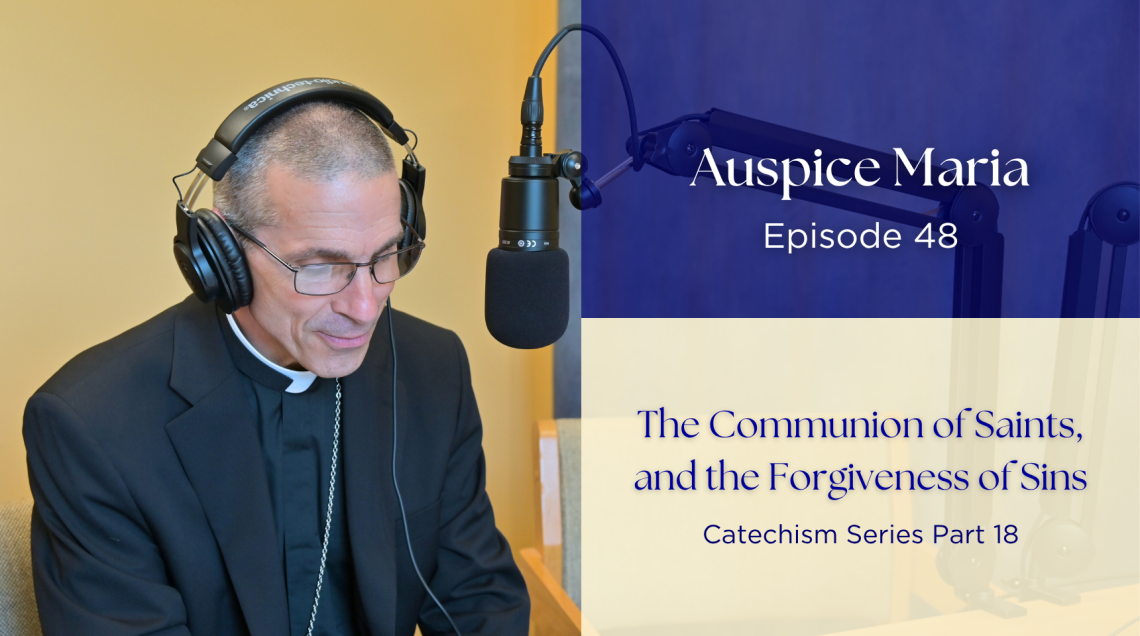
The Communion of Saints, and the Forgiveness of Sins (Catechism Series Part 18) Auspice Maria ep 48
Follow the Maine Catholic Podcast on:
Transcript:
Welcome back to the Auspice Maria podcast. I'm Bishop James Ruggieri of the Diocese of Portland in Maine. And today we continue with our series on the Catechism, touching upon these points in the Creed, the communion of saints, and the forgiveness of sins.
We're nearing the end of this first part of the Catechism that focuses specifically on the Creed that we are so privileged to proclaim every Sunday, and really helps us to understand better what we believe in as Catholics.
So, as always, I just want to ask the Holy Spirit, invoke the Holy Spirit, to guide and direct this podcast and all those who are listening. So Holy Spirit, come and just move within our hearts, inspire us, and flame in us a greater love for our faith that is so beautifully articulated in the creed that we proclaim at Mass. We thank you, Lord, for this gift of faith, and we ask your blessing upon us through Christ our Lord. Amen.
So in our last episodes we've been, as I mentioned, reflecting on the mystery of the Church, some of these principal tenets of our faith, and we considered so far the Church, these marks of the Church, as one, holy, Catholic, and apostolic.
And now we're moving further into the members of the Church. We talked also about the states of life that are found in the Church, the ministerial, the ordained, the lay states, the consecrated states. So beautifully we arrive today on this point of the communion of saints.
Now, the Catechism leads us more deeply into the spiritual life of the Church in these particular paragraphs that we are reflecting on. Right after we profess, “I believe in the Holy Catholic Church,” the Creed adds “the communion of saints.” In a certain sense, this article is a further explanation of the one that precedes it.
The Church is indeed a communion. It is not simply an institution. And the Church, yes, although visible, but there are also, we could say, invisible parts of this communion. So the Church is not simply a community of believers.
Though she is truly a community, the Church is a communion in Christ, formed by the Holy Spirit, united through, as the Catechism emphasizes in these paragraphs beginning in 946, united through holy things and among holy persons.
Just a little regression here, Jesus gives us many images in the scriptures that open our eyes to what I believe is a deeper reality, and one can, that really I think can help us to understand that not everything we see is. And what I mean by that is we see the Church, but again there's more to the Church than what we see.
I'd like to refer here to the parable of the rich man and Lazarus. This is found in Gospel of Luke, chapter 16, verses 19 to 31. So in that parable, Jesus presents a poor man named Lazarus who suffers at the gate of a rich man. And after his death, Lazarus is carried off to the bosom of Abraham.
Now again, remember, in the parable, Lazarus suffered tremendously. The rich man, who while he was on earth, he lived very luxuriously, seemingly had no cares, but also did not really care about the poor man who was at his door and then he encountered every day, although that poor man seemingly was invisible to him.
This parable, again, it's not the complete doctrine of the Communion of Saints, so I don't want to give any false impressions about that. But I think the parable also, again, can give us some insights about these other realities that are part of our existences as believers, as members of the community of saints. And those are particularly heaven, hell, and purgatory.
Now again, this parable shows us something essential, that the visible world is not the whole of reality. The parable, as you might recall, talks about how Lazarus goes to the bosom of Abraham. He's in what we would call paradise, and the rich man is in torment. And interestingly, we never even know the name of the rich man. And the whole thing about the rich man asking Abraham to send Lazarus to just quench this horrific thirst that he has while he's in this existence of torment.
But I think, again, I want to just simply come back to a simple reality that that parable can lead us to help us understand, that this life, although it is rich and beautiful, is not the end of our existence. Death does not make the human person disappear, and Jesus expresses that in the parable, that there's a continuation of these souls, the soul of Lazarus and the soul of the rich man, after they die. And both have distinct consequences. Their lives after death both have distinct consequences based on the choices that either they made directly or the circumstances of their lives while they were here on Earth. So the choices of this life, we could say, do have eternal significance.
And also, earth and eternal life, there is a connection. And just kind of holding that, that the choices of this life do have eternal significance, earth and eternity are connected, holding those thoughts, let's move now to the Communion of Saints.
The Catechism explains that the term Communion of Saints has two linked meanings: communion in holy things and communion among holy persons. And that's paragraph 948.
First, we share in holy things. We are beneficiaries of the spiritual goods of the Church, principally the sacraments. We share in the faith received from the apostles. We share in the sacraments, as I mentioned. We share in the Eucharist, principally above all the sacraments, that beautiful sacrament of charity, of unity, the bread of life, the cup of eternal salvation.
We share in charisms of the Holy Spirit, and we talked about those gifts of the Spirit that enrich the entire community. We also share in charity, and we share in general the spiritual goods that belong to the whole of the Church. Those things are outlaid more in paragraphs 949 to 953 in the Catechism.
Now, this is really a consolation that Christian life is not lived alone. So, talking it, hopefully you're getting the impression that there's a sharing of these spiritual goods. In baptism, we are not merely given an individual relationship with Christ.
Faith is personal but is not individual. We are incorporated into his body. We receive from the Church. We also contribute to the life of the Church. So there is a very beautiful mutual exchange. The faith I profess is the apostolic faith handed on in the Church. The sacraments are gifts of Christ entrusted to the Church.
The Eucharist in particular most fully brings about communion, because in receiving the body of Christ, we are drawn more deeply into communion with Christ and with one another. This is why unity matters so much. Unity is not simply practical. It's not just simply something that we desire to keep the peace.
It is part of the Church's very life. If we share in one Lord, one faith, one baptism, and one Eucharist, then we are called to strive for holiness together. My holiness is never merely my private project, although sometimes, again, that can be the mindset that we might fall into. My sin, although yes, it's my sin and it wounds me, but it also wounds the body.
My charity, on the other hand, strengthens the body. My prayer can help another. Another person's fidelity can indeed encourage me. The saints remind us that holiness is personal but never isolated.
The Catechism teaches that communion among the faithful extends across the whole Church, not only the Church on earth. Until the Lord comes in glory, what we often refer to as his second coming, some of his disciples are pilgrims on earth. Others have died and are being purified. Others are already in glory, contemplating God as he is. And this is a reference to paragraph 954, talking about these three, we could say, different states of the Church. Not three different churches. They're states of the one true Church in Christ.
And they're often referred to in these categories: the Church militant on earth, those pilgrims still here on earth striving for holiness, striving for heaven; the Church suffering or being purified, and that's often a reference to the souls in purgatory; and the Church triumphant in heaven, the saints in glory.
This means that the bonds of charity do not end at death. We remain connected to Christ. The saints in heaven do not forget us. They intercede for us. The Catechism citing Lumen Gentium, that beautiful document of Second Vatican Council on the Church, particularly paragraph 49 in this case, or section 49 in this case, says that being more closely united to Christ, those who dwell in heaven fix the whole Church more firmly in holiness and that their intercession is their most exalted service to God's plan.
And there's a reference in these paragraphs that talk about the saints in glory. Saint Thérèse of Lisieux has a famous expression that she said she wanted to spend her heaven doing good on earth. Well, if there's no interconnection between the saints in heaven and the saint, I would call the saint wannabes here on earth, then why would Therese make such a statement? “I want to spend my heaven doing good on earth.”
So this is why, importantly, Catholics ask the saints to pray for us. We don't worship the saints. We ask them to intercede for us. We are not replacing Christ. All true intercession depends on Jesus, the one mediator, and the saints intercede because they're alive in him.
Likewise, we pray for the dead. Very importantly, November is the month of all souls, and it's a very important month, but we pray for the dead throughout the entire course of the year, not just in the month of November.
Catechism teaches that from the beginning, the Church has honored the memory of the dead and offered prayers for them, especially the Eucharistic sacrifice, so that once purified, they may come to the blessed vision of God. They may go to heaven. That's referenced in paragraph 958.
So many, many people have Masses offered for the repose of the souls of those who have died. It's a beautiful way to offer what is considered the highest form of our prayer, the Holy Mass, to the Father through Jesus Christ for that soul that is being prayed for at that Mass.
So thus, that beautiful practice of having Masses offered is something that hopefully we would do or we would consider doing throughout the course of the year. We pray for them because love continues and because the Church is one across death.
And here we see the beauty of the Church. Again, we are not alone on earth and we are not separated from heaven. The whole Church is joined in Christ. When we come to Mass we do not pray by ourselves, we pray with the angels and the saints. It's another intriguing thought, that reality that at Mass the angels and the saints are there adoring Christ in the Eucharist.
In this incredible way participating in this holy sacrifice of the Mass being offered, it's unfathomable to think about what saints might be present at that Mass. How many angels might be present? We don't really know because we can't see them. But again, the communion of saints tells us that this reality is indeed a reality of our faith and our Church.
So we are strengthened by the Eucharist, we are supported by the intercession of the saints, and we are bound together in the charity of Christ. The community of saints is the living, spiritual solidarity of the whole body of Christ.
In this context, the Catechism then turns to Mary, the mother of Christ, mother of the Church. A wonderful turn in the course of these paragraphs that we're talking about. Mary belongs uniquely within the mystery of Christ and the mystery of the Church. She is called the mother of the Church. And the Catechism teaches that she is honored, of course, as mother of God and of the Redeemer, but also our mother as members of the Church, members of the body of Christ, she's our mother. And because by her charity, she cooperated in bringing about the birth of believers in the Church. It's a reference to Lumen Gentium 53, Section 53, and in Catechism, the paragraph is 963.
So Mary is not simply someone we admire from a distance. She is what the Church is called to become. If we think about this, Mary, body and soul, in heaven with Jesus, Mary shares in the resurrected body. She was assumed into heaven. So she is what we desire to be.
Her life with Christ in heaven, body and soul, this glorified body now, that really is what we're all called to be and to share in. So when the Catechism talks about Mary as the eschatological icon of the Church, it's quite a mouthful, eschatological icon. Eschatology deals with end time things, or things, again, that deal more with the realities of heaven, hell, and purgatory, end time things.
But Mary is the icon. And icons, particularly in the Eastern Church, Eastern Rite churches, icons of these beautiful paintings of saints or scripture scenes. And even me referring to them as paintings is not correct. They're not just paintings. The expression is icons are written by the iconographer.
And it's a process, there's prayer, there's just the whole process of iconology is an incredible process, a spiritual process. I like to look at icons as sort of windows, sort of like we appear into an icon, we're not just looking at a one-dimensional, I'm sorry, a two-dimensional object, we're looking at a window, we're looking at something that really allows us a glimpse into the divine.
Now, again, there's a lot there and not doing justice to this topic of icons. But if we think of Mary in that way, we look at her in glory in heaven, she is really that window through which we gaze and we see what's possible for all of us. Because in her, the Church has already reached the perfection by which she exists without spot or wrinkle. That's paragraph 972.
A complex reality to sometimes grasp, but maybe just keep it simple. Let's keep it simple. What Mary is, is what we desire to be: living in glory with Christ among the community of saints in heaven, glorified body, forever in the divine embrace of the Father.
It's so appealing and Mary is not only enjoying that for herself but she's actively praying for us. She's actively our mother and her maternal love and her maternal charity extend to us here on earth.
So scripture then helps us to glimpse the Blessed Mother and really this disposition that she has yes continues in heaven but that she had on earth. Again why is she the window we look at Mary and we see a woman open to the will of God.
A woman who is open to this incredible love of God, not only receiving but in giving, and really the ultimate disciple, totally disposed to the will of the Father in service to Christ, his Son. I'd like to just kind of give some things here that pertain to Mary.
About the Annunciation, Mary says, “Behold, I am the handmaid of the Lord. May it be done to me according to your word.” That's Gospel of Luke chapter 1 verse 38.
At Cana, she tells the servants who run out of wine and are scurrying about, she says, “Do whatever he tells you,” in reference to Jesus. That's Gospel of John chapter 2, verse 5.
At the foot of the cross, Jesus says to the beloved disciple, “Behold your mother,” Gospel of John 19, verse 27.
And then after the ascension, Mary is present with the Apostles in prayer as they await the outpouring of the Holy Spirit, Acts of the Apostles 1, verse 14.
So these moments reveal Mary as disciple, mother, intercessor, and again, image of the Church at prayer. So once more, Mary's motherhood is not just a static example, it's an active example.
“After her assumption into heaven, Mary did not lay aside her saving office, but by her manifold intercession, continues to bring us the gifts of eternal salvation.” Reference to 969, some wording comes right from that paragraph, 969.
Now, importantly, Mary does not compete with Christ. Mary depends entirely upon Christ. Mary's maternal help flows from the superabundance of Jesus' merits and rests on his mediation, the one mediator. She helps the Church because she is wholly united to her son.
After the Communion of Saints and Mary's place in the Church, which is I think a very deep, rich reflection in these paragraphs of the Catechism, the Catechism now turns to the forgiveness of sins. This belongs importantly to the mystery of the Church as well. The Church is the communion of those who have been redeemed by Christ, washed in baptism, continually sustained by mercy, and sent to proclaim repentance and forgiveness to the world.
The Creed says, “I believe in the forgiveness of sins.” It's very important, the forgiveness of sins. Our Lord linked the forgiveness of sins to faith and baptism. Now remember, Jesus sent his disciples, Gospel of Matthew 28 verse 19, to go and make disciples of all the nations, baptizing them in the name of the Father, and of the Son, and of the Holy Spirit. So baptism is the first and chief sacrament of forgiveness.
It's that sacrament of recreation, rebirth. Through baptism, we are united to Christ's death and resurrection. We are cleansed of all sin, given new life, and made members of the Church. But the Lord knew that the baptized would struggle with sin.
Therefore, on the evening of the resurrection, Jesus breathed on the apostles and said, “Receive the Holy Spirit, whose sins you forgive are forgiven and whose sins you retain are retained.” Famous scene from Gospel of John chapter 20, Easter Sunday night in the upper room.
The Catechism identifies this as the power of forgiveness which Christ entrusted to the apostles. Paragraphs 976 and 981. This is part of the apostolic treasure of mercy entrusted to the Church. Christ did not leave his people without a concrete encounter with mercy.
There is no offense, however serious. However, there's no offense, however serious that the Church cannot forgive. That's extremely, extremely important. There is no one, however wicked and guilty, who may not confidently hope for forgiveness. And again, here's an important caveat, provided repentance, the desire for forgiveness is sincere. Reference to 982.
And that's an incredible proclamation. The Church does not minimize sin, of course. Sin is very real, it wounds our communion with God and with one another. But the mercy of Christ is greater. The blood of Christ is stronger than sin. The keys entrusted to the Church are not a burden but a gift.
This is why the sacrament of reconciliation is so precious. Now, we're not going to get into here a discussion about the sacrament of reconciliation or confession at length. More to come on that as we move into the sacraments. Catechism will expound on the sacraments and particularly confession later. But it's important here to remember the gift.
Through the ministry of the apostles and their successors, Christ continues to forgive sins. In confession, the sinner does not encounter merely a human opinion or a vague feeling of release. The sinner encounters the mercy of the risen Christ, acting through the Church, acting through the ministry of the priest. It's real. It's not just simply imagined.
So this section of the Catechism gives us a beautiful vision. The Church is a communion. We share in holy things. We are united with holy persons. We walk together on earth. We pray for the dead. The saints intercede for us. Mary, mother of the Church, accompanies us and shows us what the Church is called to become. And within this communion, Christ continues to pour out forgiveness through baptism and through the apostolic ministry of reconciliation.
This is not merely a doctrine to be studied. It's really, hopefully, a life to be received and to benefit from. Importantly, again, we are not alone. We are surrounded by grace. We are accompanied by the saints, part of the communion of saints.
We have a wonderful mother, Blessed Mother, who helps us, Mary. We are sustained by these gifts, these grace-giving gifts, the sacraments. We are truly healed by the mercy of Christ, and together as one body of Christ, we continue our pilgrimage toward the fullness of communion with God. Inspiring.
And I hope we're inspired by these lines of the creed, these paragraphs of the catechism that really delve into the communion of saints and the forgiveness of sins. Again, paragraphs numbers 946 to 987.
Thank you for again joining me and listening to this podcast. I hope it has helped in some way. There's so much and if there's confusion maybe go to those paragraphs and read them over again. It might be helpful or even some commentary on them.
But thank you for listening and I'd like to give Jake, the producer, some thanks. He works very hard at producing these podcasts. Thank you, Jake.
Let's pray, asking our Blessed Mother to intercede for us all as we pray.
Hail Mary, full of grace, the Lord is with thee. Blessed art thou amongst women, and blessed is the fruit of thy womb, Jesus. Holy Mary, Mother of God, pray for us sinners now and at the hour of our death. Amen.