


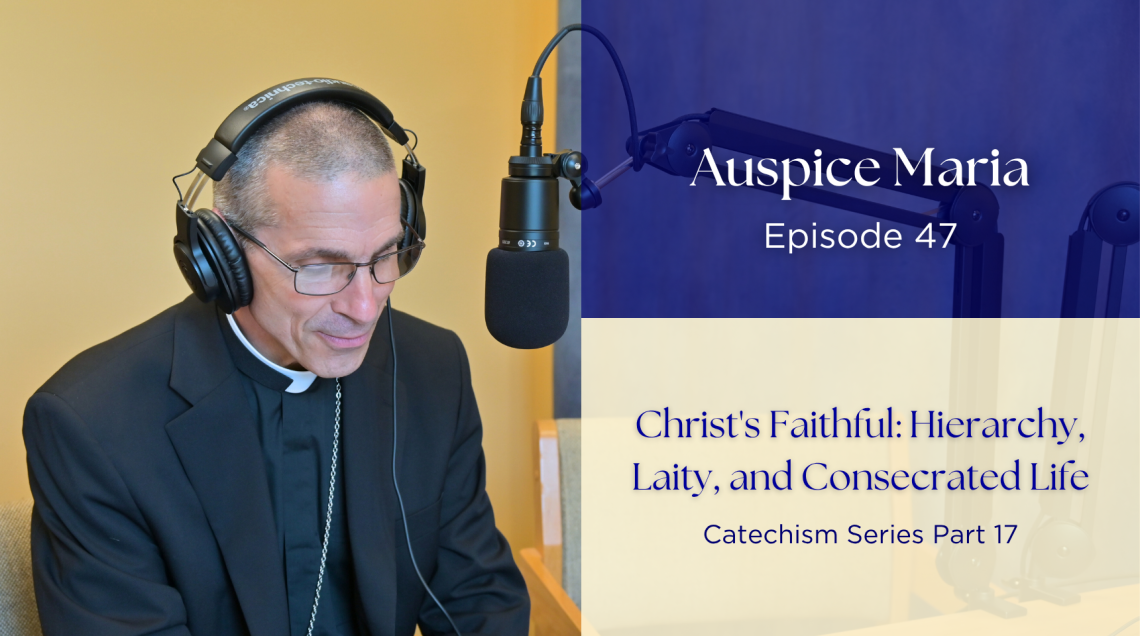
Christ's Faithful: Hierarchy, Laity, and Consecrated Life (Catechism Series Part 17) - Auspice Maria Ep 47
Follow the Maine Catholic Podcast on:
Transcript:
Well, welcome back to the Auspice Maria podcast. I'm Bishop James Ruggieri of the Diocese of Portland in Maine, and we continue our series on the Catechism of the Catholic Church. We are talking today about paragraphs 871 to 945, focusing on this topic of "Christ's faithful." We've been talking about the church, the mystery of the church, the people of God, the body of Christ, the temple of the Holy Spirit. We talked also about the four marks of the church. The church is one, holy, Catholic, and apostolic. And now we come to this sort of question, or more or less, area to ponder: who really belongs to the Church?
Obviously, we're all brought into the Church through baptism, but how can we appreciate more the different members of the Church and indeed how they live their mission and how really it's all interrelated in Christ? So again, I'd like to begin with a prayer to the Holy Spirit, asking the Holy Spirit's guidance.
Holy Spirit, fill our hearts with your peace, open our minds to your truth, and move us through especially the gift of fortitude to be more zealous in mission. And bless all those who are listening today. We ask all this through Christ our Lord. Amen.
So I would entitle this section or this podcast, Christ's Faithful: Hierarchy, Laity, and Consecrated Life. Now, the title at first may sound like a list of categories, but the Catechism is not simply dividing people into groups. It really is showing us the beauty of the Church as a living communion. The Church is not a corporation. She is not a political organization. She's not simply a collection of individuals who share religious interests.
The Church is the body of Christ, animated by the Holy Spirit, ordered by Christ himself, and sent into the world to continue his saving mission. The starting point for all of us is baptism. The Catechism teaches that the Christian faithful are those who have been incorporated into Christ through baptism and constituted as the people of God. Because of this, they share each according to his or her own state and condition in Christ's priestly, prophetic, and royal office, and they are called to exercise the mission God has entrusted to the Church. And that's from paragraph 871.
This is important because before we speak about bishops, priests, deacons, laypeople, or consecrated men and women, we must first speak about baptism. Baptism gives us our fundamental dignity in Christ. Through baptism, we are made daughters and sons of God. We become members of Christ's body. We share life and mission together.
And the Catechism says that among all the Christian faithful there exists "a true equality in dignity and activity by which all cooperate in building up the body of Christ, each according to his or her condition and function." That's from paragraph 872.
That equality does not eliminate difference. In fact, the Catechism says that the differences willed by the Lord among the members of his body serve the Church's unity and mission. There is diversity of ministry, but unity of mission.
The apostles and their successors have been entrusted with the office of teaching, sanctifying, and governing in Christ's name and by His power. The laities share in Christ's priestly, prophetic, and kingly office and have their own assignment in the mission of the people of God. Those in consecrated life serve the Church's saving mission through the profession of the evangelical counsels of poverty, chastity, and obedience. Again, that information is found in paragraph 873.
So the church is not a competition between clergy and laity, nor is she a passive community in which a few people act and everyone else simply receives. The church is a communion of persons, each with a distinct vocation, all rooted in baptism, all ordered toward holiness, all sent on mission.
The ordained ministry exists for service. This is very important. Christ himself is the source of ministry in the Church. He instituted the Church and gave her authority, mission, orientation, and goal. The Catechism teaches that Christ set up in the Church a variety of offices for the good of the whole body, so that the people of God might be shepherded and brought to salvation. It's a reference to paragraph 874. However, it does cite also the document, Lumen Gentium, the Vatican II document on the Church, section 18.
So the ordained ministry is not self-generated. No one gives himself the mission to proclaim the gospel. No one bestows grace on himself. The church receives ministers of grace from Christ who act in his name and by his authority.
This is why Holy Orders is not primarily about status. It is about sacramental service. The Catechism says that ecclesial ministry has the character of service because ministers are entirely dependent on Christ, whose word and grace are not their own, but are given for the sake of others. A reference to paragraph 876.
A bishop, priest, or deacon is not ordained for himself. He is ordained for Christ and for the Church. He is ordained so that the people of God may hear the gospel, receive the sacraments, be formed in truth, and be gathered in unity.
The bishop has a particular role in this communion. The Catechism teaches that, "individual bishops are the visible source and foundation of unity in their particular churches... They exercise their pastoral office over the portion of the people of God entrusted to them, assisted by priests and deacons." Paragraph 886.
So the bishop does not stand apart from the church; he stands within the church as a servant of communion. And he exercises his ministry in communion with the Pope and the college of bishops.
The ministry of the bishop is often described through three offices: teaching, sanctifying, and governing. As teacher, the bishop is called to proclaim the gospel and hand on the apostolic faith. The catechism says that bishops with priests are co-workers. They have as their first task to quote, "preach the gospel of God to all men." Paragraph 888.
So again, we're talking about this preaching to all men, women, young people, to all people. This is not merely administrative; it is deeply pastoral, and the Church teaches because Christ is the truth and the truth liberates. The proclamation must be made. The teaching office exists so that the people of God may remain grounded in the faith handed on from the apostles and not be carried away by confusion or error.
As one who sanctifies, the bishop is especially connected to the Eucharist, which is the center of the life of the particular church. The Catechism calls the bishop, quote, "'the steward of the grace of the supreme priesthood,' especially in the Eucharist, which he offers personally or whose offering he assures through the priests, his co-workers. Bishops and priests sanctify the church by prayer, by work, by the ministry of the Word, and by the sacraments." Again, that's found in paragraph 893.
As one who governs, the bishop is called to shepherd. But Christian governance is not domination; it is pastoral charity exercised in service. And so the Catechism teaches that "bishops govern their particular churches," their dioceses, by counsel, exhortation, example, and authority, but that this authority must be exercised in the spirit of service after the example of Christ himself, from paragraph 894.
The Good Shepherd, Jesus, is the model of the bishop's pastoral office. Every exercise of authority in the Church must be measured against Jesus Christ, who came, as he tells us, not to be served but to serve.
Priests and deacons assist the bishop and share in the church's ordained ministry in very distinct ways, each according to the grace and character of his ordination. Priests are co-workers of the bishop. They preach the gospel, they celebrate the sacraments, especially the Eucharist. They absolve sins in the sacrament of penance. They anoint the sick. They shepherd parishes, perish communities, and accompany the faithful in their journeys toward holiness. Deacons are ordained for service. They assist in the ministry of the word, the liturgy, and charity.
In a diocese, we see the Church's life unfold through this communion, the bishop, priests, and deacons serving together so that the parishes, schools, ministries, families, and communities may be strengthened in Christ.
But the catechism then turns very clearly to the lay faithful. The laity are not defined by what they are not. It might sound a little confusing, but the laity are not defined by what they are not. They are not simply non-clergy, non-ordained persons. They are baptized members of the people of God who share in Christ's priestly, prophetic, and kingly office and who have their own proper mission in the Church and in the world. From paragraph 897, their vocation is not secondary. It is essential and also critically related to the ministry of the ordained.
The Catechism says that by reason of their special vocation, the laity are called to seek the kingdom of God by engaging in temporal affairs and directing them according to God's will. Paragraph 898.
This is one of the most important insights in this section. The lay vocation is lived in the world, in family life, marriage, parenting, education, medicine, business, law, agriculture, public service, culture, science, politics, the arts, care for the poor, and the ordinary daily work by which human society is built and functions.
The church needs holy lay people, not only inside church buildings, but obviously in the world. And the Catechism says that the lay initiative is especially necessary when it involves permeating social, political, and economic realities with the demands of Christian doctrine and life, from paragraph 899.
Maybe the image could help here. The laity could be considered in many respects like that parable, like the leaven in the dough, and how that leaven is so important to making the dough rise. Well, faithful lay people living out their various states of life in the world, their various also avocations, work, and other responsibilities, doing that well, they are like the leaven in the midst of society. And their efforts, their holiness contributes to the building of the kingdom of God.
So a priest may preach about justice, honesty, respect for life, and the dignity of the human person, and he really should. But it is often the lay people, the lay faithful, who must live these truths in the workplace, in the home, in the classroom, in public life, and in the decisions that shape society.
The laity share in Christ's priestly office when they offer their lives to God. The Catechism teaches that their works, prayers, apostolic undertakings, family and married life, daily work, relaxation, and even the hardships of life when born patiently and accomplished in the Spirit become spiritual sacrifices acceptable to God through Jesus Christ from paragraph 901.
It's really a beautiful vision of holiness. The ordinary becomes an offering. A parent caring for a child, a worker acting with integrity, a young person resisting temptation, an elderly person offering suffering in faith, a parish volunteer serving quietly, all this can become worship when united to Christ.
The laities share in Christ's prophetic office by witnessing to the gospel in both word and deed. Catechism says that lay faithful fulfill this prophetic mission through evangelization and, quote, the proclamation of Christ through word and the testimony of life. That's from Lumen Gentium 35, paragraph 905 from the Catechism.
This witness has a particular power because it occurs in the ordinary circumstances of the world. People may first encounter Christ through the credibility, the patience, the joy, courage, and charity of a faithful lay Catholic, before they encounter Christ through hearing a moving sermon or experiencing a very beautiful liturgical experience like mass or going to something like a prayer service.
The laity also share in Christ's kingly office. This does not mean worldly power, of course. It means the royal freedom of Christ who conquered sin by obedience and love. And the Catechism teaches that lay people exercise this kingly mission by overcoming the reign of sin in themselves and by working to conform the institutions and conditions of the world to justice, virtue, and moral law, a reference to paragraphs 908 and 909.
Again, the idea is the leaven, or the salt, that beautiful image of being salt for the world, flavoring the world with the beautiful flavor of Christ and gospel values. It has consequences for culture, of course. It shapes families, workplaces, communities, and societies.
And the catechism goes on speaking about the collaboration of lay people with their pastors. Lay faithful may serve in a variety of ministries in our parishes, whether it be catechesis, pastoral councils, finance councils, maybe on diocesan committees or ministries, Catholic schools, charitable works, communications, and many other apostolates. In diocese, the mission of the church depends on this collaboration.
A bishop and his priest cannot fulfill the mission alone, nor is the Church even designed for that to be such. Parish life, Catholic education, service to the poor, evangelization, family ministry, youth and young adult ministry, Hispanic ministry, pro-life work, prison ministry, hospital ministry, and countless, countless hidden acts of charity depend upon the gifts of the lay faithful.
And then finally, the Catechism turns to consecrated life. Consecrated life is not a part of the hierarchical structure of the Church, but it belongs undeniably to the Church's life and holiness from paragraph 914.
Those in consecrated life, people we normally refer to as religious sisters, religious brothers, friars, monks, nuns, so these persons in consecrated life profess the evangelical councils of poverty, chastity, and obedience in a stable form of life recognized by the Church. Paragraphs 915 and 944.
So, their vocation is a sign. It reminds the whole Church that the Kingdom of God is already present among us and that our final destiny is not this world but eternal communion with God. And again, they do that so beautifully by living out those evangelical councils with great conviction and great humility, poverty, chastity, and obedience.
Consecrated men and women serve the church in a variety of ways. And their lives enrich the church through prayer, teaching, health care, missionary work, service to the poor, contemplation, spiritual accompaniment, and hidden sacrifice. But before they do anything, their very life in and of itself, their being is a witness.
The Catechism goes on to say that consecrated life manifests Christ and shows how the Holy Spirit acts so wonderfully in the Church. Paragraph 931. And it bears witness that the world cannot be transfigured and offered to God without the spirit of the Beatitudes. Paragraph 932.
So, as we draw to a close, what does this section of the Catechism reveal? It really reveals that the beauty of the Church is found in communion and, of course, mission. The ordained are given for the service of the baptized. The laity are sent to sanctify the world from within. Consecrated persons remind us of the primacy of God and the coming of the Kingdom.
Each vocation is distinct, but none, importantly, is isolated. Each is necessary. Each is ordered toward holiness and mission.
In a diocese, a local church like the Diocese of Portland, this becomes concrete. The bishop teaches, sanctifies, and governs in communion with the pope and the whole church. Priests and deacons collaborating with their bishop serve parish communities and ministries. Lay faithful, working together with their priests and deacons, and also serving and working with the bishop at times, bring the Gospel into homes, workplaces, schools, civic life, and culture. Consecrated men and women witness to the radical gift of self to God. And together, the whole Church continues the saving work of Christ on earth.
This is the beauty of the Church. She is not merely an institution, though she has a visible structure and order. She is not merely a community, though she is truly a people. She is the body of Christ in which every member has dignity, every vocation has meaning, every gift is needed, and every baptized person is called to mission. Can't emphasize that enough. Every baptized person is called to mission.
Through baptism we have been incorporated into Christ and his Church. Through the Holy Spirit we have been given gifts. Through the Church we have been sent, and in our own state of life each of us is called to help build up the body of Christ and boldly and humbly and lovingly proclaim the Kingdom of God.
That is the vision of the Catechism in these paragraphs 871 to 945. One Church, different vocations, one mission, many forms of service, all flowing from Christ, all ordered to holiness, all for the salvation of the world.
Thank you for joining me, and I'd like to end with a prayer to our Blessed Mother Mary as we pray.
Hail Mary, full of grace, the Lord is with thee. Blessed art thou amongst women and blessed is the fruit of thy womb, Jesus. Holy Mary, Mother of God, pray for us sinners now and at the hour of our death. Amen.