

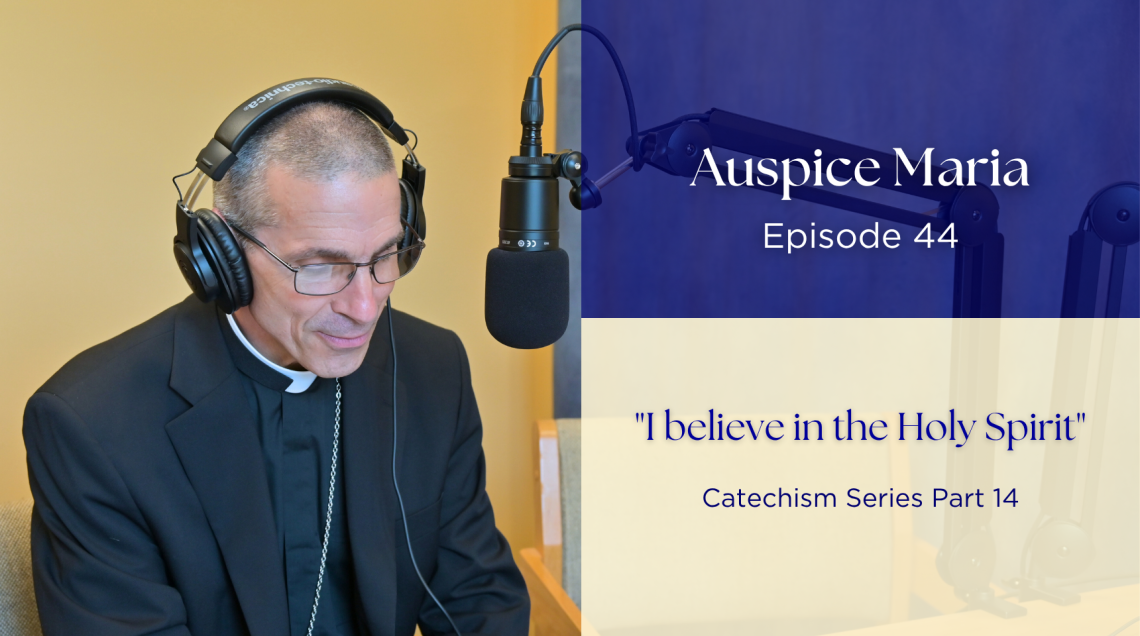
"I believe in the Holy Spirit" (Catechism Series Part 14) - Auspice Maria Episode 44
Follow the Maine Catholic Podcast on:
Transcript:
Well, welcome to the Auspice Maria podcast. I'm Bishop James Ruggieri of the Diocese of Portland in Maine. Today we'll talk about paragraphs 683 to 747 on the Holy Spirit in the first part of the Catechism of the Catholic Church that expounds really on these beautiful tenets of the creed, these elements of the creed that we profess. And as always, and I think appropriately so today, I'd like to invoke the Holy Spirit to inspire us, to help us. So come Holy Spirit, fill our hearts and open our minds and may this podcast be an assistance to those who hear it. And Holy Spirit, inspire us in all that we do in service to your church and to one another. We ask all this through Christ our Lord. Amen.
So when we begin to speak about the Holy Spirit, I think one of the most vivid places to begin is the Acts of the Apostles. There, the Holy Spirit is not presented as an abstract doctrine or a distant theological principle. Really, the Spirit is a living power, a divine presence, and the source of the Church's courage. Saint Luke tells us that on the day of Pentecost, "there came from the sky a noise like a strong driving wind and that they were all filled with the Holy Spirit and began to speak in different tongues as the Spirit enabled them to proclaim." It's right from Acts 2 in that Pentecost description.
In that moment, we see also another reality. The Church is thrust outward into mission, and what has been, really, fear begins to give way to boldness. And the Catechism teaches that on Pentecost, the Church was made manifest in the world, and that the outpouring of the Spirit inaugurates this time of the Church. Those would be in reference to paragraphs 731 to 732.
So that transformation, outward is seen most clearly in St. Peter. A little while ago, right on actually on the eve of the Lord's passion, Peter had denied the Lord three times and yet after Pentecost he stands before the crowds and proclaims with this bold conviction, God raised this Jesus of this we are all witnesses from Acts 2, 32. And the change is not merely psychological, it's really spiritual. The Holy Spirit has seized Peter, strengthened him, and given him the grace to preach Christ publicly.
Soon afterward though, when Peter speaks again before the authorities, the Acts of the Apostles says with great simplicity, then Peter, filled with the Holy Spirit, answered them. It's very important, Acts 4, verse 8. The lesson is very, very recognizable, very noticeable. The apostolic church does not preach by its own strength or wisdom. It preaches because the Spirit gives voice, courage, clarity, and conviction.
And that same pattern continues throughout Acts of the Apostles. The Spirit is not only the source of preaching, but also the principle of discernment and mission. And when the Church confronts the question of the Gentiles, which comes to a head in chapter 15, the Apostles and those in leadership do not act as though they were merely managing an organization. They say, actually in Acts 15, verse 28, "it is the decision of the Holy Spirit and of us."
And when Barnabas and Saul are sent out, it is because the Holy Spirit said, "set apart for me Barnabas and Saul for the work to which I have called them." That was earlier in Acts 13, verse 2. The early church understands herself as led, corrected, and sent by the Spirit.
That is why the Acts of the Apostles can rightly be read as a kind of gospel of the Holy Spirit, the good news of the Holy Spirit. The church is born from the Spirit, guided by the Spirit, and expanded through the Spirit.
And this is not only ancient history, of course. The same spirit who descended at Pentecost has not withdrawn from the Church. The Church today still lives from the same divine source. The Holy Spirit continues to strengthen preaching, inspire holiness, animate the sacraments, awaken charisms, guide discernment, and draw believers into communion with Christ. So if we read Acts of the Apostles carefully, we begin to see not only what happened then, but also how the Church must live now.
Which leads me now to the next section. Who is the Holy Spirit? Well, from those dramatic scenes of Acts of the Apostles, the Catechism then also leads us into a more precise question. Who is this Holy Spirit from whom the Church proclaims? And the catechism begins with a sentence of really extraordinary importance. "No one can say Jesus is Lord except by the Holy Spirit." That's paragraph 683, but quoting 1 Corinthians chapter 12 verse 3.
"No one can say Jesus is Lord except by the Holy Spirit." Even the act of faith itself is already the work of the Holy Spirit. If we know Christ truly, if we confess him as Lord, if we cry out to God as Father, then the Holy Spirit is already at work within us.
The Catechism continues by teaching that the Holy Spirit is one of the divine persons of the Most Holy Trinity, consubstantial with the Father and the Son, paragraph 685. So the Holy Spirit is not an impersonal force, not merely an influence, not merely a symbol of divine energy, the Holy Spirit is God.
At the same time, the Catechism notes something very distinctive about the revelation of the Holy Spirit. The Spirit is fully divine, yet he is revealed, we could say, in a certain humility. The Spirit does not speak of himself, the Catechism says, but rather makes Christ known to us. Paragraph 687.
And this is important. The Holy Spirit is not in competition with Jesus, He is the Spirit of Christ. He opens our hearts to the Word, leads us to the Son, and through the Son brings us to the Father. The mission of the Holy Spirit is deeply Trinitarian. He does not replace Christ. He does not distract us from the Father. He teaches us to cry, Abba, Father.
The Catechism also unfolds the names and symbols by which the Church has learned to speak of the Spirit. Water signifies the spirit's action in baptism, where new life is poured into the soul, paragraph 694. Anointing signifies consecration and the indwelling of grace, paragraph 695. Fire signifies purification, divine love, and transforming power, paragraph 696. Cloud and light suggest both the mystery and the revelation of God's presence. Paragraph 697, the seal, the hand, the finger of God and the dove each disclose something of the spirit's work in salvation history. Those are paragraph 698 to 701.
These are decorative images. They are indeed theological signs. They help us perceive that the Holy Spirit brings life, purification, strength, illumination, consecration, and peace. So when the Church says, I believe in the Holy Spirit, she is not confessing belief in an anonymous religious feeling. She is professing faith in the third person of the Most Holy Trinity. The one who awakens faith, makes Christ present, sanctifies the Church, and leads the faithful into the fullness of truth and life.
The Catechism does something very beautiful in these paragraphs that we're expounding on. It does not isolate the Holy Spirit to the New Testament alone. Rather, it also shows us that the Spirit has been active throughout salvation history. In the time of the promises, the Spirit prepares the way for Christ. The prophet spoke by the Holy Spirit. The longing of Israel for restoration, holiness, justice, and a new heart was already the work of the Spirit.
Catechism says that through the law, the kingdom, and the exile in return, the Spirit was gradually preparing the people of God for the fullness of time. Those would be paragraphs 702 to 716.
And all of this really reaches a decisive fulfillment in Jesus Christ. The Catechism presents the conception of Christ, His baptism in the Jordan, His public ministry, and His paschal mystery as events saturated by the presence of the Holy Spirit. Paragraphs 7-17 to 7-30.
Jesus is conceived by the Holy Spirit, anointed by the Spirit, led by the Spirit, and after His glorification, sends the Spirit upon the Church. Thus, the Holy Spirit is inseparable from Christ. In the mystery of the incarnation, the public ministry, the cross, the resurrection, and Pentecost, the Spirit reveals and communicates the saving work of the Son.
And that really matters pastorally because it keeps our theology from becoming fragmented. The Holy Spirit is not an extra added after Jesus. He belongs to the very heart of the Gospel. Where Christ is present, the Spirit is active. Where the Spirit truly acts, Christ is glorified.
The Church has also recognized that the Holy Spirit not only dwells in the Church as a whole, but also works within individual believers. One way of expressing this is through the gifts of the Holy Spirit. Drawing from Isaiah the prophet, chapter 11, the Church names seven gifts of the Spirit. wisdom, understanding, counsel, fortitude, knowledge, piety, and fear of the Lord.
Those gifts are listed also in the Catechism in paragraph 1831. These gifts are not merely talents or natural abilities or aptitudes. They are stable dispositions given by God that make the soul open and docile to the action of the Spirit. They help us judge according to God's mind and to live according to God's will.
If the gifts describe the Spirit's interior shaping of the believer, The fruits describe what becomes visible in a life transformed by grace. St. Paul writes in his letter to the Galatians chapter five, verses 22 to 23, "the fruit of the spirit is love, joy, peace, patience, kindness, generosity, faithfulness, gentleness, self-control."
The Catechism says that these fruits are "perfections that the Holy Spirit forms in us as the first fruits of eternal glory." That's from paragraph 1,832.
That phrase, first fruits of eternal glory, is really worth reflecting upon. In other words, the fruits of the Spirit are already a foretaste of heaven. Wherever genuine love, peace, patience, charity, and self-control are growing in a Christian life, the life of heaven is already beginning to appear.
This also protects us from a shallow understanding of the Spirit. The presence of the Holy Spirit is not measured only by intensity of feeling or by extraordinary experiences, The deeper and more reliable signs are the growth of holiness, fidelity, charity, humility, and perseverance. Where the spirit dwells, Christ becomes more visible in the believer.
The Catechism is especially rich when it turns to the relationship between the Holy Spirit and the Church. It teaches that the risen and glorified Christ pours out the Spirit and that by this outpouring the Church is manifested to the world at Pentecost. Paragraph 731 and 732. The Spirit then remains permanently with the Church, not only as her source of life, but as the one who builds, animates, and sanctifies her. Paragraph 747.
This is one of the most important affirmations of the section. The Church is not sustained merely by organization, planning, or human effort. She lives because the Holy Spirit dwells within her.
And then the Catechism goes on and explains the many ways the spirit acts in the church through sacred scripture which the spirit inspired, through tradition which hands on the faith, through the magisterium which the spirit assists, through the liturgy and sacraments in which grace is communicated, through prayer in which the spirit intercedes within us and through charisms and ministries by which the body of Christ is built up.
The spirit is therefore not confined to one part of ecclesial life. the Spirit breathes through the whole mystery of the church. This is why St. Paul can write, "to each individual, the manifestation of the Spirit is given for some benefit," and that's from 1 Corinthians 12, verse seven.
Charisms are real. They are gifts of the Spirit, but they are given for the good of the Church, not for self-display. The Catechism elsewhere reminds us that extraordinary gifts are not to be sought for their own sake, and that discernment is always necessary so that every charism may serve the common good and remain in ecclesial communion. Paragraph 799 to 801.
The spirit who gives gifts is the same spirit who creates unity. Therefore, authentic spiritual vitality and authentic ecclesial fidelity must never be separated.
Within this broader context, it is fitting to speak about the charismatic renewal. I'd like to say a word about the Catholic charismatic renewal. Its modern beginnings are commonly traced to a retreat held in February of 1967 by some faculty and students from Duquesne University in Pittsburgh, Pennsylvania. Catholic renewal sources describe that retreat as a pivotal moment in which many participants experienced a fresh awareness of the Holy Spirit's action in their lives, an experience often described within the renewal as baptism in the Holy Spirit.
Those same historical accounts are also noted that the retreatants had prepared prayerfully by reading Acts of the Apostles. which gives this beginning a particularly striking biblical basis, biblical resonance.
From that initial moment, the experience spread rapidly to Notre Dame, to Michigan, and then much more widely throughout the church in the United States and beyond. At its best, the Charismatic Renewal has emphasized personal conversion, expectant prayer, praise, love for sacred scripture, openness to the charisms, and renewed zeal for evangelization.
These emphases can be pastorally fruitful when they remain deeply rooted in the sacramental and doctrinal life of the church. Pope St. John Paul II spoke appreciatively and clearly about these fruits and in his address on October 30th, 1998 to the participants in the International Conference for Catholic Charismatic Leaders, he said that the Catholic Charismatic Renewal has helped many Christians to, "rediscover the presence and the power of the Holy Spirit," and that this rediscovery has awakened in them a faith in Christ filled with joy, a great love of the Church, and a generous dedication to her evangelizing mission.
In the same address, however, he also gave an essential criterion for discernment. Leaders of the renewal must safeguard its Catholic identity by maintaining, "a close and hierarchical link with the bishops and the pope." It's important, again, St. John Paul II, for him and really for the benefit of the renewal, authentic, charismatic vitality is never opposed to ecclesial communion, but rather is in service to ecclesial communion, in service to the church.
On April 24, 2000, in a message to the Catholic Charismatic Renewal, he emphasized that the certainty of faith does not come from ourselves. But through the Spirit recalling St. Paul's words, no one can say Jesus is Lord except by the Holy Spirit. Again, 1 Corinthians 12.3. St. John Paul II then situated every authentic ecclesial community within the one people of God, insisting that no community is self-enclosed. but must remain open to the riches of the universal church.
He also said that the church looks with gratitude upon the flourishing of lively communities in which the faith is passed on and lived, recognizing in them the work of the Holy Spirit. This is the best and proper Catholic framework for understanding the Catholic Charismatic Renewal. It is not something outside the Church, nor something parallel to the Church, nor should it be treated as though it were the only expression of the Spirit's action.
Rather, it is one contemporary expression of the Holy Spirit's work within the Church. To be welcomed with gratitude, discerned with prudence, and integrated into the church's sacramental doctrinal and communal life. This is consistent with the Catechism's teaching that charisms are given for the good of the church and require discernment so that all may serve the common good in communion.
All of this finally leads to a deeply personal point. To say "I believe in the Holy Spirit" is not merely to assent to a theological proposition, a theological dogma. It is to confess that God is at work now personally and actively in the life of his people.
The same spirit who overshadowed the Virgin Mary, descended upon Christ at the Jordan, raised Jesus from the dead, and set the apostles on fire at Pentecost is not absent from the church today. He is present in baptism and confirmation. He is present in prayer. He is present in the proclamation of the gospel. He is present in the saints, in the sacraments, in discernment, in mission, and in the hidden work of grace within the soul.
Catechism says that through the Spirit the Church enters into communion with the Trinity and that by the Spirit the faithful become children of God, members of Christ, and temples of the Holy Spirit. That spans some paragraphs 733 to 741.
All this means that the doctrine of the Holy Spirit is not secondary, it is central to Christian life. Without the Holy Spirit, Jesus remains really only a figure of the past. Without the Holy Spirit, the church becomes only a human institution, a human organization. Without the Holy Spirit, Christian morality becomes really only effort and strain at that.
But with the Holy Spirit, Christ is alive, the church is living, the sacraments are fruitful. Scripture becomes incredibly luminous and the believer is gradually transformed from within.
So, in conclusion, when the Church teaches us to say, I believe in the Holy Spirit, she's teaching us to speak not only of doctrine, but of divine life. The Holy Spirit is the Lord and giver of life. He is the one who awakens faith, reveals Christ, forms the Church, bestows gifts, bears fruit in holiness, raises up charisms, and leads the people of God toward the fullness of the kingdom.
And perhaps that is where the episode should end, not merely with explanation, but with invocation. The church does not only define the Holy Spirit, she prays for him. She calls upon him. She depends upon him.
And so the most fitting conclusion is also the most ancient and simple one. As we hopefully say as a church with frequency, come Holy Spirit. Come into your church. Come into our hearts. Come and renew the face of the earth. Thank you for listening and, as always, I'd like to simply end with a prayer to our Blessed Mother, also affectionately known as the Spouse of the Holy Spirit.
Hail Mary, full of grace, the Lord is with thee. Blessed art thou amongst women and blessed is the fruit of thy womb, Jesus. Holy Mary, Mother of God, pray for us sinners now and at the hour of our death. Amen.