


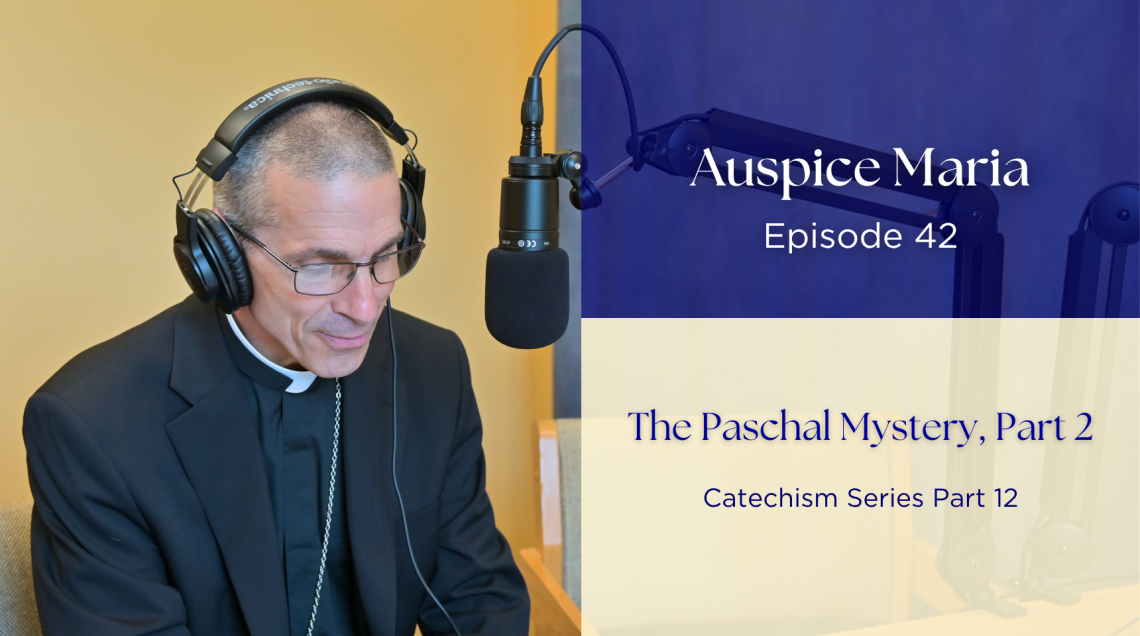
The Paschal Mystery, Part 2 (Catechism Series Part 12) - Auspice Maria Ep. 42
Follow the Maine Catholic Podcast on:
Transcript:
Welcome back to the Auspice Maria podcast. I'm Bishop James Ruggieri of the Diocese of Portland in Maine. And we continue with this walkthrough, discovery, hopefully greater appreciation and growing more and more for the Catechism of the Catholic Church section, the first part, first section, based on the Creed. And I'd like to talk today about paragraphs 571 to 630. But again, more in a presentation, hopefully, that is thematic.
Really at the heart, as we dive into this, at the heart of the Christian faith is not first a moral system, nor a philosophy, nor even a set of dogmatic teachings. At the heart of the Christian faith is a proclamation, a proclamation so simple and yet so profound that it has the power to change a life. God loves you. God loves you.
I'd like to pause here for a moment and just reflect on that. God loves you. And then if we could offer a prayer of thanks and a prayer invoking the guidance of the Holy Spirit, that the Holy Spirit help us to realize this reality more and more.
God, we thank you for the reality of being loved by you unconditionally. We pray for your Holy Spirit's wisdom and guidance, especially during this podcast, that those who listen to it might come to recognize how infinitely they are loved by you. And we ask all this through Jesus' name, amen.
So again, the reality of the proclamation, God loves you. And this love is not generic. It's not abstract. It's not in any way sentimental. But God loves you and I personally. This love is not merely spoken. It is revealed. It is lived. It is given.
In our last episode, we walked with Christ to the cross. Now I would like to just step back for a moment and ask a deeper question. Why? Why did Jesus live as he did? Why did he suffer? Why did he die? The Catechism reminds us that everything in the life of Christ is part of a single mystery, and I quote from paragraph 571: “the paschal mystery of Christ's cross and resurrection stands at the center of the Good News.” At the center of that mystery, the paschal mystery, is love.
If we look closely at the earthly life of Jesus, we notice a pattern. He seeks people out, not the powerful or the self-sufficient, but those on the margins. Consider Zacchaeus, a tax collector, socially rejected and spiritually questionable. And yet Jesus looks up into the tree and calls him by name. “Zacchaeus, come down quickly, for today I must stay at your house.” He does not wait for Zacchaeus to change first. Jesus invites himself into Zacchaeus' life. And that encounter changes everything.
Or, consider the woman, in St. Luke's Gospel also, who had suffered from hemorrhages for 12 years. She is not only physically afflicted, but ritually excluded and socially invisible. And yet, in the crowd, she reaches out and touches the cloak of Jesus. Jesus stops. He turns and asks, “Who touched me?”
He does not ask because he lacks knowledge. Amazingly, so he asked to reveal her, to bring her out of invisibility, to restore her dignity, and to affirm her faith. This is how Jesus reveals the love of the Father, not from a distance, but through encounter.
The Catechism teaches that Christ's entire life is a mystery of redemption. Not only his death, not only the cross, but his words, his encounters. Everything reveals the Father. What we repeatedly see is that Jesus does not reduce people to their failures. He sees who they are and who they are called to become. At times, this love is gentle, at times it is challenging. Jesus speaks firmly to the scribes and Pharisees, for example, because truth matters and leadership carries responsibility. Love is not indifference, love is truth spoken for the sake of salvation.
There are people today who quietly carry a sense that they are unseen. Perhaps they are surrounded by others and yet feel alone. Perhaps they have made mistakes and now believe they are defined by those mistakes. Perhaps they simply feel forgotten. And yet the Gospel tells us something different. Christ sees, Christ calls, Christ enters.
Sometimes that encounter happens in a very simple way, through a word spoken at the right time, a gesture of kindness, or a presence that does not judge. In that moment, something shifts. Dignity is restored, and hope begins again. And yet, this love does not remain at the level of encounter. It moves towards something greater. Jesus knows where His path leads.
The Catechism tells us that his passion was not the result of chance. A quote from paragraph 599: “Jesus' violent death was not the result of chance in an unfortunate coincidence of circumstances, but is part of the mystery of God's plan.”
That is essential. sThe cross is not accidental, it is intentional. Again, the cross is not accidental, it is intentional. Not because the Father desires suffering, but because the Father desires salvation, our salvation. Christ freely accepts the cross. This leads us to the central point and a central question. Why did he die?
The Catechism quotes Saint Paul, “Christ died for our sins in accordance with the scriptures,” right from paragraph 601. He dies for us in our place out of love. This is not abstract, this is personal. Jesus gave himself for me, for you, for each person. The cross is not simply a historical event, it is a personal gift.
And the Catechism teaches this truth when it teaches in paragraph 609, “by embracing in his human heart the Father's love for men, Jesus loved them to the end.”
Jesus loved them to the end, to the end, to the cross, to the point of total self-gift. This is what love looks like, not partial, not conditional, but complete. The cross is not the defeat of Jesus, it is the revelation of divine love in its fullness. Sin is real, evil is real, but the good news is love is greater.
So what does this mean for us? Well, if the heart of the gospel is the proclamation that God loves us, then the mission of the church flows directly from this. We are called to proclaim that love, not only with words, but with our lives. Jesus shows us how. Again, he encounters, he listens, he restores dignity, he speaks truth, he gives himself.
This is not opposed to doctrine. It is the living expression of it. And the Catechism reminds us that everything Christ did was for our salvation. And now we, we are sent to continue that mission. This means that the proclamation of the gospel is not first about arguments or strategies. It begins with presence.
It begins with seeing the person in front of us, not as a problem to be solved, but as someone loved by God. It means embracing the present moment, taking the time to listen, to accompany, to recognize the dignity of the person that is already there, even if it has been obscured or forgotten.
In our families, this mission takes shape in patience, in forgiveness, in the daily decision to love when it is not easy. In our parishes, it takes shape in hospitality, in creating welcoming environments where people can encounter truth spoken with clarity and charity and not in judgment.
This mission takes shape in the quiet but firm witness to the dignity of every human person from the moment of conception to natural death. And this mission is not reserved for a few. It belongs to every baptized person. Each of us in our own way, in our own circumstances, is called to make that love visible.
This is our privilege, to proclaim not ourselves, but Jesus Christ, to reveal in whatever way we can that the Father's love is indeed real, that it is offered and that it is transformative. Now there are moments when proclamation does require words. There are moments when we must speak clearly about the truth of the gospel, about moral principles, virtues, values.
But even then, the manner in which we speak must reflect the one we proclaim. Jesus never separated truth from love. He never compromised the truth, but he always spoke it in a way that opened the possibility of conversion rather than closing the door.
Sometimes that will happen in very simple ways, a conversation, a gesture, a moment of patience, a willingness to remain when it would be easier to leave. These may seem small, but in the light of the gospel, they are not small at all. They are the continuation of Christ's own way of loving in the world.
So the Paschal Mystery reveals the deepest truth about God. God is not distant. God is not indifferent. God is love. A love that seeks us out. A love that calls us by name. A love that goes to the cross.
And this love is not only something we receive, it is something we are called to share, to live, to proclaim. God loves you, and that love changes everything.
Well, thank you again for listening to the Auspice Maria podcast. And as always, I'd like to end with a Hail Mary invoking Mary's intercession that we may simply be faithful to our Heavenly Father's will as she was faithful.
Hail Mary, full of grace, the Lord is with thee. Blessed art thou amongst women and blessed is the fruit of thy womb, Jesus. Holy Mary, Mother of God, pray for us sinners now and at the hour of our death. Amen.